Showing posts with label peacekeeeping. Show all posts

Sunday, October 14, 2007

Darfur - Peacekeepers Without a Peace to Keep

The New York Times has a short piece entitled, 'Peacekeepers Without a Peace to Keep'.

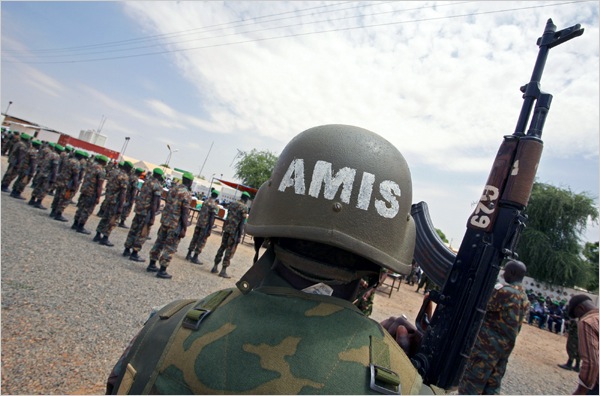
The article continues the debate on how damaging the attack on AU peacekeepers in Haskanita will be in the short- and mid-term. While this take on the incident isn't new, the author does start to pose some more critical questions about whether military intervention in Darfur is already too late?- Or, is it too early?

FCBDBFF5-F30C-4BB2-893D-1DCA0A7D505A.jpg


A recent statement by the AU force commander captured the challenge facing peackeepers- 'AU outnumbered, outgunned in Darfur'. It is easy to make calls for peacekeepers to enforce the 'Responsibility to Protect', as Roméo Dallaire does: '...the troops must “go inside the camps, do night patrols and snap inspections, essentially go wherever they need to, without the Sudanese Army or police blocking them.” He said they also need to go after “every one of those splinter groups” and they’ll need the proper gear to do so.' How realistic are these calls?

A number of uncomfortable comparisons in the article are made between Darfur and Somalia. Yet perhaps a better comparison would be the early days of UNPROFOR in the former Yugoslavia? The lack of political will in FRY crippled even relatively well-equipped peackeepers. Can UNAMID hope for better?

Monday, October 01, 2007

Sudan- Peacekeepers Look for Missing in Darfur

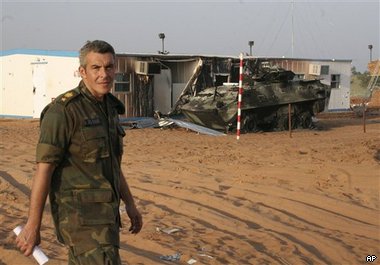
There are numerous articles chronicling a rebel attack on an African Union base in Haskanita, northern Darfur yesterday. Apparently 1,000 rebel gunmen overwhelmed the base and its 150 troops before dawn. At least 10 peackeepers have been killed, and between 20 and 50 are still missing.

b6ea01a6-a028-47df-9d08-962ae46f12be.jpg

The rebels looted vehicles and ammunition, and it took Sudanese government troops to chase them away. Photos show government troops looting the leftovers, and burnt armoured vehicles. A quote from an anonymous officer underlines the stakes for the AU Force:

'"It may not be the right political thing to say, but the government forces saved us," said an AU officer, who also asked not to be named because of military regulations.'

The IHT published the first obvious article on the future of Darfur and peacekeeping, namely, whether this tragic incident won't un-nerve other nations considering contributing to the more robust hybrid AU-UN force for Darfur. A spokeman for OXFAM framed the attack in light of the kinds of threats that humanitarian agencies are facing:

'"It's indicative of the complete insecurity," said Alun McDonald, a spokesman for the Oxfam aid organization in Sudan. "These groups are attacking anybody and everybody with total impunity."

McDonald added that armed groups were "increasingly targeting aid workers to steal their vehicles, radios and logistical stuff."

He said the attack on the peacekeepers "sounds quite similar to that, just on a much larger scale."'


149e2e6b-13ea-408c-b2df-95019fc9dd33.jpg

Tuesday, September 25, 2007

Sudan Advises Aid Agencies to Accept Military Escort Offer

VOA reports that the Sudanese government is warning UN agencies and aid groups that they should accept military escorts to travel through the Darfur region. This offer follows a day after OXFAM reported they would consider withdrawal from Darfur if the security situation did not improve.

Monday, September 24, 2007

NATO retreats from establishment of rapid-reaction force - International Herald Tribune

After months of telegraphing the difficulties of having non-troop contributing nations to shoulder the costs of deployments in Afghanistan, it is perhaps little surprising that NATO member-states have sunk the dream of a NATO Response Force.

"NATO has a problem that affects the EU as well. There are simply not enough troops. NATO is asking member states to sign up to the Response Force at a time when more troops are needed for Afghanistan. NATO has hit a ceiling. The Response Force is a luxury member states cannot afford."

Politics aside, it seems a sad ending that undermines efforts to bolster the Responsibility to Protect and support sustainable peacebuilding and peace support operations. If NATO member-states can't afford this 'luxury', who can?

United States Insitute for Peace- US Police in Peace and Stability Operations

USIP has a recent publication examining why the US should carry through on plans to create a federal-level police reserve for international peace and stability operations.

Summary:

• The first obligation of an international intervention force in a peace or stability operation is to provide security for the civilian population. Inevitably the arrival of foreign military forces is followed by a breakdown of public order.

• Historically U.S. military forces have been unable or unwilling to perform police functions to control large-scale civil unrest. This was true in Iraq, where looters destroyed government buildings, cultural centers, and commercial areas.

• The United States lacks civilian constabulary (gendarmes) or other national police forces specially trained for crowd and riot control. Instead the U.S. relies on civil police provided by commercial contractors that do not perform this function.

• Fortunately the U.S. government is taking steps to address this deficiency. Current State Department plans call for creation of a Civilian Reserve Corps that would have a police component.

• There is no agreement on the ultimate size and character of this police capacity. However, the history of U.S. interventions from Panama to Iraq argues for a robust capability.

• A review of U.S. interventions in post-conflict environments demonstrates that the United States has repeatedly needed highly capable police forces but has lacked the capacity to respond effectively. The case studies in this report provide lessons applicable to future operations.

• The State Department’s current efforts are a useful first step that will give an opportunity to create the basic infrastructure for expansion of U.S. capabilities in peace and stability operations.

Coordinating Chaos - Peace and Conflict Society (PACS), Trudeau Centre for the Study of Peace and Conflict, University of Toronto

The Peace and Conflict Society (PACS) at the Trudeau Centre for the Study of Peace and Conflict at the University of Toronto is organizing a conference entitled 'Coordinating Choas' which might be of interest to readers.

'The Peace and Conflict Society’s third annual conference entitled Coordinating Chaos: Taking a Multi-Dimensional Approach to Stabilization Operations, focuses on the changing nature of humanitarian intervention and on how to integrate the multiple actors operating within conflict zones in order to foster a lasting peace. The conference seeks to advance the academic dialogue surrounding conflict intervention and to expand potential policy options available to global leaders whose decisions determine the fate of nations and directly impact global stability. Coordinating Chaos will examine the challenges of integrating political, military, economic, and humanitarian actors within conflict zones so as to develop coherent, multi-dimensional strategies for peace support and counterinsurgency operations.'

UN INSTRAW - Gender, Peace and Security- Gender Training for Peacekeepers

peacekeepers.pngA good resource site that has a comprehensive overview of available gender training for peacekeepers. Curious to see how little is available in the Americas and East/South East Asia.

Friday, September 14, 2007

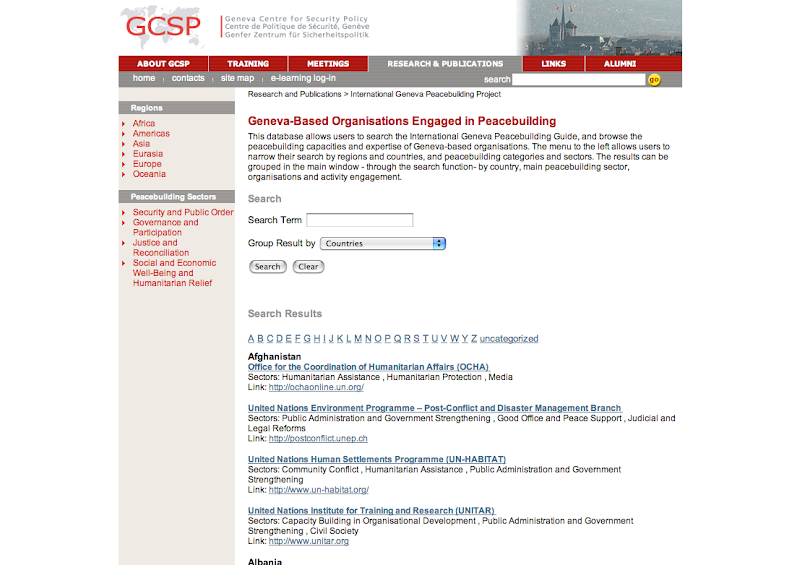
The International Geneva Peacebuilding Guide- An Inventory of Geneva-based capacity and expertise

A new resource was launched this week by the Geneva Centre for Security Policy:

'This conference presents the preliminary findings of an analytical mapping that was undertaken as an integral part of ‘The UN Peacebuilding Commission and International Geneva’ project. Since late 2005, the GCSP and its partners have organised a series of events and public discussions looking at the implications for International Geneva of the work of the UN Peacebuilding Commission. The project has been developed by the Geneva Centre for Security Policy (GCSP) in collaboration with its partners, the Quaker United Nations Office in Geneva (QUNO), the Graduate Institute for International Studies (HEI/PSIS) and the Geneva Centre for Democratic Control of Armed Forces (DCAF). Financial support has been provided by the Swiss Federal Department of Foreign Affairs (FDFA) and the Geneva International Academic Network (GIAN).

Since 2006, the project and its partners have engaged a broad range of International Geneva stakeholders in discussions, workshops and public events, aimed at examining the importance of peacebuilding, and the formation of the UN Peacebuilding Commission (PBC). These events and discussions led to a number of findings and recommendations that looked at how International Geneva could influence peacebuilding issues including questions of financing, local ownership, civil society, expertise, analysis, networks and coordination. Please refer to Annex 3 for more details activities of the project to date.

To complement the ongoing discussions and events of 2006, it was decided to undertake an analytical mapping of the peacebuilding capacities and expertise of Geneva-based stakeholders. The results of this mapping have been made public in an online database, the ‘International Geneva Peacebuilding Guide’. This Guide allows users to conduct complex searches and filtering of the data collected from the mapping. The International Geneva Peacebuidlding Guide can be consulted at the following link: http://www.gcsp.ch/e/publications/IGPeaceProject/Guide/index.htm.

The preliminary findings of the project to date are included in this document, and offer a first glimpse of the data collected as of 09 September 2007. We are able to have a comprehensive look at the topography of the International Geneva peacebuilding landscape, the types of organisations present, the countries in which these organisations are engaged, the peacebuilding sectors in which they are active, and the types of activities they undertake. A total of 69 organisations have provided detailed information on on up to 3 peacebuilding sectors where they feel they have the greatest added value, and have also elaborated on how they engage in these priority sectors in the actual and potential PBC focus countries.'


The Guide can be accessed here.
Picture 1.png

Monday, August 20, 2007

UN praises Indian women police officers deployed in Liberia - Yahoo! India News

We posted earlier on the deployment of 125 Indian Para-military forces soliders to Liberia. Great to see that they are receiving well-deserved praise for their work:

'New York, Aug 19 (PTI) Indian women police officers - members of the first ever all female unit deployed by the UN - have come in for high praise from the world body's officials who commended their work in emergency situations as also in crime prevention in Liberia where they are posted.

As a mark of the appreciation, UN Secretary-General Ban Ki-moon's Special Representative Alan Doss decorated the officers - who have also been praised for their unflinching support to the National Police in Liberia (NPL) - with the UN Peacekeeping Medals at an impressive ceremony in the Liberian capital, Monrovia.

"Though a new beginning for gender equality in peacekeeping, this deployment is a continuation of India's consistent commitment to peacekeeping operations," Doss said. "All of you standing here represent a proud tradition of service to international peace." Also present at the ceremony were Force Commander Lt Gen Chikadibia Isaac Obiakor, Director of Administration Stephen Lieberman, the Inspector-General of the Liberia National Police Beatrice Munah Sieh, UNPOL Acting Commissioner, General Maritz Du Toit; the Consul-General of India Upjit Singh Sachdeva and other Government officials.

The United Nations Mission in Liberia (UNMIL) is currently assisting the NPL to attract more women into the police.'

Sunday, August 19, 2007

East African and Southern African Nations Creating Regional Peacekeeping Force

Voice of America has a piece introducing the new Eastern African Standby Brigade (EASBRIG).

'Kenyan President Mwai Kibaki opened the defense ministers' council meeting in Nairobi with a call for financial support and troop contributions to a new stand-by force. Mr. Kibaki said that troops should be available within three years to handle any crisis, from terrorist attacks to natural disasters, on the African continent.

The new force, to be called the Eastern Africa Standby Brigade (EASBRIG) has its headquarters in Ethiopia's capital, Addis Ababa, as well as a planning department in Kenya. Though exact numbers of soldiers have yet to be announced, military officials have said EASBRIG will be made up of five brigades.

Officials of the Inter-Governmental Authority on Development (IGAD), a seven-country regional development organization in East Africa, say the new force is needed, because they are overwhelmed with demands for troops to be sent to war-torn areas on the continent, including Sudan's Darfur region, Somalia and Democratic Republic of Congo.'


In a case of duelling-launches, the SADC announced the creation of their own Southern African peacekeeping brigade on the same day.

Thursday, August 02, 2007

AFRICOM: A Wolf in Sheep's Clothing?

Refugees International was invited to testify before the Subcommittee on African Affairs, Committee on Foreign Relations. They have posted the complete testimony entitled AFRICOM: A Wolf in Sheep's Clothing here. Have cut a few clips from the presentation, Mark Malan doesn't waste many words on niceties and gives a comprehensive view of how AFRICOM risks undermining US (and more globally, NGO) interests in Africa:

'In some parts of the world, like Iraq and Afghanistan, the face of US foreign policy is clearly a military one. In Africa, the DoD appears to be putting a civilian mask on the face of a combatant command, with its marketing pitch for AFRICOM. This disingenuous strategy is not working. The veneer of the mask is simply too thin, and attempts to patch the holes that have emerged—by telling us “what AFRICOM is not about” and re-emphasizing a humanitarian and developmental role for the US military in Africa—simply make the face of US foreign policy much shadier....

There is much sense in the argument for inter-agency cooperation; what does not make sense is linking this to a combatant command. According to one of Africa’s leading security analysts, AFRICOM should be orientated to an appropriate and clearly delineated role, with non-military issues kept outside of its grasp: “The much-vaunted inter-agency staff to be included in AFRICOM should be seen for what it is—the further co-option and subjugation of US foreign and development policy to a neocolonial agenda which is inimical to Africa and ironically, to the US itself.”

...The main concern of operational NGOs is that AFRICOM will increase the trend towards the militarization of humanitarian action, which raises fundamental concerns about the purpose of such assistance. Security objectives envisioned in the short term can run at cross purposes to the longer-term vision of creating stable and sustainable institutions that are accountable and responsive to the needs and aspirations of all segments of the population. Such concerns are amplified by the way AFRICOM is being presented as a tool for integrating US military, political, and humanitarian objectives under a unified military command.'


Malan's conclusions are good ones: he proposes that AFRICOM limit its purely extra-miliary role fo defence sector reform and support to the building o African peacekeeping and Standby Force capacity- already a significant workload.

Wednesday, August 01, 2007

Haiti- UN Peacekeeping Force Evolving to a Policing Role

069a1564-b5c9-4979-bfaf-7d05850905c9.jpg

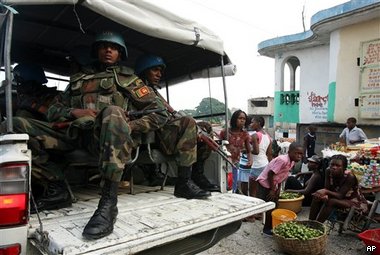
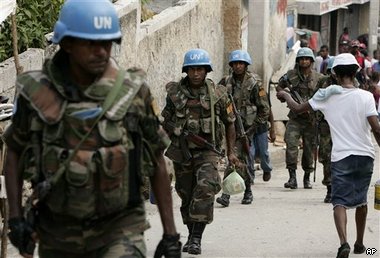
In the lead-up to the UN Secretary General's visit, Haiti is getting some long-merited attention. This AP article takes a balanced look at the challenges facing peacekeeping and peacebuilding in the Haitian state.

Haiti is in a transitional phase, where it is out of immediate crisis, but where, 'The senior U.N. envoy to Haiti says it is too soon for the U.N. to consider withdrawing its 8,800-strong, Brazil-led peacekeeping force, noting past failed attempts to help the country... "An early withdrawal right now would be a big mistake, 'Big' with a capital letter," Edmond Mulet said in a recent interview with The Associated Press. "This is a time to hold on, to make this work this time."'

The challenge is that UN military peacekeepers are obliged to undertake what is essentially a policing function. '... the U.N. mission eventually hopes to use more civilian police than soldiers but is hampered by a world shortage of trained, French-speaking officers... The peacekeepers provide more than 80 percent of Haiti's security needs, but the government is working to eventually take over that responsibility. The national police academy is pumping out hundreds of recruits, trying bolster the nation's small police force of 6,000.'

Chronic poverty and gangs, drug-traffickers still pose a threat to real peace and stability in Haiti, with official suggesting that a UN force will be need until President Preval's term ends in 2011.


5f18c7cb-5b14-43d0-ae71-af54ad447ce9.jpg

Saturday, July 21, 2007

UN Investigations of various abuses by peacekeeping troops

The United Nations is investigating allegations of widespread sexual abuse and exploitation by peacekeepers serving in Ivory Coast. A UN statement said the latest allegations had been uncovered by an internal inquiry, and a full investigation was now under way.

While the accused contingent has not been named publicly, apparently the entire unit has been confined to base while the investigation continues.

In 2007 alone, there have been investigations into sexual abuse claims in the Sudan, Liberia, Haiti and Ivory Coast, and reports that sexual abuse allegations have doubled over 2006.

This new investigation follows on the heels of an ongoing probe of Indian peacekeepers stationed in eastern DRC, who allegedly were trafficking in gold and guns. The accusations suggested that the Indians were trading food rations for gold with Rwandan rebels.

Update: AlertNet stated the nationality of the suspended peacekeeping troops in Ivory Coast is Moroccan.

Thursday, July 19, 2007

Lebanon- Peacekeeping with Hizballah's Help | TIME

TIME has an excellent piece on the challenges facing the relatively successful UNIFIL mission in Lebanon. The peacekeepers are apparently being forced to 'shake hands with the devil'- in order to improve their force protection, and reduce further threats from yet another metaphoric devil. The suggestion is that UNIFIL is obliged to maintain contacts with Hizbollah, in order to protect themselves from further Al-Qaeda attacks:

'The contingents comprising the peacekeeping force known as UNIFIL have good cause for concern. Last month, six Spanish and Colombian UNIFIL soldiers were killed in a bomb ambush, the deadliest attack against the peacekeeping mission in its 29-year history. In a video message released this week, Al-Qaeda deputy leader Ayman al-Zawahiri hailed the attack as "a response against those invading Crusader forces who were occupying a beloved part of the land of Islam". And, UNIFIL officials fear, given the worsening security situation in Lebanon, there could be more attacks on the way. "The major difficulty we are going to face for sure is this kind of terrorist attack because even if we have no idea yet who could be the perpetrators... another attack can come," Major General Claudio Graziano, UNIFIL's commander, told TIME in an interview at his headquarters in the southern coastal village of Naqoura.'


Whatever contacts may exist between UNIFIL and Hizbollah, there was also another roadside bomb that struck a peacekeeping vehicle, the second such incident in a month.

Sunday, July 08, 2007

AFRICOM Update

There's quite a bit being written about AFRICOM, including a few previous posts we've done (also here and here).

- The US Department of State website has a briefing by Ryan Heny, Principal Deputy Under Secretary of Defense for Policy. The transcript gives a good preamble to the raison d'etre of AFRICOM. ''When it comes to the security or the defense part of this, AFRICOM is not meant to fight wars. It is one that is based on building partnership capability and in the areas of security cooperation. The missions that AFRICOM will emphasize are those of humanitarian assistance, civic action, the professionalism of militaries, assistance in border security and maritime security, and again the area of security cooperation and response to natural disasters.' The proposed comand structure is presetned as being a sort of non-linear/de-centralized HQ with 'nodes' spread across Africa.

- The International Relations and Security Network (ISN) has an exhaustive overview of AFRICOM- 'Questioning AFRICOM's intentions'. The piece explains:
'The Pentagon reportedly plans to establish another dozen bases in the region; in Algeria, Senegal, Mali, Mauritania, Niger, Chad, Ghana, Morocco and Tunisia.

But for now, AFRICOM remains an orphan without an African home, with Algeria and Libya rejecting the idea outright, and Morocco being distinctly cool.

The Transition Team will be housed temporarily at the US Army's Kelley Barracks in Stuttgart-Mohringen, Germany until the issue can be resolved. AFRICOM initially will be a sub-unified command, subordinate to EUCOM, also based in Stuttgart, with a projected Initial Operational Capability (IOC) by October 2007. As the Defense Department continues to search for a suitable African host country, high among its concerns is providing for the safety and security of an estimated 500 American personnel and their families who will staff the command.'


- Commentary on a recent WSJ article by UFPPC.

- Also, keep an eye out in September for an upcoming book entitled, 'Beyond Humanitarianism: What You Need to Know About Africa and Why it Matters'. The book will be a compilatoin of recent work by the Council on Foreign Relations and Foreign Affairs.

Wednesday, July 04, 2007

Resource- International Policing Guidelines

A new pubication of interest to readers: 'Peace Support Operations: Information and guidance for UK police personnel'. These guidelines are a resource on specific aspects of policing in PSOs, and include case studies and best practices for users.

'In addition to explaining why the UK makes a contribution to PSOs, the Guidelines outline, among other things, international policing principles, the legal context in which such missions operate, the kinds of tasks UK officers might perform, and the standards of behaviour expected of them. There is nothing similar available either nationally or internationally. The handbook will reinforce officers' pre-deployment training and act as an aide-memoire whilst on mission.'

The UK Internatinal Policing website which hosts the document is also an excellent resource.

Sunday, July 01, 2007

UN decides to split Department of Peacekeeping Operations

The United Nations General Assembly decided by consensus to split the Department of Peacekeeping Operations (DPKO), creating a new Department of Field Support to look after management and logistic under the supervision of an Under-Secretary-General. The Peacekeeping Department will now concentrate on operations and will also be headed by an Under-Secretary-General.

'...Ban sees it [the splitting of DPKO] as an important part of the reforms process and asserts that it would increase the overall efficiency at a time when the world body is being asked to take on more and more responsibility of peacekeeping.'


Sunday, June 24, 2007

Incident- 4 killed in attack on UNIFIL patrol in south Lebanon

_42418884_marjayoun_230body_afp.jpgFour Spanish UN peacekeepers were killed and several others wounded in an attack on a UNIFIL patrol in southern Lebanon on Sunday afternoon. It was unclear whether it was a deliberate attack, or whether the partol had run over a mine or unexploded ordinance from last year's war.

Update: further articles on 25 June confirmed that 5 were killed, and strong suspicions that it was a targeted car bomb attack. No one has claimed responsibility for the attack, which took place in a region under the effective control of Hezbollah.

Sunday, June 17, 2007

UN And African Union Agree to Strengthen Security Cooperation (Page 1 of 1)

The UN Security Council and the African Union (AU) issued a joint communiqué where they underlined the importance of developing the African Standby Force, and bolstering their overall collaboration in addressing conflict and building peace. The press statement was the result of a week-long mission by UN Security Council members to Africa. Following their visit to Addis, the members will visit Sudan, Ghana, Côte d’Ivoire and the Democratic Republic of the Congo (DRC).

Saturday, June 16, 2007

PriceofPeace.org- Video Petition

Couldn't resist posting this flashy video from PriceofPeace.org. Beyond the quality of the product, the message isn't too bad, either- 'Peace. It's cheaper than war.'