Sunday, May 27, 2007

Aegis Charitable Foundation- Private Security Companies- Low Cost, High Impact Assistance

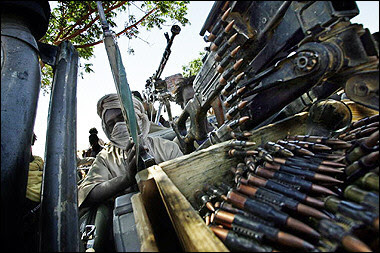
Had originally intended to post on a vehicle of British-based security comapny Aegis Specialist Risk Management having been hit by a roadside bomb in Basra.

While visiting the Aegis website, gave a full read to the profile of Aegis' founder, Tim Spicer. Found a glimpse of Aegis [private security companies in general] that hadn't seen before:

'He [Tim Spicer] created the Aegis Charitable Foundation in 2004, a registered UK charity which provides direct assistance to communities through low cost, high impact civil affairs projects. Tim’s effort and support of this charity not only significantly helps communities in great need having suffered from conflict, but has also enhanced the ability of Reconstruction Operations in Iraq to actually implement their programmes successfully. Tim’s concept for the charity has been to carefully target projects that communities need and also want. The Foundation has therefore concentrated its efforts on building relationships with local tribal leaders and communities to provide clean water projects, inoculation programmes, school and health clinic equipment and smaller items such as toys, clothes and shoes. Tim has now expanded the Foundation’s arena to include Afghanistan.'


Sure enough, the Aegis Charitable Foundation enjoys its own pages to show off its good work- replete with images of (presumably) Tim himself delivering life-saving supplies of soccer balls to Iraqi children. [It is recommended to scroll through their projects- it is so rare to see humanitarian marketing photos of the benevolent aid-providing staff and their interlocutors with their faces blurred... Needless to say, the smiling beneficiaries are all lucky enough to have their faces shown without blurring...] Wonder if Aegis considers this as part of their Corporate Social Responsibility (CSR) strategy?

Saturday, May 26, 2007

Darfur- UN Council endorses plans for large Darfur force

Flurry of events around Darfur:

The UN Security Council endorsed a plan for a Darfur Peacekeeping force of more than 23,000 troops and police. 'The proposals, from the United Nations and the African Union, have two troop options: one with 19,500, composed of 18 infantry battalions, and another with 17,605, with 15 infantry battalions. Police would include 3,772 officers and perhaps an additional 2,500 policemen to establish a local police force in refugee camps... One of the main tasks is to provide security to the tens of thousands living in camps and patrol humanitarian supply routes and "where necessary escort humanitarian convoys," which have been attacked regularly by armed groups and militia, the document said.

The UNSC session had to reconvene for when US Ambassador Khalilzad read the wrong statement on the Sudan the first time round. The erroneous statement was a hard-hitting denunciation of Sudanese aerial bombardment in Darfur

The EU released 40 million euros in financing for the AU peacekeeping force.

Finally, the AU has nominated a Nigerian General to lead the Darfur peacekeeping force. '"General Agwai will serve first as the force commander of the African Union Mission in the Sudan and ultimately as the Force Commander for the AU-U.N. hybrid operation," the African Union said in a statement seen by Reuters on Thursday.'

Afghanistan- US Forces interrogating Afghans in Aid Agency Compounds??

The Guardian was stirring things up last week with a series of articles predicting the collapse of Afghanistan along the lines of Iraq, all fueled by comments from OXFAM.

They did seed a rather explosive closing paragraph in the article, which really needs to be expanded:

'Separately, the Guardian has learned that, to the fury of civilian organisations, US forces are using an aid agency's property as a place to interrogate Afghans.'

The accusations seem a bit unlikely that these furious civilian aid agencies haven't already published multiple press releases on the subject... Hey, would be happy to be proven wrong, has anyone seem more details of these allegations?

Wednesday, May 23, 2007

DRC- Accusations that UN troops 'traded gold for guns'

The BBC alleges that a UN investigation concluded that Pakistani peacekeepers in north-eastern Democratic Republic of Congo were trading gold with local militias and selling confiscated weapons back to their previous owners. The incidents, which would have taken place in 2005, were investigated in 2006, though there the article illustrates that the investigators were obstructed in their work. Interestingly, the UN was alerted to the gold trading allegations by Human Rights Watch.

Tuesday, May 22, 2007

Border agents recruited for Iraq duty

In the same vein of outsourcing, a military contractor is actively recruiting Border agents for service in Iraq. DynCorp International already has 700 trainers in Iraq, but received a request from the State Department to augment this force. Not surprisingly, the salary is roughly triple what agents earn at home. DynCorp is not new in this business, its website includes provides further background on this service they provide.

Northrop Grumman Awarded Contract for Global Training of Peacekeeping Forces

Northrop Grumman was awarded the contract for the Global Peace Operations Initaitive (GPOI- more on the initiative here and here). The $200 million US contract over five years is part of the US Department of State initiative to build worldwide capacity for peacekeeping operations. L3 Communications MPRI was also awarded a similar contract.

As the press release makes clear, Northrop Grumman has already been providing similar training under the ACOTA program- African Contingency Operations Training Assistance- since the 1990s.

Friday, May 18, 2007

Africa Command: U.S. Strategic Interests and the Role of the U.S. Military in Africa

The Congressional Research Service published a report entitled 'Africa Command: U.S. Strategic Interests and the Role of the U.S. Military in Africa.' Ths is a great resource that is worth a read. The appendices include a history of US military involvement in Africa.


China pledges $20bn for Africa

'China intends to provide about $20bn in infrastructure and trade financing to Africa during the next three years, eclipsing many of the continent’s traditional big donors by a single pledge.'

This article might not seem entirely germane to the civil-military question, but in light of the renewed US focus on Africa through AFRICOM, the Chinese have upped the ante in one foul swoop, and through civilian, financial means.

China's moves haven't gone unnoticed by other donors. 'The World Bank has accused China of financing projects rejected by others because of environmental concerns and rights groups say it lends without regard to standards on governance or corruption.' Sour grapes? The real concern, beyond mere competition, appears to be that China's preference is towards bilateral and not multilateral development initiatives.

Wednesday, May 16, 2007

Female Police in Liberia Hope to Curb Rape Epidemic

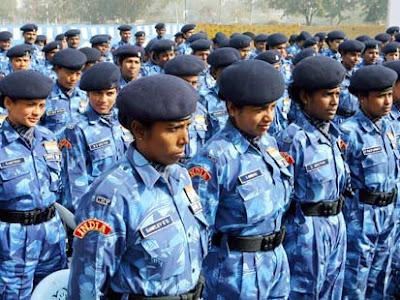
ABC reported on the deployment of an female Indian Para-military force serving with the UN Peacekeeping force in Liberia. Theirs is the first deployment of an all-female unit by the United Nations.

A direct impact of this group of peacekeepers has been to give Liberian women the confidence to report assaults directly to them- not a small achievement, given that the UN in Liberia has convicted peacekeepers with 30 cases involving sex for food in 2006 alone.


'Part of the policewomen's mission here is to encourage Liberian women to join a national police force of their own. Their belief is that the sight of uniformed women in positions of authority can reduce the level of violence against all women.'

Poppy Fields Are Now a Front Line in Afghanistan War - NYT

NYT has an excellent article on the new front line in Afghanistan- the drug war.


The article doesn't shy away from the evident criticism- that having avoided fighting the opium trade in Afghanistan has seriously eroded the military, political and development progress made elsewhere. The issue of exactly 'who?' should take on the drug war has been a political- and military- hot potato since the 2001 war. At alternating intervals, ISAF, Coalition Forces and the Afghan government have denied their role in the drug war, and often even its importance.

One interlocutor made an interesting parallel with Iraq:
“This is the Afghan equivalent of failing to deal with looting in Baghdad,” said Andre D. Hollis, a former deputy assistant secretary of defense for counternarcotics. “If you are not dealing with those who are threatened by security and who undermine security, namely drug traffickers, all your other grandiose plans will come to naught.”

DoD Announces the ROTC Language and Culture Project

This is an interesting (and overdue) initiative by the US Department of Defense:

In partnership with Indiana University, San Diego State University, the University of Mississippi and the University of Texas at Austin, DoD will promote the linguistic and cultural skills of ROTC cadets:

'As part of this project, Indiana Universitywill offer scholarships for study at their prestigious summer institute in languages including: Arabic, Russian, Azeri, Kazakh, Pashto, Tajik, Turkmen, Uyghur and Uzbek. San Diego StateUniversity plans to re-shape their military science minor while drawing on the resources of the community around them to teach different dialects of Arabic as well as Farsi and Russian. TheUniversity of Mississippi will offer opportunites for study of Chinese including summers of study abroad. The University of Texas at Austin will invest in material and curriculum to expand their programs in Arabic and Farsi.

Originally posted on Abu Muqawama- thanks!

Blast kills AU soldiers in Mogadishu

AlertNet reports that an explosion has killed several AU peacekeepers traveling in a convoy in Mogadishu.

Proposed Budget Levels for UN Peacekeeping- 2006 - 2008

UN Pulse published a note by the Secretary-General, showing approved resources for peacekeeping operations for the period from 1 July 2006 to 30 June 2007 and proposed budgetary levels for the period from 1 July 2007 to 30 June 2008.

Peacekeeping ain't for the faint of heart: 2006- 2007 comes in at $5 406 019 800 US, and 2007 - 2008 at $5 348 059 500 US- barring any new deployments, of course.

In terms of DPKO 'humanitarian projects', the same budget includes $7.34 million US for quick-impact projects.

Tuesday, May 15, 2007

15 guidelines for Peacekeepers - Jan Pronk

Former SRSG in Sudan, Jan Pronk, published his 15 guidelines for Peacekeepers as he ended his tenure in Khartoum. There's some sensible stuff in his proposals:

First: United Nations peacekeepers in a country are visitors. Their presence is temporary. Their function is catalytic, no more. Peace ought to be home grown.

Second: There is no peacekeeping without peace. Peace, to be made by the parties to a conflict themselves, should precede efforts to keep the peace.

Third: The sovereignty of a state has to be respected, but brought into balance with the protection of the people within that state. Keep that balance!

Fourth: Respect national traditions and domestic cultures.

Fifth: International staff members should respect national staff members, their views and their positions. They are vulnerable: they have no ticket to leave the country. They know their country better than you.
National staff members should have patience with international staff members.
They could have chosen for comfort back home. They are idealists, or anyway, once they have been idealists.

Sixth: All UN staff members have the duty to follow a unified approach, in whichever agency they work, as peacekeepers or as humanitarian and development workers. That implies a commitment to the same goals and a duty to respect the same boundary conditions, for instance those set by the Security Council representing the international community. A unified approach of all UN agencies also implies the duty to consult each other about each other’s work, the duty to cooperate and to use a common infrastructure and common services. Finally this unified approach requires the acceptance of a unified command.

Seventh: Delegate, decentralize, trust your staff and show this to them.

Eight: Work as a team.

Nine: The field is more important than headquarters. People in headquarters should understand this. But those who are working in the field, when critical about headquarters, should be aware that they are not “the” field, but that, farther away, other colleagues may consider them too as a headquarters.

Ten: Never be satisfied. There is no room for complacency, despite many achievements.

Eleven: Insecurity, risk, uncertainty and political pressure are not a hindrance, but a challenge. They are no exceptions to a normal and stable pattern. They are not exogenous factors, but inherent to peacekeeping.

Twelve: Fight bureaucracy. Fight also the bureaucrat in yourself. Stay a movement; keep the spirit of a pioneer.

Thirteen: Care for people. People first.

Fourteen: Peacekeeping is a calling, not a joba

Fifteen: Please, stay.

Thursday, May 10, 2007

Afghanistan- Revived Taliban restrict Afghan aid effort

CS Monitor has a provocative article attempting to equate the military successes of the Taliban with restriction on aid and development in Afghanistan.

Against the backdrop of NATO troops giving out candy, the author highlights the difficulties that donors are having in finding Afghan NGOs to implement projects in volatile regions. Presumably the search for Afghan partners is now the tactic of choice to make up for the absence of international partners, who are unable to work without armed security. But even this approach is apparently failing, as the Afghan NGOs are explaining the same problems that their international counter-parts have faced since 2001:

'...finding Afghan aid agencies who are willing to work on projects in outlying southern districts has become a thorny problem – especially in areas where international troops visit districts to inspect aid work, such as the canal-clearing project in Niki Kaz.

"When they [NATO soldiers] monitor the projects themselves, they come with tanks, with weapons, and this affects our staff badly," says Abdul Salaam Siddiqi, the deputy director of the Voluntary Association for the Rehabilitation of Afghanistan (VARA).

Mr. Siddiqi says his agency has rolled back its activities steadily over the past two years and now operates only in provincial capitals in the south.

Delivering aid in outlying districts has become impossible, and eight staff members have been killed since 2002.

"We face many problems. The Taliban have arrested our engineers there and captured our vehicles," he explains.'


Sunday, May 06, 2007

UN Job creation schemes in Iraq economic plan

We posted earlier on a $1bn job creation plan in Iraq, as a parallel to the military surge announced in January.

The UN-brokered economic compact, signed this week, announces many of the same ambitions for Iraqis, aiming to create a liberal free market in Iraq.

'But, while the language echoes Washington’s dreams for transforming Iraq before the March 2003 invasion, officials on the ground admit that, in the short term, reviving state-owned industries to create jobs will take priority.

“At this stage in Iraq’s situation, I would argue very strongly that profitability is not the key aspect in assessing your state-owned enterprises,” a senior US official in Baghdad involved in economic policy said this week.'

Saturday, May 05, 2007

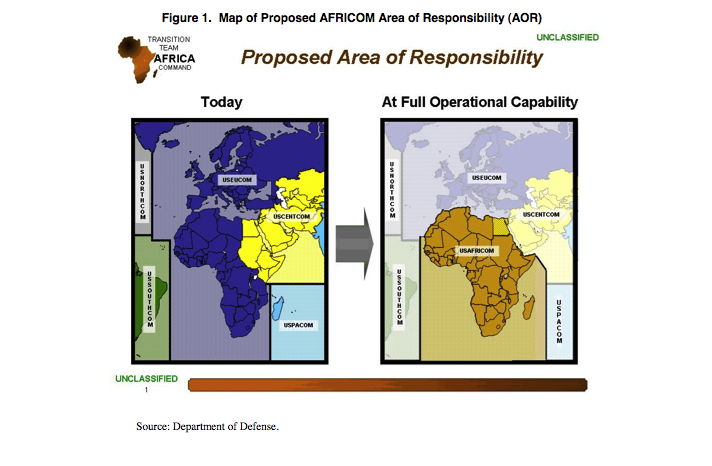
The Pentagon's New Africa Command

The Council of Foreign Relations has an excellent backgrounder on the New African Command (AFRICOM) announced by President Bush in February.

The article highlights some of the differences between the future AFRICOM and existing Commands:

- 'The Pentagon stresses that Africom’s primary mission will be preventing “problems from becoming crises, and crises from becoming conflicts.”'

- 'It resembles the mission statement of other regional commands, but “the difference is that building partnerships is first and foremost of the strategies which is not necessarily the case with other commands,” says Ambassador Loftis.'
An interesting statement, as the authors frame it, AFRICOM will be more of a diplomacy-development Command, with focus being heavy on cooperation activities with national armed forces, and only a limited capacity for 'kinetic' military operations.

- 'Though Africom will be led by a top-ranking four-star military general, unlike other regional commands, its deputy commander will be a State Department official... Some defense officials say that Africom could function like the interagency task force within Southern Command; in that structure, interagency members have the authority to make decisions without consulting Washington.'
This mixing up of military and civilian staff and agendas is an experiment at a scale not yet attempted by others. Will be curious to see how this aspect is fleshed out over the coming months.

Research- US Marines unlikely to report civilian abuse -study

Some interesting statistical data on the percentage of US soldiers deployed in Iraq. The Pentagon report stated that only 40% of Marines and 55% of Army soldiers would a report a fellow serviceman for killing or injuring an innocent Iraqi. The survey found increasing rates of mental health problems for troops on extended or multiple deployments.

There have been some interesting pieces on the relationship between the prisoner mistreatment at Abu Ghraib and a sharp rise in scenes of torture on prime time television. The prime culprit is the Fox show 24, where hero Jack Bauer is regularly torturing, terrorists, friends and even US officials, all justified by a patriotic sense of 'the end justifies the means'. While we can't make a scientific link, the same Pentagon survey found that over one-third of soldiers and Marines believe torture should be allowed to elicit information that could save the lives of American troops or gain knowledge about Iraqi insurgents. Art imitates reality- or vice-versa?

Friday, May 04, 2007

PRTs accused of spending unequal amounts on development

'Sarabi longs for a US-led PRT [Provincial Reconstruction Team] in her impoverished province, which would have spent, she says, more development money than the existing New Zealand PRT.'

So begins this short Alertnet article entitled 'PRTs accused of spending unequal amounts on development'. The theme is a fresh take on the eternal PRT debate: seen from the point of view of a provincial governor in Afghanistan, PRTs are a good thing. In fact, they are a great thing, especially if they are well-financed.

The article does provide a balanced overview of views and realities as concerns PRTs around Afghanistan. Ultimately, there is little debate on the divergent agendas, approaches and budgets of the various nations staffing the different PRTs on the ground. Even '..the minister for rural rehabilitation and development, Ehsan Zia, told IRIN: "We cannot make a decision which should equalize PRTs development budgets in all provinces. It is impossible for us to ask the British-led PRT in Helmand province and the Lithuania-led PRT in Ghor province to spend equal amounts of development money."'

Wednesday, May 02, 2007

Afghan Army and police: A long way to go - International Herald Tribune

IHT has an excellent article on the challenges in building up the Afghan Armed Forces and Police. The author uses some poignant images to show the extremes of development that these forces face: at one extreme, an english-speaking officer cadet is interviewed at a military academy modelled after West Point; at the other extereme, a police station in Oruzgan province is visited by NATO forces, who find the local police are cultivating poppy in their compound.

The creation and bolstering of national armed forces- be it the Congolese Armed Forces by MONUC in the Congo, or the ANA in Afghanistan- is a task regularly falling to multi-national military missions and peacekeepers. In the context of Afghanistan, the stakes are high- recent scandals have greatly discredited the efforts made, particularly by private sector actors. Dyncop's training program of Afghan police was described as, '...an appalling joke ... a complete shambles', by Ambassador Holbrooke.

Tuesday, May 01, 2007

Technical Difficulties

Update- technical issue has been solved, older posts have been validated and posted below.

Apologies for not having posted- have been traveling over the last weeks, and also seem to be having issues with the software I use to do my postings with. Should have it sorted out by tomorrow!

Resource: Afghanistan: Enhancing aid effectiveness

The Agency Coordinating Body for Afghan Relief (ACBAR) made a press release on 22 April that is wide-ranging and hard-hitting critique of aid effectiveness and the responsibility of donors in Afghanistan.

Afghanistan: Enhancing aid effectiveness focuses on the performance of donors in fulfilling their commitments under the Afghan Compact in three key areas: use of aid; transparency; and aid efficiency and use of Afghan resources.

As concerns Use of Aid, the comments question the agendas and means for the delivery of assistance:
'Evidence indicates that the delivery of aid is being increasingly distorted by donors' domestic political agendas. A disproportionately high level of aid is being directed towards opium intensive or insecure areas of Afghanistan, particularly the south and south-east, in order to achieve counter-narcotics or counter-insurgency objectives. For example, USAID, by far the largest donor, allocates more than half of its aid to four highly insecure provinces in southern Afghanistan. This approach overlooks massive development needs in areas which are comparatively stable and creates perverse incentives – for provinces to create insecurity to attract resources. It also overlooks the potential for conditions in these areas to deteriorate.

The delivery of aid is being heavily influenced by domestic political demands for rapid results. Provincial Reconstruction Teams, for instance, have in many cases undertaken quick impact projects or short term assistance at the expense of projects which aim at more sustainable capacity building. In other cases, under domestic political pressure donors have pressed recipients to spend large sums rapidly, with little consideration for the utility, suitability or sustainability of the projects undertaken.'

The notion of creating 'perverse incentives'- that provinces will create insecurity in order to attract assistance is probably not as far-fetched as it might sound.

The last recommendations is on Aid and humanitarian response, where ACBAR again attempts to overturn certain myths:
't is important for donors to acknowledge that much of Afghanistan is in the process of protracted relief and recovery, and not purely the development phase widely assumed. A two-track approach is needed. Humanitarian actors are increasingly unable to provide adequate protection and assistance to displaced people and other populations at risk in the south and east of Afghanistan due to the significant deterioration in the security situation. Humanitarian space and humanitarian access continues to be seriously limited. Humanitarian response has also been compromised over time by reduced humanitarian coordination mechanisms.'

Monday, April 30, 2007

Canada's Afghan Jitters

The Council on Foreign Relations has an insightful article on Canada's Afghan Jitters.

'Canada’s parliament on April 24 narrowly defeated (NYT) a measure aimed at withdrawing Canadian troops from Afghanistan, in the face of fervent opposition from the country’s Liberal Party. But despite the vote, the debate does not seem likely to go away. As in America, Canadian lawmakers face a public that has turned increasingly anti-war in recent months as they grope for an exit strategy from Afghanistan.'

Tuesday, April 17, 2007

Afghanistan - 3,400 more trainers sought for Afghan Army and police - International Herald Tribune

NATO defense ministers meeting in Canada have agreed to a new plan to deploy more than 3,400 trainers for Afghan Army and Police forces. The IHT article gave a reference point for the scale of the proposed deployment- the equivalent of increasing the international military commitment by 10%

Would be curious how this political commitment will be translated into reality- already much of these training roles have been farmed out to Private Security/Military Contractors. Will the various NATO ministers involved be willing to perpetuate the same approach, or will they be willing to put in harm's way their Mounted Police and other national resources?

Defense Secretary Gates made the US position quite clear:
"Where you have nations that are not willing to put combat troops in, it is an area where those who are not willing to do that or able to do that may be able to pick up the slack in this area," he continued. "Those of us who are contributing most of the combat forces don't have additional forces available."

Chinese peacekeeping hospital opens in Lebanon

A Chinese peacekeeping hospital was opened in southern Lebanon on Monday. The hospital provides emergency resuscitation, surgical operations including stabilization limb and life-saving, basic dental care and casualty evacuation to a higher level hospital for all the peacekeeping personnel, and was described as 'an important humanitarian asset'.

Research- Smoke and Mirrors- PRTs and What the State Department is not accomplishing in Iraq

Robert Kaplan has an graet piece entitled, 'What the State Department is not accomplishing in Iraq' that digs in to what PRTs are- and mostly are not- accomplishing in reality.

Focussing on a State Department officer called out of retirement to lead a PRT in Iraq, the article describes the diplomat's arrival:
'When she arrived in Baquba, Diyala’s regional capital, a year ago this month, Munshi’s PRT consisted of two Department of State employees, “an absolutely new and raw” Army civil affairs team, a few interpreters, and 18 guys from a private military company called Blackwater USA whose mission was primarily to protect her. There were six Internet connections for all these people, no desks or chairs, no operating funds, and no office supplies. “If it isn’t nailed down, take it,” she told them all.'

The short piece is a quick read, and in its brevity is fills the void of critical views on what PRTs have become over the last years. Beyond debates on 'which nation does the best PRTs', there are little first-hand accounts that provide any clear indication of whether the experiment has been successful, or even what success should look like. We posted earlier (and here) on the rise of PRTs in parallel to the surge in Iraq, but again, have heard little since.


On the same theme, Jane's has an in-depth look at the PRT debate, in an article entitled 'Blurring the line - Involving the military in humanitarian affairs'- it is unfortunately available to subscribers only.

Monday, April 16, 2007

Officer of the AU peacekeeping force killed in Darfur

An UNMIS officer was killed in what appears to be a car-jacking in west Darfur. His death brings the death toll to seven in the last month.


In related news, Senegal was considering the withdrawal of its troops, unless the African Union could do more to ensure their security. Senegal lost five of its soldiers in a recent attack.

Research- Improving NATO-NGO Relations in Crisis Response Operations

The NATO Defense College has published a great article on Improving NATO-NGO relations. The conclusion of the article is an interesting- about face to the trend of mission integration- the author proposes that a relationship of complementarity will yield the best results, and not strict integration.

Friday, April 06, 2007

Iraq - Humanitarian aid met with smiles

More good news from Iraq- US troops delivered a truckload of food, oils and sanitation supplies.

'At first, hesitant bystanders looked puzzled as the council members and MND-B Soldiers gathered near the rear of the truck. The more people realized what was happening, the more they gathered and gave a helping hand.'

Dutch Soldiers Stress Restraint in Afghanistan


The New York Times has an interesting article showcasing the Dutch military approach to fighting insurgency in Afghanistan. Whether their approach is truly different or not, the article posits that Dutch 'restraint' is the reason for which they have suffered no combat fatalities since it began operations in Uruzgan province last August.

The approach- and the views of its detractors- can be summed up with this paragraph: 'Its [Dutch military contingent] counterinsurgency tactics emphasize efforts to improve Afghan living conditions and self-governance, rather than hunting the Taliban’s fighters. Bloodshed is out. Reconstruction, mentoring and diplomacy are in. American military officials have expressed unease about the Dutch method, warning that if the Taliban are not kept under military pressure in Uruzgan, they will use the province as a haven and project their insurgency into neighboring provinces.'

The Dutch Commander makes a nice turn of phrase that I can only imagine CIMIC officers will want to adopt in the future: “We’re not here to fight the Taliban,” said the Dutch commander, Col. Hans van Griensven, at a recent staff meeting. “We’re here to make the Taliban irrelevant.”

PCR Project- The Danish Approach to State-Building

Our friends at the PCR Project posted on a recently published article on The Danish Approach to State-Building:

Anja Dalgaard-Nielsen, head of the Research Unit, Political Violence, Terrorism and Radicalization, at the Danish Institute for International Studies (DIIS), has just published her findings on the Danish military and its approach to state-building. Full report is available here.

The research findings are provocative- Dalgaard-Neilsen concludes that deployed Danish military units are evaluated as conducting good reconstruction support tasks, when measured against basic principles of good development work.

Exec summary:
'The Danish armed forces, together with the armed forces of other nations, have come under political pressure to accept a range of state-building tasks, including support for reconstruction. This is the case in areas such as Iraq and Afghanistan where few civilian and humanitarian organisations are willing to operate. This report analyses how the Danish armed forces have approached and prioritised reconstruction support and asks how their performance might be improved. It is based on empirical evidence collected over a period of five months of “embedded” research, during which the author took part in the daily activities of deployed Danish units in Kosovo, Iraq, and Afghanistan. It points out how the Danish units assigned reconstruction support tasks are neglected in a number of ways by their own organisation and show how they nevertheless perform well as measured against basic principles of good development work. It draws on Edgar H. Schein’s theory of organisational culture to explain this pattern and shows how civil tasks, while clashing with some aspects of the culture of Danish armed forces – notions about mission and means to fulfi l the mission – are compatible with other parts – notions about human beings and human relations. The report closes with a discussion of which political, organisation, and educational initiatives would enhance the current performance of reconstruction support tasks.'

Wednesday, April 04, 2007

VOA- East Africa Drought, US troops in Djibouti dig wells, build schools, Feature Stories: East Africa Drought, US troops in Djibouti dig wells, build schools

Voice of America (VOA) ran an article yesterday on the work of US military forces based in the Horn of Africa.

One counter-point to the enthusiasm of the well-received US aid was that of Kenneth Bacon of NGO Refugees International:

"In rare and emergency cases it makes sense for the military to do what only it can do very quickly,” Bacon says. “On a day-to-day basis, I don't think it makes sense for the military to be out distributing aid, vaccinating kids, [and] drilling wells. These are things that can be done by other groups. They can be done much more cheaply and much more effectively by operations like Oxfam or Save the Children or International Rescue Committee or CARE."

TNR- Does the military endanger humanitarian aid workers?


David Bosco has an article in The New Republic Online, entitled, 'Does the military endanger humanitarian aid workers?'. Our friends at PCR Project posted the same piece last week.

The introduction sums up the topography of issues around which the debate is centered:

'The long list of indictments against recent American foreign policy includes one issued by some of the world's noblest people: international aid workers. By cynically and recklessly blending military and humanitarian missions, the charge goes, the United States has blurred the line that once kept aid workers safe and has made them attractive targets for extremists seeking to attack American interests. Innovations like Provincial Reconstruction Teams in Iraq and Afghanistan, which mix military personnel with civilian aid experts have made some humanitarian workers queasy, and the sight of American troops driving around Afghanistan in white SUVs--long favored by aid groups--only made things worse.'

From this point onwards, the argument changes. Basing itself on the Center for International Cooperation's, 'Providing Aid in Insecure Environments:
Trends in Policy and Operations
', Bosco concludes that the evidence doesn't fit the charge. Specifically, an increase in attacks on aid workers is a result of an increased number of workers in the field, and not on the blurring of lines between military and humanitarain actors, or the mixing of humanitarian with politico-military agendas.

While Bosco takes a balanced approach in his charting of the issues, in the balance his tone suggests that the future of impartial humanitariran assistance is somewhat cloudy. The debate continues...

Danish military to aid African armies

An interesting shift in Danish foreign aid, from a country typically associated with generous contributions to civlian development and humanitarian agencies:

'While Danish foreign aid to Africa has traditionally gone to humanitarian projects such as digging wells and conducting immunization drives, the country has now allocated 248 million Danish krone (about 44.5 million U.S. dollars) of its development aid budget to defense related projects.'

The article did not specify precisely the form of assistance that Denmark would provide, but suggested support might include helping to train Kenyan peacekeeping forces, conducting courses at defense academies, or helping to train Ghana to patrol its coastal waters.

Aid still days away for Solomons homeless

Following Monday's Tsunami that hit the Solomon Islands, international peacekeepers were the first responders in assisting civilians affected by the disaster. The peacekeepers, stationed in the country since 2003, evacuated several injured people to hospital in the capital.

'Australia and New Zealand have offered US$2 million in aid, and around 100 peacekeepers that arrived on Wednesday brought with them water, food rations, shelter and other relief supplies. A New Zealand air force Hercules carrying water containers, blankets, tarpaulins, food and lamps also arrived in the islands, with supplies to be ferried by helicopter and boat to the worst-hit areas.'

Sunday, April 01, 2007

A call for regulation in humanitarian action and a high level panel

Felt that this post from ODI blog deserves to get wider circulation. For military audiences, it should serve as a good benchmark for understanding why civilian humanitarian agencies lack professional codes, associations or standards that might make it easier to distinguish the 'real' agencies from the less credible variety. It is not so much the absence of a professional body that regulates humanitarian agencies, but more the infernal debates that seem to characterize the lack of progress.

Comparison between military and humanitarian worlds might help illustrate the question. For example, many lament the lack of consistency that armed forces show when it comes to doctrine and practice of CIMIC. Some armed forces advocate that CIMIC is not about doing humanitarian projects; others put more emphasis on the fact that CIMIC doctrine does not exclude undertaking assistance projects. If we look at how different armed forces have set up and run their PRTs over the last 5 years in Afghansistan, we see how these different views translate into reality: not very consistently.

This debate on regulation of the humanitarian industry is remarkably similar to debates on 'what is CIMIC?'- but arguably no where near as advanced. Instead of agreeing that regulation is inevitable, and would add to the quality and accountability of the assistance and protection provided, more distractions are proposed. Proposals range from 'high level panels' to 'embracing the increasing diversity of humanitarian actors' to 'recruiting the Public Relations world' to help us better hear the voices of the stakeholders of humanitarian action. In short, and still speaking comparatively, the humanitarian world isn't even building their own inconsistent network of PRTs, they are still debating whether to build a PRT.

Can we compare the absence of professional standards, accountability and regulation in the humanitarian sector to divergence and difference in CIMIC policy, doctrine and practice? I think we can- and if we do, the military comes across as much further advanced in the debate.

Multi-National Force - Iraq - Iraqi, U.S. Soldiers outfit schools

Iraqi and US soldiers conducted a good-will mission to help school children receive some life-saving school supplies.

The humanitarian assistance operation included distribution of chocolate chip cookies made by a stateside mother-in-law and invitations to return for future visits- “We have no problems with the Iraqi or U.S. Soldiers coming – please feel free to come anytime."

It was a busy weekend of providing assistance, another post had Iraqi and US soldiers providing humanitarian aid to Tal'Afar- nice pictures, as well.

Refugees International- Security Sector Reform Must Focus on Protection of Civilians


Refugees International (RI) sent a statement to the UN Security Council on February 16, 2007, appealing for a coordinated UN approach to Security Sector Reform (SSR). The 'punchline' of their appeal was that SSR must place more focus on the protection of civilians.

RI makes some excellent points in their piece, notably on the rationale behind their appeal:
'Regenerating and strengthening of the security sector post-conflict have been issues of UN concern for some time. Modern integrated UN peacekeeping missions incorporate military, political, humanitarian and development actors. Like the more traditional peacekeeping missions, these multidimensional missions still fulfill short-term stabilization and protection duties. But today peacekeepers are also expected to lay the ground work for long-term development and a self-sustaining peace. The weak or corrupted security institutions that make peacekeeping necessary in the first place must be developed into strong, accountable institutions that protect civilians, ensure stability, and create the necessary conditions for lasting peace, security, and rule of law.'

Curious as to how these initiatives on SSR link into the UN Peacebuilding Commission.

ISAF CIMIC teams help Kandahar City schools

The Canadian Armed Forces stationed in Afghanistan seem to have their own blog, replete with the expected pictures of CIMIC troops surrounded by smiling, waving children. You can subscribe to their content via RSS.

Tuesday, March 27, 2007

UN Peacekeepers Bring In Fresh Water For Haitians

Peacekeepers in Haiti are nothing short of a fountain of good news, this time brought to us by the Sri Lankan contingent. The communications/PsyOps folks of MINUSTAH really outdid themselves, delivering a story on water to celebrate World Water Day:
'It may be a mere drop in the ocean, but for 160 children in a Haitian orphanage it meant much more when United Nations peacekeepers delivered 9,000 litres of clean, fresh water: it meant that they were not alone in the battle against poverty and the diseases brought by contaminated supplies.'

Sunday, March 25, 2007

'Peacekeeping in Africa is not for the faint-hearted'

An excellent piece on the challenges and risks of peacekeeping in Africa:
"The first half of 2006 has not been kind to peacekeepers in Africa. The UN force in Cote d'Ivoire was forced to evacuate bases in the face of rioters; the UN force in the Democratic Republic of Congo suffered casualties and soldiers captured in the Ituri district, major attacks by dissident soldiers in North Kivu province and lacked the troops to deal with a Mayi Mayi rebellion in Katanga; the African Union force in Darfur took casualties in clashes with militias and bandits and the UN had to withdraw aid personnel from two bases in Chad after rebel attacks."

Thursday, March 22, 2007

Change sought in U.S. reconstruction programs

The opening paragraph of this IHT article provides a tidy summary of a report by the Special Inspector General for Iraq Reconstruction:

'The failures of the American-financed reconstruction program in Iraq threaten to be repeated elsewhere unless the gulf between the military and civilian efforts in wartime is bridged by structural changes in the U.S. government, a federal oversight agency said in a report Thursday.'


Iraqi insurgents blow up car with children inside | Iraq | Guardian Unlimited

The Guardian reports that US forces in Iraq were investigating a potentially new tactic on the part of insurgent in Iraq. In a recent incident, a car with children was allowed to pass an American checkpoint, before being detonated with the children still inside. It is thought to be the first incident where children have been used as 'decoys' to facilitate passage of a car bomb. Apparently the adults who would have driven the car fled before the detonation.


Haiti: Peacekeepers Restores Provincial Library

In Haiti, UN peacekeepers have restored a provincial library at a cost of $3,500 US.

'QIPs [Quick Impact Projects] are widely viewed as being among the most effective tools used by UN missions around the world to help local communities at ground level and at low cost, from repairing leaking roofs in schools in Georgia to opening a vocational centre in Liberia to refurbishing sanitation facilities in Burundi.'

Wednesday, March 21, 2007

All-female unit keeps peace in Liberia | csmonitor.com

This article writes about an all female peacekeeping unit in Liberia. The 103 Indian women are said to be having a 'profound impact', in inspiring Liberian women to join the nascent Liberian police force.

A sub-text of the article is that the deployment of more female peacekeepers will somehow better limit instances of rape and sexual abuse that have plagued the UN. In the past three years, 319 peacekeepers have been investigated for abuse, and 179 repatriated or abused. In the least, this deployment is an overdue effort to address a severe gender imbalance in peacekeeping.

Pakistani peacekeepers renovate school in Liberia as part of ongoing UN project

A press release publicizes a project of Pakistani peacekeepers who renovated a school in Liberia as part of ongoing UN project.

The project is only the beginning of an ambitious education, water and nutrition project that the Pakistani peacekeepers intend to provide:

'Pakistani Commander Brig. Gen. Ahmad Nawaz said peacekeeping is not possible without the active backing of the inhabitants of the area. “Support of the people in an area can only be won by being absolutely impartial, fair, highly upright in one’s conduct and doing things beyond the laid-down mandate aimed at winning the hearts and minds of the people."

He announced that the dedication marks the start of an initiative under which all units and sub-units of the UNMIL Pakistani contingent, wherever they are located, will each adopt a school.'

US troops in Philippines defy old stereotype | csmonitor.com

US troops in Philippines defy old stereotype | csmonitor.com


'In southern islands, the US has helped the Philippine Army for more than five years to stem Muslim insurgency.'

Presented as a 'good news' story, this article provides an overview of US support to the Armed Forces of the Philippines in their battle against insurgents. While the initial fears were of the return of permanent American bases in the Philippines, the complexity changed over time.

On the one hand, there has been a certain US success in winning the hearts and minds of local populations with their focus on development projects and humanitarian assistance- while providing counterinsurgency training to the Philippine Army.

Despite being able to publicize their 'benign intentions', some hearts cannot be one over: 'Mr. Muarip says that his brother, a Muslim who favors adoption of sharia Islamic law in Mindanao, is skeptical of US largesse and rejects the deployment in the Philippines. Other critics say that the arrival of US troops, whatever their intentions, stirs anxiety among Muslims.'


Tuesday, March 13, 2007

Haiti: UN mission helps refurbish high school for 5,000 students

'The United Nations Stabilization Mission in Haiti (MINUSTAH) has helped rehabilitate a high school for some 5,000 students in the St. Martin quarter of Port-au-Prince, the capital, after it had been out of commission since 2004 because of insecurity and disrepair.'

An earlier post examined the challenges of maintaining stability in Haiti.

The Fog of Humanitarianism: Collective Action Problems and Learning-Challenged Organizations

The Journal of Intervention and Statebuilding have an timely and insightful article on humanitarian action in their latest issue. The author's conclusions are particularly insightful:

'This essay explores humanitarian action, and by effect post-conflict state-
building, in the so-called new wars of the post-cold war period especially the targeting of civilians, the proliferation of non-state actors, and the perils of war economies. The host of reactions by aid agencies, termed ‘new humanitarianisms’, has called into question traditional operating principles of neutrality, impartiality and independence while the system has experienced dramatic increases in the number of organizations and available funds. Arguing that too little institutional learning has yet occurred, the authors call for changing the culture of aid agencies and investing in information gathering and sharing, policy analysis, and planning. In an era when reflection time is as valuable as reaction time, they stress the need to develop a humanitarian equivalent of military science.'

Nigerian UNMIL peacekeepers donate clinic to local community

A story from Liberia, where the 850 members of the Nigerian contingent donated $10 US each to finance the construction of a clinic for the village of Charlesville, close to Monrovia.

'The gift from the 11th battalion of the Nigerian Contingent - NIBATT 11 - is the latest in the long list humanitarian projects being undertaken by Nigerian peacekeepers in addition to their primary tasks of keeping the peace in war-torn Liberia. "This beautiful building will remind us, long after today, of the generosity, care and concern of all members of NIBAT11," said the Officer in Charge of the UN Mission in Liberia, Mr. Jordan Ryan as he commissioned the clinic.'

The integration of this project into the bigger reconstruction picture is called into question by the battalion commander's appeal for external support at the opening ceremony:
'"Our vision is to see this clinic transform into a full-fledged hospital in the near future, and generally boost the health sector of Liberia." He appealed to other concerned organizations, NGOs, businesses and individuals to help provide the clinic with medical equipment, beddings, drugs, electricity, borehole, and additional structures.'

Shoot-out between UN, Liberian gang

Report on a UN patrol having exchanged fire with a gang of armed men in northern Liberia over the weekend. It was the first such gunfight involving UN peacekeepers in Liberia since the swearing-in of the postwar government of Ellen Johnson Sirleaf in 2006.

Monday, March 12, 2007

Humanitarian-military dialogue- Humanitarian Practice Network

The Humanitarian Practice Network has a forum for online exchange- there is a lively short exchange around the complementarity and limits of the humanitarian-military dialogue and relationship.

The there authors make very good cases from their respective points of view. The editorial is certainly worth a read, as is a later post by Eva von Oelrich, entitled 'Coopted by the UN? Time for NGOs to take up the challenge'

Iraqi Police Commercial

Interesting Iraqi effort to improve the profile of their police.

Sunday, March 11, 2007

Sudan- More Darfuris flee, begging for UN troops to help

An article that collects the various perspectives around the deployment of a peacekeeping force in Darfur. Opinions range from the frustration of the conflict's victims, who suggest that the AU force themselves require protection; to the Khartoum government, who downplays the conflict's costs, and accuses western media of having blown the conflict out of proportion.

the Protection Group: Sudan- More Darfuris flee, begging for UN troops to help

Soldiers are no longer the key to winning conflicts

A good article that unpacks the changing nature of the battlefield and the rationale of using force.

The punchline was very much oriented around the importance- and challenge- of creating alliances around legitimate military objectives:

'The Iraq war and Israel's wars with Hamas and Hezbollah show the limits of what military power can achieve, as well as vindicate diplomacy and conflict resolution. When it comes to tackling complex political and cultural conflicts, forging international and regional alliances around a legitimate objective is more important than sheer military capacity.'

Saturday, March 10, 2007

Six months since 1706: The international failure to protect Darfur

Comprehensive look at where things stand in Darfur, and compliments the response from Sudanese President Omar Hassan al-Bashir, refusing to accept an interim U.N. plan to bolster African troops in Darfur, despite an earlier agreement in principle.
Security Management Initiative: Six months since 1706: The international failure to protect Darfur

Human rights group protests IDF battle exercises in West Bank

A unique situation in Israel, where IDF forces used a live assault on a Palestinian village in the West Bank as a training exercise for Reserve forces focusing on routine security operations in the West Bank.

The human rights group Yesh Din intervened with IDF authorities.

Update: AlertNet ran an article on the same subject, with greater detail.

Iraqis Seek Role in Rebuilding Their Nation

'When Rahim al-Daraji looks at the dusty lots just east of Sadr City where scores of bodies have been dumped in the past year, he sees a Ferris wheel, a roller coaster, coffee shops and restaurants... “The plan is not only about security,” said Naeem al-Kabbi, Baghdad’s deputy mayor in charge of municipal services. “It’s about security, services and reconstruction.”'

This article brings together the many forces at play in Iraq, as the Iraqis are increasingly using the Coalition's vocabulary of reconstruction. Given that the Iraqi government has pledged $10 billion US for reconstruction in this year's budget, authorities are finding themselves facing crowds of 'volunteers' to help direct their spending...

India's UNIFIL contingent to provide prosthetic limbs

'The Indian contingent of the United Nations Interim Forces in Lebanon (UNIFIL) announced a "Jaipur Foot Project" at the headquarters of the contingent in Ibl al-Saki on Monday. The project aims to provide prosthetic limbs to Lebanese soldiers and civilians who have lost a limb to cluster bombs or land mines in the South.'

Afghans caught in war's rising tide

As NATO launches its largest offensive to date in southern Afghanistan, this CSMonitor is a good topography of the stakes in Afghanistan today,and the battle for the hearts-and-minds of the Afghan citizens that both sides are battling for.

Some of the man-on-the-street quotes give a good sense of the enmity towards both Taliban and NATO forces. One illustration towards ISAF troops, obliged to maintain an aggressive posture for their own force protection:

'Indeed, on the streets of Kandahar, some see the local Canadian ISAF contingent as a greater menace than the Taliban.
Among a clutch of rickshaw drivers assembled by a dusty curbside recently, one says that the Canadians shot his nephew; and another claims that they shot two of his cousins, who were only riding their bicycles.'

UN commander says in control of Haiti

An insightful interview with the Brazilian force commander on the successes of the Peacekeeping mission in Haiti:

'U.N. peacekeeping forces have established military control in Haiti and paved the way for reconstruction but have yet to contain the supply of arms to slum gangs, the Brazilian force commander said.'

Thought it might be interesting to underline the humanitarian commitment to Haiti by civilian agencies. To illustrate the scale of spending, UN Agencies alone are undertaking some $98 million US period 2006- 2007.

Resource- Civil-Military Relations

Smartpowerblog has an excellent resource page, with links and references on the subject of civil-military relations, writ large.

Friday, March 09, 2007

US: DynCorp Hired for Somalia Peacekeeping

A number of sources reported on the hiring of US PSCs to provide the logistics support for AU peacekeepers destined for Somalia. This logistics support provided through private security contractors via the State Department support is not new; in 2004, the US also provided logistic support to the deployment of AU peacekeepers in Darfur. Some might ask why such outsourcing hasn't become even more important, given the continual rise of peacekeeping missions worldwide.

The Ugandan vanguard had been attempting to maintain a low profile on their deployment plans; the first officially arriving contingent was met with a mortar barrage at the airport. They also suffered their first casualties on 08 March, also reported by the BBC.

Thursday, March 08, 2007

NATO basic civil military cooperation course

This is a great initiative, the first time that NATO has advertised one of its courses via ReliefWeb. Hopefully this will attract greater participation from NGO audiences, the chronic challenge that military trainers face in running CIMIC courses.

Especially for those of you in civilian organizations- this is a great course to get a heavily-subsidized introduction to CIMIC. Getting to spend 9 days in Italy isn't so bad either...

Fixing the collateral damage

This editorial piece in IHL starts off well:

ISAF's chief spokesman, Brigadier Richard Nugee, recently admitted: "The single thing that we have done wrong and that we are striving extremely hard to improve on is killing innocent civilians."

The point of the article is a good one, and doesn't escape the reader: gosh, but NATO really has to win the hearts-and-minds of the population over. Oddly, the subtext to the article is a bit 'off': avoid killing civilians, it suggests, as it's simply bad press, poor marketing for the success of our military effort. What about IHL? 'War crimes'?

Holewinski unpacks the issue competently, going further to understand why key states aren't willing to do more even for those civilians that do become collateral damage. She doesn't find more convincing answers there, either. Her conclusion?

'This is a war you can't win unless you win the people.'

Tuesday, March 06, 2007

'Aid Workers With Guns'

Another sensational article on the military becoming the 'all-singing, all-dancing' humanitarian machine, in addition to its apparently obsolete role of war-fighting.

Examining CENTCOM's presence in the Horn of Africa, the author Nicholas D. Kristof is an unabashed advocate of the softer side of this military presence- 'It [CENTCOM] aims to help bring stability to northeastern Africa and to address humanitarian needs — knowing that humanitarian involvement will make us safer as well.'

Kristof's commentary on the new Africa Command is a just one: that there is humanitarian potential in a more robust presence. Whether we agree the assertion that, '...in some poor countries the most useful “aid workers” are the ones in camouflage carrying guns'- that's another question.

At some point in this opinion piece, the logic falls flat- the author jumps from applauding camouflaged aid workers to advocating the dispatch of mobile, armed peacekeepers along the models of Sierra Leone. Apparently militarized humanitarian aid won't solve everything in Africa?

LEBANON: UNIFIL wins hearts and minds in south, but questions remain over security

The UN appears to be leading a hearts-and-minds fiesta in Lebanon:

'BEIRUT, 4 March 2007 (IRIN) - Nepalese soldiers are teaching computing skills to the women of Houla, a Shia Muslim village 2km from Lebanon’s southern border with Israel.

At barracks across the south-east, Spanish troops meet their Lebanese counterparts to teach them Spanish.

And at 8am in the Christian valley town of Ebl Al Saqi, just south of the Litani River, a class of excited eight and nine-year-olds from Al Fardis School learn the basics of yoga from the Sikhs of the 15th Punjab Division.'

This adds to an earlier posting where the Spanish military contingent announced that they had a budget of some 6.5 million Euros to undertake humanitarian projects. In this example, the UNIFIL is undertaking $500k US in Quick Implementation Projects (QIPs) including the traditional well-digging and street cleaning projects.

While the scale of projects is impressive- 4,000 patients from mobile clinics alone- it does pose a very simple question- What is the point of having humanitarian agencies in Lebanon if peacekeepers are doing so much? More revealing still is the lack of information on what UNIFIL is accomplishing on the security front- presumably their primary task. The same spokesperson recounting their humanitarian successes made at best vague references to the effect that no Hezbollah fighters have been seen moving weapons, though, '...there was, reportedly, evidence that Hezbollah fighters were building a new line of defence just north of the Litani.'

The debate continues. In the meantime, the Lebanese can benefit from the secondary yogic effects of Peacekeeping...

Afghanistan: US Should Investigate Civilian Deaths

Military events in Afghanistan have prompted calls for investigations, following the deaths of civilians caught in crossfire.

On March 4, insurgents in a civilian van carried out a suicide bomb attack on a US military convoy on the Jalalabad highway in eastern Nangarhar province; reports suggest that US forces shot indiscriminately at civilian vehicles and pedestrians as they sped away, with 8-16 killed and 25 wounded.

In the second incident, Afghan officials announced that 9 civilians had been killed after a NATO airstrike linked to skirmishes between US forces and insurgents.


HRW made an interesting IHL-based argument:
"Suicide bombers in Afghanistan regularly pose as civilians, but that doesn't give coalition forces carte blanche to respond with indiscriminate fire," said Brad Adams, Asia director at Human Rights Watch. "The fact that the insurgents violate the laws of war doesn't absolve the US and its allies of the need to observe them."

'Human Rights Watch said that the US military should ensure that meaningful investigations take place in both cases. Appropriate action, including disciplinary measures and prosecution, should be undertaken as warranted. Human Rights Watch welcomed the Afghan government's intention to participate in these investigations.'

On 06 March, hundreds of Afghans protested the killings in eastern Afghanistan, while NATO launched a major southern offensive called Operation Achilles, said to target Taliban and narco-traffickers.

DPKO- They Year in Review- 2006

The UN Department of Peacekeeping Operations has published their 2006 Year in Review, entitled, 'New Challenges, New Horizons'. The theme is very much oriented around more peacekeepers being called into action worldwide.

Also released is an 'Audit of the management structures of the Department of Peacekeeping Operations', published by the UN Office of Internal Oversight Services (OIOS). The audit assesses whether the Department’s current structures adhered to sound management practice in providing political, logistical and administrative support to peace missions led by the Department and focuses on governance, accountability, doctrine, organizational structure, delegated authority in key administrative functions, training, mission support and partnering in peace operations.

Pakistan | Hearts and Minds?

The PCR Project has a great article looking at US attempts to win hearts and minds in the Muslim world.

Using the specific example of American aid in Pakistan following the 2005 South Asia Earthquake, the graph they use illustrates a dramatic increase in the favorable opinion of the United States. These gains- rising from 23 to 46%- were as quickly lost as they were gained. Following a January 2006 predator strike in Pakistani territory, ratings dropped back down to 27%

Sunday, March 04, 2007

Introducing The 404s: Military's Lamest Websites

Granted, this post is only tangentially related to the subject at hand, but this contest being run by the folks over at Wired magazine's DANGER ROOM have come up with a novel idea: a contest to find the absolutely worst military website.

The rationale:
'The federal government started building websites for its various agencies back in the mid-90s. The idea was to better inform the public -- and to share information across bureaucratic silos. At least, that was the theory.
In practice, those high-minded ambitions have rarely, if ever, been met. That's especially true at the Department of Defense. Many military websites barely have any content at all. And what content they have is years out of date.'

Sarcasm aside, the post does make a good point that is often over-looked: that information sharing actually helps armed forces, the obsession with security classification aside.

One final point- to level the playing field, one has to wonder if the websites of civilian humanitarian and development agencies are in any way more informative than the average military website. While the graphics may be better, is if often incredibly difficult to find concrete information what agencies are doing for whom, where.

Draconian Observations: The Coming JFCOM 'Shaping' JOC: A Revolution In Development Policy?

Draconian Observations: The Coming JFCOM 'Shaping' JOC: A Revolution In Development Policy?

Great commentary on a new Joint Operating Concept that risks having huge impact on the development and humanitarian sector. The following clip from an already very comprehensive commentary on the JOC shows how the military is seeing the next multi-national/agency operating environment:

'Proposed Solution: The Joint Force, as a part of a larger multinational and interagency effort, conducts continuous, anticipatory shaping operations that build partnerships with governmental, nongovernmental, regional and international organizations and reduce the drivers of conflict and instability in order to prevent or mitigate conflict or other crises and set the conditions for success in other operations—all aimed at a secure global environment favorable to US interests.'

The warning the author makes in closing is a direct call to civilian agencies:
'On the civilian side, including the whole of the development universe: You better wake up and follow this development closely. The Pentagon has so much logistical and funding clout that if the Shaping concept does indeed get feet, then there will be some very real opportunities to move the development agenda forward. My guess is, however, that most likely the development crowd will shy away from cooperation with the Pentagon. This is especially the case for the European development agencies.'

Combat Camera: Iraqi, Polish Soldiers Provide Aid

From the blog The Tension, a collection of photos of Polish army soldiers from the Civil Military Cooperation Group, Multi-National Division - Central South, Camp Echo, Iraq, and Iraqi army soldiers from the 8th Iraqi Army Division arrive for a mission at a children's and maternity hospital in Diwaniyah, Iraq, Dec. 7, 2006. The Polish and Iraqi army soldiers delivered 100 boxes of medical supplies to the hospital.

Changes to Civil-Military Relations

Just a few notes on changes I have made to this blog over the weekend:

- yes, adopted a different template. Don't particularly like the white background, but do appreciate the wide-screen format- comments from users?
- added a subscribe by email function, courtesy of feedburner
- subscribed to technorati and added appropriate buttons and functions.

Hope you like the changes!

Resource- Civil-military cooperation Blog

Recently discovered a blog entitled 'Civil-military cooperation- The website for research into the field of civil-military cooperation'. The site includes some excellent links, abstracts and original publications- definitely worth a visit.

Saturday, March 03, 2007

The US military is having trouble recruiting local Arabs to help with training by manning 'Iraqi villages.'

Christian Science Monitor has an insightful article on the difficulty in finding civilian role players for US mission preparation exercises for Iraq, being staged at the Joint Multinational Readiness Center (JMRC) in Bavaria.


'The Army has built a dozen mock villages complete with shops, gas stations, mosques, and prisons at the installation. The US army says making simulations more realistic saves both American and Iraqi lives.'

This sort of elaborate exercise is not new, and in general, must be applauded. Such 'live' exercises put equal emphasis on the cultural environment in which armed forces will be deployed, and attempt to break the mold of military exercises which focussed on war-fighting. It is refreshing to see such multi-dimensional simulations and, equally, exercises where the simulation reacts to the behavior of participants- 'At Fort Irwin, each villager belongs to a clan that stretches across village boundaries, so if a soldier roughs up a civilian, GIs in a neighboring town find friendly villagers quickly turning surly.'

One criticism that can be leveled at armed forces running such high-end exercises, is the quality of the role players selected- the white cell actors which include civilians, religious and political leaders, human rights and humanitarian workers. Some colleagues have described such exercises as relying almost exclusively on private security contractors, with there being a certain irony to having former soldiers taking on roles in which they have no expertise. Can a former platoon commander credibly play the role of journalist or aid worker?

In the example of the JMRC, efforts are clearly being made to recruit Iraqis and arabs as role players in the exercise. The challenge is apparently to find willing participants: 'Unlike in the US, where hundreds of Iraqi Americans have eagerly taken part in life-like training exercises, many Arabs here are so angry at the US that the contractor charged with recruiting role players has been struggling to fill its quota... "As soon as they hear it involves working with the US military, many people want nothing to do with it," says one recruiter, who asked that his name be withheld.'

It would appear that the challenge of perception is only compounded by what seem to be relatively poor renumeration- role players are offered only 130 USD a day...

UPDATE
The Guardian ran an article entitled, 'It's only a wargame! Arabs reject US army bit-part', which described the same issue from a different perspective. Apparently, a Berlin-based casting agency was hired to recruit the civilian role-players for a US exercise. They posted a cryptic ad in a Berlin tabloid looking for walk-on extras.

When informed of the true nature of the recruitment, only 4 arabs out of dozens agreed to participate.

Friday, March 02, 2007

Reconstruction, security go hand-in-hand

The title is an oldie, but a goodie: 'Reconstruction, security go hand-in-hand'.

From the official website of Operation Iraqi Freedom, another example that attempts to connect war-fighting and re-building as intrinsically linked acts. Curiously, this link doesn't really work in the text itself, where the military spokespeople admit, 'Although there has been some initial progress, the enemy continues to disrupt the efforts of Coalition forces and improving security in Iraq will take some time.' Despite these disruptions, there are apparently, 'There have also been great strides made in the reconstruction effort in Iraq.'

At the end of such upbeat announcements, the article closes on a note of participatory development: “Ultimately, it is up to the Iraqi people to rebuild and secure their country.”

The following day, the same site publishes a further article entitled: 'Reconstruction projects provide Iraqis with improvements to essential services'. The article gives some dimensions to the reconstruction projects the Department of Defense has planned and implemented as of 28 February, 2007:

• Planned 3,832 projects, at a program cost of $12.05 billion.
• Completed 3,183 projects, at a program cost of $8.67 billion.

So much for the military not managing humanitarian, development and reconstruction projects?

Thursday, March 01, 2007

Fleeing gangs set up new bases in rural Haiti

Reuters report on heavily armed gangs who have left Cite Soleil following publicized raids by UN Peacekeepers in the past weeks.

'Reports from other provincial cities, including Les Cayes in the south, also indicate armed gangs hunted by U.N. soldiers in the capital have tried to set up in rural areas where the police or U.N. presence is absent or very weak.'

While this UN military-police action might have solved problems in one area, it clearly created a host of new- and seemingly unanticipated- problems elsewhere. The comment by UN officials illustrated these 'unexpected outcomes': the primary goal of the sweeps was not to capture gang leaders but to take control of areas held by gangs and give residents a sense of security.

Monday, February 26, 2007

'Mercenaries' to fill Iraq troop gap

The New Scotsman reports that the UK government is negotiating contracts with private security providers to fill the gap that is being created by the reduction of British troops in southern Iraq.

The article does highlight an unforeseen trend- "But, despite expectations that the booming market for private security would go into decline following the bursting of the "Iraq bubble", firms have now been told to expect even more lucrative work during the "post-occupation phase". It is not entirely clear why they suggest that we are only now entering into the post-occupation phase.

Beyond some interesting statistics that give some dimensions to UK spending on PSCs, the article hits the same notes about outsourcing state/military tasks, the concerns of giving over such responsibility to private sector actors, etc.

Philippines increases security for US forces

Philippines armed forces were obliged to provide security for a joint reconstruction project with US armed forces after clashes broke out nearby. Curious that the 300k USD in projects focused on humanitarian assistance are presumably undertaken to win the hearts-and-minds of those guerrillas that they are in turn being protected from:

"The Philippines tightened security on Monday around U.S. forces building a road and a school on a southwestern island after clashes broke out with Islamic rebels nearby in which six guerrillas were killed."

A further article entitled 'Anti-U.S. sentiment dwindles in southern Philippines' attempted to portray a happier picture of increasing acceptance for US troops in Jolo. Banned by the Philippine constitution to engage in combat operations, US forces are involved in '...training Filipino troops, providing intelligence on the Abu Sayyaf and conducting social projects like building roads and schools, providing Internet access (!?) and giving medical care.' Under the sub-title of 'good for business' the battle gear-clad US troops are apparently being welcome with cheers and waves wherever they go.

Update:
U.S., Philippines end hearts and minds exercise
This follow-up article describes the close of the joint US- Philippines 'hearts and minds' exercise. Against a backdrop of flag-waving, singing Filipino children, one soldier looks back the experience nostalgically, and frames the comments in light of Iraq:

'Captain Randy Hooper, a U.S. marine who has served in Iraq and was in charge of the projects in Bato-Bato, said the Philippines was a welcome change.

"The locals are so friendly and so open," he said.

"We carry weapons," he added, patting a pistol under his camouflage tunic. "But we don't have to be aggressive at all."'

U.S. military scrambles to cover the global chess board

Good article looking at the strains that face the US military in maintaining its current long-term deployments. The way in which General Pace framed how the US armed forces would do is somewhat curious:

"He unwaveringly stated that the armed forces would succeed at any mission ordered by the president; the response would just be slower, less elegant, more dangerous."

Comments on inelegance aside, the article had an interesting sidenote equating strategy with managing risk- something that humanitarian agencies have yet to truly embrace or confront:

"At the end of the day, strategy is the management of risk, whether personal or military strategy," said Jeffrey McCausland, a retired army colonel now a senior fellow at the Carnegie Council in New York. "The question is, how much risk are we willing to live with? We are taking a significant amount of strategic risk today because, if you look at our ground forces, we have pulled almost everything out of the box already. So if a major problem arises somewhere else, what do we turn to?"

Canadian PM to boost Afghanistan reconstruction aid

Seemingly oblivious to the lessons being learned by their neighbours to the South, the Canadian Prime Minister announced a further 200 million dollars in reconstruction aid for Afghanistan. The Globe and Mail framed the announcement in less than glowing terms: 'Before those dispiriting images of flag-draped coffins return to Canadian television sets, the prime minister hopes to remind the country of the more uplifting things being accomplished.'

The punchline of the article is in underlining that the failure to date has been that civilians are unable to operate in hostile environments- operate in a way that allows them to select good quality projects, and implement them according to commonly accepted principles, standards and in a transparent and accountable manner. Nothing new in the commentary.

The article moves on to make an odd comparison with the US:
'By way of comparison, the U.S. gives its military officials access to a $136-million (U.S.) fund which they use to quickly dish out cash for infrastructure projects.'

Sunday, February 25, 2007

Nearly 800 Iraq Contractors Killed

It might seem a bit tangential to the question of civil-military relations, but the issue of outsourcing military tasks to civilian organizations is one germane to the issue. Firstly, the scale of outsourcing is simply astounding:

"The U.S. has outsourced so many war and reconstruction duties that there are almost as many contractors (120,000) as U.S. troops (135,000) in the war zone."

In this description, we have a huge group of people, largely grouped as Private Security/Military Companies (PSC/PMC) undertaking both military and civilian tasks. Given that they are deployed with and without uniforms (often the same as their employer's national armed forces) and with and without guns, it becomes increasingly difficult for combatants to discern who is a legitimate military target, and who is 'just another armed civilian contractor'....

The article is quite clear of one key advantage of using such contractors- their deaths are not included in the official body counts. It should be underlined that this is the case not only for the military, but also for humanitarian organizations.

Friday, February 23, 2007

Where US is helping to make gains against terrorism

An excellent article showing how hearts-and-minds operations are globalizing. Christian Science Monitor reports on US efforts with Philippine armed forces to win over the civilian population:

'Gaining the trust of residents in Panamao, a stricken village on the edge of a combat zone, is why US and Philippine troops are dug in here. In counterterrorism jargon, this Muslim community is a "center of gravity" that can be swayed with targeted projects – a new well, a school classroom, or a toilet. "It's not the amount of people that you affect. It's who you affect," says Captain Battle, a civil-affairs officer.'

AFGHANISTAN: Aid delivery limited by lack of information

Good example from Afghanistan, illustrating the problems of security and access for civilian actors:
'Aid agencies acknowledge the acute problems of delivering assistance to people in conflict areas, admitting that only a fraction have received help because of access difficulties, compounded by a lack of accurate information about the extent of the problem.'

An interesting nuance in the article is framing the story around civilians recently displaced. Again, the humanitarian issues are trumped by security issues- in this case, the fear of retaliatory bombing by international forces after the Taliban had captured their village.

Suicide bomb wounds 6 US soldiers in Afghan hospital

In an earlier posting we saw the appeal to insurgents and Coalition forces in Iraq to avoid compromising the civilian character of hospitals and medical centres. In this article, we find an interesting example from Afghanistan where US soldiers in an Afghan hospital are wounded by a suicide bomber disguised as a doctor.

UN: Chad Needs Strong Protection Force

An updated story on the urgency to deploy a robust peace-keeping force in Chad:
"The proposed UN mission in Chad should be equipped with a mandate and sufficient resources to respond to attacks against civilians, secure humanitarian access, patrol the Chad-Sudan border and monitor the movement of arms and armed groups. Additionally, the proposed mission should include a strong human rights unit and a civilian police force tasked with building judicial and policing capacity and helping bring human rights violators to justice, which would help deter communal violence and inhibit the activities of local and community-based militias."

As necessary and useful as such a force might be, it risks being over-ambitious, particularly given the difficulties to deploy further staff in neighbouring Darfur. Given the additional appeals being made over Central African Republic, it remains to be seen where further troops can be found to support yet more unforeseen military deployments.

Sunday, February 18, 2007

Ex-US envoy says Iraq rebuilding plan won't work

A career US diplomat is the focus of this article criticizing the Provincial Reconstruction Teams (PRT) in Iraq. Having come out of retirement to lead a rebuilding group in Iraq, she quit in some frustration at the situation on the ground:

""In spite of the magnificent and often heroic work being done out there by a lot of truly wonderful people, the PRTs themselves aren't succeeding. The obstacles are too great," Munshi said this week in Washington, where she was pressing her view at the State Department and to Congress.
"Once again we are proceeding to lay people's lives on a line drawn with faulty information. Once again the fantasies of the 'policy-makers' drive decisions without much link to the realities on the ground," said Munshi, who retired from the foreign service in 2002."

CHAD: Obstacles to getting peacekeepers on ground

AlertNet charts the challenges facing an eventual deployment of a UN Peacekeeping force to eastern Chad. The article makes multiple references to this military deployment under the auspices of the Responsibility to Protect.

The appeals in the article come from various corners- WFP, OXFAM and the UN Security Council. The statement made by OXFAM is of particular interest, as it could be seen as an NGO appealing for the deployment of a peacekeepers who might be obliged to employ force in the discharging of their mandate:

"Any international force deployed to Chad will need to direct its focus to the safety and security of the Sudanese refugees, Chadian displaced people and local communities to put an end to further attacks on civilian populations," Oxfam said. "Actions to stop violence against civilians must be taken swiftly and decisively," the statement said.

Tuesday, February 13, 2007

IRAQ: Armed groups occupying hospitals and kidnapping doctors

A more exceptional example of the relationship between humanitarian and military actors in this story from Reuters AlertNet. Exceptional in that humanitarian actors were using IHL in their dialogue with multinational armed forces, and not limited to questions of coordination.

The NGO Coordinating Committee in Iraq (NCCI) and the United Nations Assistance Mission in Iraq (UNAMI) made appeals to Coalition Forces and Insurgents to respect the neutral, civilian character of hospitals in Iraq.

Not surprisingly, the presence of arms carriers around hospitals in Iraq attracts attacks, and as such keeps civilians from having access to medical care. For medical staff, there is the risk of being coerced into providing treatment to combatants, of being kidnapped, or accused of collusion by the opposing forces.

Monday, February 12, 2007

Reconstructing Stability: A New U.S. Office

A new article in the Journal of Humanitarian Assistance, profiling the need and funcitonality of the US Office of the Coordinator for Reconstruction and Stabilization (S/CRS). Interesting to see that the fragile states/nation and state-building debate moves onward without respite.

This article takes an interesting and critical approach, and makes clear that state-building is not a project undertaken in urgency, and that linking global security and nation-building is often a counter-productive approach that creates false expectations.

Sunday, February 11, 2007

U.S. to Create a Single Command for Military Operations in Africa

A confirmation of the creation of a single Command for US Military Operations in Africa. The announcement by President Bush and Defense Secretary Gates underlined the importance of security cooperation and 'capacity building' of US partners.

In linked comments, the incoming head of CENTCOM framed the new command and the Africa focus somewhat differently:
"The man who is about to become the head of the Central Command, Adm. William J. Fallon, told the Senate Armed Services Committee on Jan. 30 that he favored establishment of an Africa Command, in light of the humanitarian crises and instability across much of the continent and its strategic importance." The humanitarian operations aspect has been one that CENTCOM has been quick to emphasis in its operations in the Horn of Africa.

More on the Combined Joint Task Force- Horn of Africa can be found here.
The Guardian also writes about Africom -

UN shifts toward aid projects in Lebanon

Looking towards the UN, this CSMonitor article gives an interesting look at how the UNIFIL mission in Lebanon is, '...beginning to emphasis its humanitarian side.' The financial contribution from the Spanish alone is substantial.

In looking at the current UNIFIL mandate, it is curious to note that there is no explicit mention of asking peacekeepers to provide humanitarian assistance. At best, the only mention of humanitarian is the following: 'Extend its assistance to help ensure humanitarian access to civilian populations and the voluntary and safe return of displaced persons.'

The notion of 'ensuring humanitarian access' is somewhat difficult to reconcile with the 5 million euros of humanitarian projects described by the Spanish batalion:

'That type of role [humanitarian], he says, is crucial to maintaining the good will of the local population. Spanish battalion doctors and a veterinarian now hold regular clinics in the villages, and the soldiers have just begun teaching Spanish language courses. Madrid has allocated €5 million ($6.5 million) to the battalion to be spent on humanitarian projects.

"Our training in Spain is always for war fighting," says Lt. Col. Garcia Vaquero, commander of the Spanish battalion. "But you don't need specific skills here – we rely on our Spanish character. We share a drink with the people, sing and dance."

Thursday, February 08, 2007

Many U.S. diplomats refuse to work in Iraq

Continuing to focus on the 'surge' in Iraq this IHT article gives a good taste of the problem of mounting a stronger and integrated miltary-political approach at the field level. The article outlines that of 350 posts foreseen for State Department staffing, there has been a request that the Defense temporarily fill those slots.

The last sentence apparently drives home the current thinking in Washington on Iraq, namely that the failings of the Iraq War of 2003 were due to bad civilian planning:

"The issue flared this week when Defense Secretary Robert Gates testified at a Senate hearing that he shared the concerns of officers who complained about a request from Rice's office that military personnel temporarily fill more than one-third of 350 new jobs in Iraq that the State Department is supposed to be responsible for. The New York Times reported on Wednesday that senior military officials were upset at the request and told President George W. Bush and Gates that the new Iraq strategy could fail unless more civilian agencies stepped forward quickly to carry out plans for reconstruction and political development."

More of the same issues are picked up in a follow-on IHT article:
http://www.iht.com/articles/2007/02/08/news/diplo.php

Tuesday, February 06, 2007

Reconstruction and the 'surge' in Iraq

A short article that concretely illustrates how reconstruction will be linked with the much-discussed 'surge' of US troops in Iraq. Interestingly, the military-dominated panel presented a range of civilian projects that would be traditionally undertaken in an occupation:

"Clapp [Director of Security, Plans and Operations] discussed developments in service restoration in Baghdad in support of the Baghdad security plan; services such as water, sewage, electricity, education opportunities, health care, trash collection, parks and recreational services, and vocational and technical training."

Looking closely at the text, it is often a bit difficult to unpack why certain projects are undertaken: there are undertones of linking security with reconstruction. A final example where security projects are presented as humanitarian/development issues: 'Nash spoke of security projects in Baghdad. His office manages approximately 150 projects throughout the city worth close to $500 million. The projects include schools, courthouses, water networks and more.'

UN-CMCoord IMPACT "Integrated Missions Practical Approach to Coordination Tools "

OCHA just released UN-CMCoord IMPACT "Integrated Missions Practical Approach to Coordination Tools." It promises to be an interesting contribution which visits a set of guiding documents on civil-military coordination in complex emergencies and presents the various mechanisms for humanitarian coordination at the headquarters and country level. Importantly, it also reviews the core humanitarian principles that guide civil-military coordination from a humanitarian perspective.

More, NATO, more

Another article alluding to the increasingly common calculus of more 'troops + development = stability'.

"WASHINGTON: NATO defense ministers need to make some tough decisions about Afghanistan when they meet in Seville this week. The violence in Afghanistan is four times more intense than it was a year ago. Suicide attacks have jumped from 27 in 2005 to 139 in 2006; the use of roadside bombs has doubled. Aid and reconstruction workers are targeted, setting back development efforts.

First and foremost, more troops are needed...."

Monday, February 05, 2007

Guidelines on: The Use of Military and Civil Defence Assets In Disaster Relief – "Oslo Guidelines"

Further reference material-
Revised Guidelines on: The Use of Military and Civil Defence Assets In Disaster Relief – "Oslo Guidelines" of November, 2006.

OCHA Civil-Military Coordination Section (CMCS)

A good reference document on OCHA's CMCS from December 2006, that describes the structure, function and role/responsibilities in the humanitarian community.

Interesting to look back upon the role given CMCS (then CMCoord) in 1995:
"The Unit aims to facilitate timely, sufficient and cost effective support by military and civil defence assets to concerned humanitarian agencies when requested. It will act as a focal point for governments, regional organizations, military and civil defence institutions interested in planning and, when requested, providing support to agencies engaged in humanitarian operations. The Unit will support the establishment of preparedness and response measures, the development of planning tools (databases, manuals), the definition of a legal framework for the use of military and civil defence assets, and the preparation and implementation of training exercises."

Thursday, February 01, 2007

Confusion in the Margins: Narrow or Wide? Saving Lives or Building peace?

An insightful piece by Antonio Donini, Senior Researcher at the Feinstein International Center.

He looks at the question of how wide the definition of humanitarianism should be- a narrowly defined niche only for civilian do-gooders who prize neutrality and independence? Or, as he succinctly puts it:

"Thus, humanitarianism is in the eye of the beholder. It is self-defined. The term is ambiguous in that a diverse range of actors claim to operate under a banner that is used to justify a multitude of interventions. There is no formal standard to which organizations, who see themselves as humanitarian, can be held to account. This is one of the problems: there is not one humanitarianism; there are many. And, quite naturally, there is a range of views on whether humanitarian action should be narrowly defined or broad in scope."

Antonio will be presenting his paper at the upcoming ICVA Conference: A Contribution to the Debate, in Geneva, Switzerland, 2 February 2007.