Voice of America has a piece introducing the new Eastern African Standby Brigade (EASBRIG).
'Kenyan President Mwai Kibaki opened the defense ministers' council meeting in Nairobi with a call for financial support and troop contributions to a new stand-by force. Mr. Kibaki said that troops should be available within three years to handle any crisis, from terrorist attacks to natural disasters, on the African continent.
The new force, to be called the Eastern Africa Standby Brigade (EASBRIG) has its headquarters in Ethiopia's capital, Addis Ababa, as well as a planning department in Kenya. Though exact numbers of soldiers have yet to be announced, military officials have said EASBRIG will be made up of five brigades.
Officials of the Inter-Governmental Authority on Development (IGAD), a seven-country regional development organization in East Africa, say the new force is needed, because they are overwhelmed with demands for troops to be sent to war-torn areas on the continent, including Sudan's Darfur region, Somalia and Democratic Republic of Congo.'
In a case of duelling-launches, the SADC announced the creation of their own Southern African peacekeeping brigade on the same day.
Sunday, August 19, 2007
Afghanistan
A German woman was kidnapped in broad daylight from a Kabul bakery popular with foreigners. Her male expatriate colleague was not taken.
Canadian Prime Minister Harper continue to trumpet his armed forces 'humanitarian' work in Afghanistan to his electorate in an attempt to maintain public support for the deployment. Germany is not ruling out further troop contributions for Afghanistan, despite sharing similar Canadian reticence to go down the road of combat deployments.
Great piece entitled, 'Professors on the Battlefield', showcasing the deployment of social scientists with US forces in Iraq and Afghanistan as cultural advisors to Brigade Commanders. If it isn't enough that humanitarians denounce the blurring of lines between military and humanitarian action, the American Anthropological Association recalls the irreparable damage done to academia by 'militarization of the social sciences' that affected their profession in the 60's and 70's. The article captures the worrying comparison to that which humanitarian organizations face in speaking with donors, diplomats and armed forces:
'In recent years, the annual meetings of the American Psychiatric Association, the American Psychological Association and the American Anthropological Association have been dominated by discussion about what ethical responsibilities scholars have in relation to war, terrorism and torture. At such events, Ms. McFate and her rare sympathizers often sound like a lone voice in the wilderness.'
Finally, it seems that PRTs are in season again: a DefenseLink 'good news' piece on PRTs in Afghanistan.


More YouTube- Australian PRTs in Afghanistan
Two personal interest pieces on YouTube, showcasing Australian PRT successes in Afghanistan:
Thanks to Warisboring for the links.
Thanks to Warisboring for the links.
Thursday, August 09, 2007
PRTs in Iraq | MountainRunner
MountainRunner has a comprehensive post that includes the best overview of PRTs (Provincial Reconstruction Teams) of the US armed forces in Iraq that we have seen thus far.
Afghanistan- NGOs question new government directive on armed escorts IRIN Asia | Asia | Afghanistan | AFGHANISTAN: NGOs question new government directive on armed escorts | Governance Conflict Aid Policy | News Item
'Afghanistan’s Ministry of Interior has ordered Afghan security forces not to allow foreign aid workers to travel outside Kabul without an armed escort.'
In the aftermath of the ongoing hostage crises in Afghanistan, the move was probably inevitable, as are the reactions by NGOs:
'...The Afghan security authorities have repeatedly requested all foreign aid workers to seek their advice before travelling beyond Kabul city.
“We would not be facing the current crisis if the Koreans had informed us about their travel plans in advance,” said Zemarai Bashari, a spokesman for the Interior Ministry (MoI). “We could have provided them with an armed escort for their protection,” he added.
The government of Afghanistan has expressed it readiness to provide armed police escorts for international staff who would like to drive out of the capital, officials said.
However, representatives of local and international NGOs have dubbed the government’s extra security measures “disproportionate” and “counterproductive”.
“Armed escorts will undoubtedly make NGOs a legitimate target for anti-government elements,” said Hashim Mayar, deputy director of ACBAR - a coordination umbrella for NGOs in Afghanistan.
Mayar also said that in light of criticisms of widespread corruption and inefficiency within the MoI, many NGOs fear disclosing an advanced itinerary to the Afghan police, fearing it would increase possible risks.
Matt Waldman, an adviser to the UK charity Oxfam, said: “Whilst we understand the reasons for this move, we believe it is disproportionate and could have adverse consequences for development works, particularly in rural areas.”'
Disproportionate does seem to characterize many aspects of this story. In particular, how many agencies were truly working far outside the relative safety of Kabul (or other urban centres...) and as such would truly be affected by this travel restriction- if we can even call it that- ?
Wednesday, August 08, 2007
Iraq- Video: Inside the Surge
The Guardian's Sean Smith has a good short film on the surge in Iraq. Part II can be found here.
Afghanistan- Servicemembers Volunteer to Convoy Supplies to Needy Afghans
'Every other week, servicemembers from all branches of the military conduct convoys from this base to deliver clothing and supplies to needy Afghans in the surrounding areas. But they're not doing it because they have to. They're doing it because they want to help.
Members of the Combined Security Transition Command Afghanistan unload a truck full of donations from the U.S. at a refugee camp outside of Kabul, Afghanistan. Photo by Air Force Master Sgt. Jim Varhegyi
(Click photo for screen-resolution image);high-resolution image available.
“These are military and coalition members who volunteer,” said Air Force Lt. Col. Michael Weber, Camp Eggers garrison chaplain. “They participate on their own time and at their own risk to do something good for the people of Afghanistan.”
The chaplains on Camp Eggers have organized the deliveries as part of a community relations program. Working with local religious leaders, as well as various government and relief agencies, the program organizers plan their missions to deliver aid to areas most in need of the assistance.'
US Civil Affairs- Peace Through Puppets
One article lead us to dig deeper into this phenomenon: Peace Through Puppets.
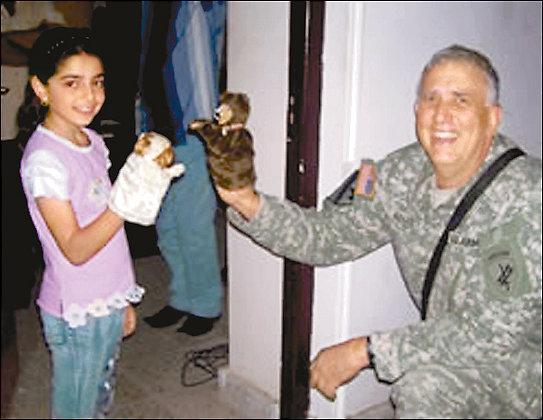
'The reaction was immediate when Army 1st Sgt. Bruce L. Reges strode into the classroom in the Baghdad suburb of Baqubah, in the volatile Diyala province.
At 6-foot-5 and wearing full body armor, Reges, 57, looked fearsome to the schoolchildren. Outside, two Stryker armored vehicles blocked the street. A heavily armed security detail was checking out the roof and other classrooms.
Reges is assigned to an Army civil affairs unit out of Fort Bragg, N.C., working to reconstruct and support schools, irrigation projects and honey farms in Diyala. The team was visiting the school to assess what could be done to help, but the young students were terrified.
"Two of the girls started to cry and escape somehow, and the teacher had to calm them down and tell them that we were there to help them, not to hurt them," Reges recalled. "It was emotionally tough for me to see a child so traumatized by U.S. soldiers that they reacted that way."'
You can guess at the rest of the article- an email to his mom, the inevitable shipment of handpuppets assembled by concerned mothers in Reston, Louisiana and now Civl Affairs soldiers in Afghanistan and Iraq are not to be found without a 'puppet in their pocket', so to speak. As with the best things in life, you can donoate money via PayPal on the website (20 USD = 12 soft puppets), in addition to enjoying photos of thoroughly softened US troops in body armor, wrap-around sunglasses and hand puppets... Other armed forces can seemingly request their own puppets with a simple mail to peacethrupuppets@aol.com.
SOMALIA: Call for agencies to scale up aid operations in capital
UN official makes the call for aid agencies to step up their activities in Somalia, taking advantage of military escorts and protected compounds in Somalia:
'A senior UN official has urged humanitarian agencies to take advantage of security provided by African Union troops in Mogadishu to improve the delivery of aid to tens of thousands of displaced people camped in surrounding areas.
"Response [to the crisis] has not been adequate because of difficulties of access and too many security incidents," Eric Laroche, the UN Resident and Humanitarian Coordinator for Somalia, said on 2 August, a day after a visit to Mogadishu.
Aid agencies should be mobilised to scale up their operations in the Somali capital, he said, adding that this would help get relief supplies both to the city and the surrounding areas.
He said the availability of African Union security escorts facilitated his visit to Mogadishu and the Afgoye.
"We are starting to have access and we need to use it," Laroche said. "If we can operate from Mogadishu, we can reach more people."'
Thursday, August 02, 2007
AFRICOM: A Wolf in Sheep's Clothing?
Refugees International was invited to testify before the Subcommittee on African Affairs, Committee on Foreign Relations. They have posted the complete testimony entitled AFRICOM: A Wolf in Sheep's Clothing here. Have cut a few clips from the presentation, Mark Malan doesn't waste many words on niceties and gives a comprehensive view of how AFRICOM risks undermining US (and more globally, NGO) interests in Africa:
'In some parts of the world, like Iraq and Afghanistan, the face of US foreign policy is clearly a military one. In Africa, the DoD appears to be putting a civilian mask on the face of a combatant command, with its marketing pitch for AFRICOM. This disingenuous strategy is not working. The veneer of the mask is simply too thin, and attempts to patch the holes that have emerged—by telling us “what AFRICOM is not about” and re-emphasizing a humanitarian and developmental role for the US military in Africa—simply make the face of US foreign policy much shadier....
There is much sense in the argument for inter-agency cooperation; what does not make sense is linking this to a combatant command. According to one of Africa’s leading security analysts, AFRICOM should be orientated to an appropriate and clearly delineated role, with non-military issues kept outside of its grasp: “The much-vaunted inter-agency staff to be included in AFRICOM should be seen for what it is—the further co-option and subjugation of US foreign and development policy to a neocolonial agenda which is inimical to Africa and ironically, to the US itself.”
...The main concern of operational NGOs is that AFRICOM will increase the trend towards the militarization of humanitarian action, which raises fundamental concerns about the purpose of such assistance. Security objectives envisioned in the short term can run at cross purposes to the longer-term vision of creating stable and sustainable institutions that are accountable and responsive to the needs and aspirations of all segments of the population. Such concerns are amplified by the way AFRICOM is being presented as a tool for integrating US military, political, and humanitarian objectives under a unified military command.'
Malan's conclusions are good ones: he proposes that AFRICOM limit its purely extra-miliary role fo defence sector reform and support to the building o African peacekeeping and Standby Force capacity- already a significant workload.
Wednesday, August 01, 2007
Haiti- UN Peacekeeping Force Evolving to a Policing Role
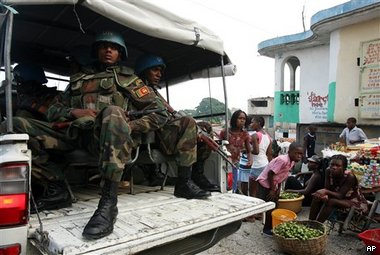
In the lead-up to the UN Secretary General's visit, Haiti is getting some long-merited attention. This AP article takes a balanced look at the challenges facing peacekeeping and peacebuilding in the Haitian state.
Haiti is in a transitional phase, where it is out of immediate crisis, but where, 'The senior U.N. envoy to Haiti says it is too soon for the U.N. to consider withdrawing its 8,800-strong, Brazil-led peacekeeping force, noting past failed attempts to help the country... "An early withdrawal right now would be a big mistake, 'Big' with a capital letter," Edmond Mulet said in a recent interview with The Associated Press. "This is a time to hold on, to make this work this time."'
The challenge is that UN military peacekeepers are obliged to undertake what is essentially a policing function. '... the U.N. mission eventually hopes to use more civilian police than soldiers but is hampered by a world shortage of trained, French-speaking officers... The peacekeepers provide more than 80 percent of Haiti's security needs, but the government is working to eventually take over that responsibility. The national police academy is pumping out hundreds of recruits, trying bolster the nation's small police force of 6,000.'
Chronic poverty and gangs, drug-traffickers still pose a threat to real peace and stability in Haiti, with official suggesting that a UN force will be need until President Preval's term ends in 2011.
Resource- Guidelines for Relations Between US Armed Forces and Non-Governmental Humanitarian Organizations
The United States Institute of Peace launched their Guidelines for Relations Between US Armed Forces and Non-Governmental Humanitarian Organizations on 24 July 2007.
Have pasted in the broad recommendations for armed forces and humanitarian agencies. Taken out of context, it might look a bit simplistic. There's much more in the guidelines, and the processes aspect is particularly well done. One can only guess at how difficult it was in finding 'lowest common denominators' for such a diverse audience. One can quickly find some issues of contention, such as: 'In situations in which there is no actor to servea as a bridge, a US military Civil Affairs cell could serve as a temporary point-of-contact between NGHOs and other elements of the US Armed Forces.' What about OCHA's CMCS?
To be seen how US stakeholders will implement this- and who will enforce it?
'On July 24, 2007, leaders of the U.S. military and NGO community celebrated a promising moment for civil-military relations in peace operations: the rollout of Guidelines that will serve as “rules of the road” for how the two entities operate in hostile environments.
Facilitated by the U.S. Institute of Peace, the Guidelines seek to mitigate frictions between military and NGO personnel over the preservation of humanitarian space in places like Afghanistan and Iraq. Principles in the Guidelines include ensuring that military personnel wear uniforms when conducting relief activities to avoid being mistaken for nongovernmental humanitarian organization representatives. Conversely, it recommends that humanitarian relief personnel avoid traveling in U.S. Armed Forces vehicles with the exception of liaison personnel to the extent practical.
The heads of both the U.S. military and InterAction (an umbrella organization for U.S. NGOs) have endorsed the Guidelines and will be disseminating them throughout their organizations. Two years in the making, the effort represents “a desire from both sides to move beyond polemics to proactive problem solving,” said Jeb Nadaner, Deputy Assistant Secretary of Defense for Stability Operations at the Pentagon. NGO leaders likewise expressed optimism at the potential for change. “We do not want to understate the importance of this document for us,” said Sam Worthington, InterAction President and CEO. “We believe that these guidelines will serve a purpose beyond U.S. NGOs to our global partners.”
The initiative was launched in March 2005 when Amb. Carlos Pascual, Coordinator for Reconstruction and Stabilization at the U.S. State Department, asked the Institute to establish a Working Group on Civil-Military Relations in Non-permissive Environments. What began as a dialogue between military and NGO leaders has resulted in a pioneering effort upon which both sides hope to expand. Military and NGO leaders intend to promulgate the Guidelines throughout their communities via media and education channels: NGOs will publish the Guidelines in their newsletters and literature; the military will incorporate the Guidelines into joint military doctrine publications. The next challenge lies in implementing the Guidelines in the field and creating a monitoring mechanism by which the Guidelines can be continuously tested and revised.
For the U.S. Armed Forces, the following guidelines should be observed consistent with military force protection, mission accomplishment, and operational requirements:
1. When conducting relief activities, military personnel should wear uniforms or other distinctive clothing to avoid being mis taken for NGHO representatives. U.S. Armed Forces personnel and units should not display NGHO logos on any military cloth ing, vehicles, or equipment. This does not preclude the appro priate use of symbols recognized under the law of war, such as a red cross, when appropriate. U.S. Armed Forces may use such symbols on military clothing, vehicles, and equipment in appropriate situations.
2. Visits by U.S. Armed Forces personnel to NGHO sites should be by prior arrangement.
3. U.S. Armed Forces should respect NGHO views on the bearing of arms within NGHO sites.
4. U.S. Armed Forces should give NGHOs the option of meeting with U.S. Armed Forces personnel outside military installations for information exchanges.
5. U.S. Armed Forces should not describe NGHOs as “force mul tipliers” or “partners” of the military, or in any other fashion.
6. U.S. Armed Forces personnel and units should avoid interfer ing with NGHO relief efforts directed toward segments of the civilian population that the military may regard as unfriendly.
7. U.S. Armed Forces personnel and units should respect the de sire of NGHOs not to serve as implementing partners for the military in conducting relief activities. However, individual NGOs may seek to cooperate with the military, in which case such cooperation will be carried out with due regard to avoid ing compromise of the security, safety, and independence of the NGHO community at large, NGHO representatives, or public perceptions of their independence.
For NGHOs, the following guidelines should be observed:
1. NGHO personnel should not wear military-style clothing. This is not meant to preclude NGHO personnel from wearing protec tive gear, such as helmets and protective vests, provided that such items are distinguishable in color/appearance from U.S. Armed Forces issue items.
2. NGHO travel in U.S. Armed Forces vehicles should be limited to liaison personnel to the extent practical.
3. NGHOs should not have facilities co-located with facilities in habited by U.S. Armed Forces personnel.
4. NGHOs should use their own logos on clothing, vehicles, and buildings when security conditions permit.
5. NGHO personnel’s visits to military facilities/sites should be by prior arrangement.
6. Except for liaison arrangements detailed in the sections that follow, NGHOs should minimize their activities at military bases and with U.S. Armed Forces personnel of a nature that might compromise their independence.
7. NGHOs may, as a last resort, request military protection for convoys delivering humanitarian assistance, take advantage of essential logistics support available only from the military, or accept evacuation assistance for medical treatment or to evacuate from a hostile environment. Provision of such mili tary support to NGHOs rests solely within the discretion of the military forces and will not be undertaken if it interferes with higher priority military activities. Support generally will be provided on a reimbursable basis in accordance with appli cable U.S. law.'
Monday, July 30, 2007
Afghanistan: The World's Worst Suicide Bombers?
Our thanks to TIME for uncovering an excellent essay that asks whether, statistically speaking, the Afghans are not the world's worst suicide bombers?
An excerpt from the essay shows the science and helps us understand there is more than just some black humour at play here:
'Missing the Target
An analysis of the attacks carried out in the last two years reveals a curious fact. In 43% of the bombings conducted last year and in 26 of the 57 bombings traced in this study up to June 15, the only death caused by the bombing was that of the bomber himself. Astoundingly, approximately 90 suicide bombers in this two year period succeeded in killing only themselves. This number exceeds 100 when you factor in those who succeeded in killing only one person in addition to themselves. There was one period in the spring of 2006 (February 20 to June 21) when a stunning 26 of the 36 suicide bombers in Afghanistan (72%) only killed themselves. This puts the kill average for Afghan suicide bombers far below that of suicide bombers in other theaters of action in the area (Israel, Chechnya, Iraq and the Kurdish areas of Turkey). Such unusual bomber-to-victim death statistics are, of course, heartening for both coalition troops—who have described the Afghan suicide bombers as "amateurs"—and the Afghan people—who are usually the victims of the clumsy bombings.
These statistics also represent a uniquely Afghan phenomenon that warrants investigation. In the first portion of this study, it was demonstrated that a part of the reason for this low kill ratio lies in the Taliban's unique targeting sets (Terrorism Monitor, March 1). As Pashtuns with a strong code (Pashtunwali) that glorifies acts of martial valor and badal (revenge), the Afghan suicide bombers are more prone to hit "hard" military targets than callously obliterate innocent civilians in the Iraqi fashion. On the rare occasions where there have been high casualty bombings of Afghan civilians, they tend to have been carried out by Arab al-Qaeda bombers.'
NATO, Afghanistan- Smaller bombs, fewer civilian casualties?
Seems the attempt to win good press around respecting IHL in Afghanistan isn't getting very far. Now the calculus seems to be, 'smaller bombs, fewer casualties'.
'NATO plans more restrained tactics in its war against Taliban guerrillas, including smaller bomb loads on aircraft, in an effort to cut civilian casualties, the alliance's head said in an interview published on Monday.
The Financial Times said NATO Secretary-General Jaap de Hoop Scheffer had acknowledged that mounting Afghan civilian casualties had hurt support for NATO, and had said commanders had ordered troops to hold off on attacks in some situations where civilians were at risk.
"We realise that, if we cannot neutralise our enemy today without harming civilians, our enemy will give us the opportunity tomorrow," the paper quoted him as saying in an interview.
"If that means going after the Taliban not on Wednesday but on Thursday, we will get him then."
De Hoop Scheffer said that while it was impossible to avoid civilian casualties entirely, NATO was "working with weapons load on aircraft to reduce collateral damage".
More than 330 civilians have been killed in operations involving foreign troops in Afghanistan this year, according to Afghan officials and Western aid workers.
Afghan President Hamid Karzai has warned that the casualties could damage support for the presence of foreign forces in his country.
The Financial Times quoted a NATO diplomat as saying that using smaller bombs could cut civilian casualties. "If you put a 250 kg bomb rather than a 500 kg bomb on the plane, that could make a huge amount of difference," the unnamed diplomat said.
The paper quoted other NATO officials as saying the alliance would increasingly leave house-to-house searches to the Afghan army to avoid confrontations.
Seems to pick up on our earlier comments around the same subject. The Guardian is following the same story with a bit more depth.
Civil Affairs- YouTube
Credit where credit is due- Small Wars Journal had a selection of YouTube clips on Civil Affairs in action in the field. If you look under the 'Related' tab on the YouTube site, you can find a substantial amount of other similar videos.
Friday, July 27, 2007
Training- NATO Basic CIMIC Course
NATO is offering a Basic CIMIC Course in Italy, open to civilians as well as military staff. Having taken a similar NATO course, can highly recommend it to those in IOs//NGOs to get a better idea of how the military sees its role in undertaking traditionally civilian tasks. They are kind enough to heavily subsidize the course for participants.
IraqSlogger: Fighting an Insurgency With F-16s
IraqSlogger has a great post entitled 'Fighting an Insurgency with F-16s: Need to Minimize Collateral Damage Leads to Tough Choices'. It gives some real insight on how limiting collateral damages and respecting IHL can in fact 'complicate' war-fighting. Have copied out the text from Michael Yon's observatino of watching an F-16 and a Shadow circling a house where an insurgent ran after shooting a gun at US forces:
'The F-16 and Shadow both beamed down live images of the house where the terrorists had hidden after firing on US forces. Now was option time. Which weapon to use? There were so many choices: mortars, missiles, and cannons of various sorts, among others. With the enemy hiding in the building, an F-16 and a Shadow orbiting in the black above, both peering down on thermal mode, the Battle Captain asked the Air Force experts,(the JTACs) what weapons the F-16 was carrying. As a JTAC started ticking off a long list, I was thinking, “How in the world to do those little jets carry all that?” In fact, I believe they were reading down the list for two jets flying in the same package. They carry a mixture of weapons cross loaded between the jets so that they will have the black magic needed for a likely situation.
In addition to the F-16’s bombs of various sorts, there was the MLRS rocket system dozens of miles away that had been precisely punching rockets through Baqubah rooftops for days. The MLRS had been flattening buildings that were rigged as giant bombs. There were the 155mm cannons on this base that can hit and flatten anything in Baqubah and beyond. The Apache helicopters could spin up with their rockets and cannons. Infantrymen could just roll in. Or tanks. Or Bradleys. Or Strykers. Even Humvees. The idea was to use just the amount of force to kill the enemy fighters, but leave everyone in the surrounds unscathed, if possible. If that was not possible, often they would simply not fire, but other times they would. Judgment call.
By about 0400, the Battle Captain had decided to use 120mm mortars. As a reference, if a 120mm were to land on a car, the car would be obliterated, but a 120mm would not be enough to flatten a decent house. The first round was shot, and the explosion left a black-hot thermal cloud on the two video screens. The impact looked hundreds of yards off target. Successive shots did not hone it, but got worse. It was starting to look like a turkey shoot, so the Battle Captain ordered the mortars to cease fire and refused to consider using the mortars again for that mission.
They discussed dropping a JDAM (a special type of bomb from one of the jets), but were worried about CD (collateral damage). The idea of a strafe run came up but that would likely cause even more CD, and so that idea was also nixed. Things sure look different from the comfort and safety of the TOC, even though the TOC is still so close to the battlefield that often the explosions can be felt from there. Still it’s like being a thousand miles away by comparison to being with the infantry in the dark and danger. (TOCs do get hit by rockets or mortars sometimes.)
The MLRS rockets and JDAMs were good enough to actually hit buried IEDs, and could easily take the house. The F-16 was carrying at least one concrete bomb—literally, just a bomb made from concrete, like throwing boulders at people—but a JTAC said, “We are not dropping a concrete bomb.” For some reason he didn’t want to just throw a rock. Personally, I don’t like to see bombs explode because it means we are still at war. But a strange feeling came over me: I wanted to see the F-16 drop a boulder on the people that shot at our guys. I knew if the rock hit them, the neighbors would be fine.
While they were discussing how best to kill the guys, the F-16 was running low on fuel. The jets flew low in a show of force and rumbled away. I walked to breakfast at 0515 while they were still plotting. I have no idea if they killed them and if they did, what method they finally settled on. But I know that when there is that kind of careful deliberation in the TOC, combined with excellent combat soldiers on the streets, (the low number of civilian casualties) that otherwise would seem unbelievable are believable.'
Movie Review: No End in Sight
Mountainrunner has a great post on the film No End in Sight, we post it below:
Movie Review: No End in Sight: "

Charles Ferguson has made a strong picture that will likely get strong traction by not playing on emotion but telling it like it was. Through 3,000 pages of interview transcripts over'70 interviews, plus 40 more in Iraq, he creates a riveting narrative with smart interviews spliced with press conference footage'to make this film. The result is some pretty incredible, and damning,'statements from former Deputy Secretary of State Richard Armitage, Ambassador Barbara Bodine, General Jay Garner, Col. Lawrence Wilkerson, Col. Paul Hughes, Nir Rosen, George Packer and others. Splicing in news conferences from Donald Rumsfeld, Richard Cheney, President George W. Bush, and others helped tell the story of OHRA, CPA, and after. Needless to say, Rumsfeld plays a significant role in the movie through his press conferences.
If you'read Imperial Life in the Emerald City,'you already have an idea the charlie foxtrot the movie describes. If you read Packer's The Assassins' Gate, you already have an idea of what the movie's about, especially since it was over dinner with Packer in 2004 that Ferguson decided he needed to make this film.
The movie begins with the post-9/11 attempts to link Saddam with al-Qaeda, through'Shinseki's testimony,'the selection of Chalabi, the creation of OHRA, then the CPA, Bremer's four fateful orders (including de-Baathification and disbanding the military), but stops before the Golden Mosque Bombing. By then, as Ferguson said in the panel discussion after the movie (also on the panel were Greg Treverton from RAND and Nicholas Cull from USC), the die had been cast and the purpose of the movie fulfilled: highlighting the'mismanagement, the ignoring of sage and local advice, and the venality of the policy makers that created the environment of tinder the Golden Mosque bombing ignited.
Because of its strategic focus, there are areas the movie does not delve into, such as the private military contractor debate, save some brief comments and the showing of part of the Aegis Trophy Video. It also does not delve too far into the privatization of the rebuilding, save a few penetrating examples such as Marines working with local Iraqi's to build a frontier fort in 5 months for $200,000 while Parson's required over 17 months and spent well over $1 million more. But in truth, it doesn't need to get into these specifics as it instead focuses on a strategic leadership that created its own reality.
Speaking with Ferguson after the movie, it seems the distributor will put on the website interviews not included in the movie, such one with Larry Diamond. But don't hold your breath, it seems those won't be online for a long time, possibly a year.
This is a must see movie even if you have been paying attention. This is not Michael Moore emotional'hyperbole but a factual account of failed leadership. If you haven't been paying attention, which is probably not many readers of this blog, Ferguson creates an easily digested synopsis of how America managed to create an insurgency in Iraq.'''
Iraq- PRTs Help Iraqis with Rule of Law and Connecting With Central Government
Good glimpse of how the PRT concept has evolved in Iraq- whether it's evolved in theory or reality is difficult to ascertain. The notions are interesting, particularly the concept that PRTs have become a 'bridge-builder' that accompanies provincial authorities in improving rule of law activities.
'About 70 percent of the $506 million Iraqi reconstruction relief fund budget has been spent to build or renovate courthouses, corrections facilities, police and fire stations and training academies, a witness protection facility, and other related structures, Wolf said.'
The article also includes a video of a press conference on the subject, link is found in the text.
A second press release applauds the 25 PRTs as showing local authorities how to work more effectively with the central government.
'There is at least one PRT in each of Iraq’s 18 provinces, Reeker said, noting that Baghdad has several PRTs. Many PRT specialists come from the National Guard or reserves. These organizations help establish stability in Iraq by building capacity in areas such as government, economics, rule of law, services, infrastructure and public diplomacy.
The 25 PRTs in Iraq have more than doubled in number from the 10 that existed in April, as part of the president’s new way-forward strategy, Reeker said. The PRT effort is a joint coalition endeavor, he pointed out, noting that British-, Italian- and Korean-led PRTs also are working in Iraq.'
Interesting to see the evolution of the civil-military link of the Coalition surge in Iraq, months ago it remained merely vague concepts of how the civilian branch would complement the military aspect.
Monday, July 23, 2007
Afghanistan- Kites for Hearts and Minds?
Polish troops serving with ISAF in Afghanistan have started distributing ISAF-logoed kites to poor children in Ghazni province.
'With big grins and excited chattering, the children jumped up and down shouting, "Patang! Patang!" (the Pashto word for kite.) Soon the sky had several of the yellow, green and red kites with International Security Assitance Forces logos flying, much to the delight of the children dancing around below.
"These kites are so much fun," said Mahmad-Amid Hahn, a 12-year- old boy, as he made whooping sounds while his kite dipped and swerved in the air. "The Taliban would never give us these things." For the children who had never seen a kite before, some of the Polish soldiers stepped in to assist, unfolding the kites and showing them how to take off with a running start to get it airborne.'
One has to wonder if the ISAF-flags won't be yet another magnet for Taliban forces looking to see who has colluded with foreign forces, that violence will provoke more visits by foreign troops... the cycle of accusations of collusion will continue.
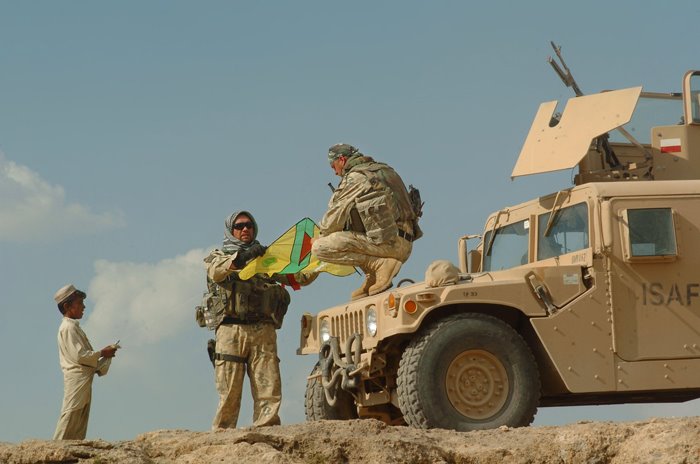
'With big grins and excited chattering, the children jumped up and down shouting, "Patang! Patang!" (the Pashto word for kite.) Soon the sky had several of the yellow, green and red kites with International Security Assitance Forces logos flying, much to the delight of the children dancing around below.
"These kites are so much fun," said Mahmad-Amid Hahn, a 12-year- old boy, as he made whooping sounds while his kite dipped and swerved in the air. "The Taliban would never give us these things." For the children who had never seen a kite before, some of the Polish soldiers stepped in to assist, unfolding the kites and showing them how to take off with a running start to get it airborne.'
One has to wonder if the ISAF-flags won't be yet another magnet for Taliban forces looking to see who has colluded with foreign forces, that violence will provoke more visits by foreign troops... the cycle of accusations of collusion will continue.
Saturday, July 21, 2007
Training Coaching US troops on Iraqi culture
As part of their pre-deployment training, US armed forces are enjoying increasingly sophisticated immersion exercises. BBC has a great article on "Mojave Viper", a new pre-deployment cultural training course established to prepare US forces for "irregular warfare" in Iraq. We've posted on these elaborate training exercises in an earlier post, with particular focus on the difficulties in finding appropriate role players.
'Barack Salmoni, deputy director of the centre, says the focus reflects a 2006 military assessment that "developing broader linguistic capability and cultural understanding is critical to prevail in the long war and to meet 21st century challenges".
During the six- to eight-week course, the marines learn about 200 basic words in Arabic - enough to allow them to deal with local people on the ground in Iraq...
But, Mr Salmoni says, the US military became aware of the need to give the troops' mission in Iraq "civil and cultural dimensions" when the Bush administration decided to establish a new Iraqi government.
The US military is trying to teach troops how to build trust with Iraqis.
"We noticed that we had the military tactics but lacked the knowledge of Iraqi laws and traditions so we needed to learn about them all. I am afraid we didn't anticipate all these bifurcations."
Since January, newly established PRTs (Provincial Reconstruction Teams) have increased their operations in Iraqi cities.
The military is becoming more involved in "civil affairs", which entails helping to build local infrastructure.'

Iraq- Pentagon tries to learn from Madison Ave. Washington Post - MSNBC.com
'In the advertising world, brand identity is everything. Volvo means safety. Colgate means clean. IPod means cool. But since the U.S. military invaded Iraq in 2003, its "show of force" brand has proved to have limited appeal to Iraqi consumers, according to a recent study commissioned by the U.S. military.'
This is the observation of a Rand Corp report commissioned by the US Joint Forces Command. There seems to be some dry humor in the report, we particularly liked the 'We will help you' brand- wasn't that the underlying rhetoric back in 2003?:
'Helmus and his co-authors concluded that the "force" brand, which the United States peddled for the first few years of the occupation, was doomed from the start and has lost ground to enemies' competing brands. While not abandoning the more aggressive elements of warfare, the report suggested, a more attractive brand for the Iraqi people might have been "We will help you." That is what President Bush's new Iraq strategy is striving for as it focuses on establishing a protective U.S. troop presence in Baghdad neighborhoods, training Iraq's security forces, and encouraging the central and local governments to take the lead in making things better.'
This video must be part of the 'show of force' brand that apparently hasn't worked....
UN Investigations of various abuses by peacekeeping troops
The United Nations is investigating allegations of widespread sexual abuse and exploitation by peacekeepers serving in Ivory Coast. A UN statement said the latest allegations had been uncovered by an internal inquiry, and a full investigation was now under way.
While the accused contingent has not been named publicly, apparently the entire unit has been confined to base while the investigation continues.
In 2007 alone, there have been investigations into sexual abuse claims in the Sudan, Liberia, Haiti and Ivory Coast, and reports that sexual abuse allegations have doubled over 2006.
This new investigation follows on the heels of an ongoing probe of Indian peacekeepers stationed in eastern DRC, who allegedly were trafficking in gold and guns. The accusations suggested that the Indians were trading food rations for gold with Rwandan rebels.
Update: AlertNet stated the nationality of the suspended peacekeeping troops in Ivory Coast is Moroccan.
Friday, July 20, 2007
Iraq- Danish army evacuates 200 Iraqis
BBC reports that the Danish military has secretly airlifted out 200 Iraqis who had been employed as aides and translators to Danish armed forces serving in Iraq. This is a pleasant surprise, to see armed forces at once rewarding the service of their national staff, while recognizing that such service could put same staff at mortal risk. One only assumes that the families of such staff were also evacuated. The Danish contingent will soon leave Iraq, ending Denmark's contribution to MNFI.
This action stands in stark contrast to the US and UK, who have been- to be polite- 'reluctant' to carry out similar protection of staff whose employment with their forces have put their lives at risk.
Update: a more recent article has the top US diplomat in Iraq proposing to grant immigrant visas to the US to all Iraqis working with the Americans.
Afghanistan- Canadian CIMIC provides village medical outreach
Video report by Canadian Armed Forces Army News, profiling the 'village medical outreach' program of the Canadian Contingent in southern Afghanistan. While the report highlights the medical support being offered to Afghan women, the whole exercise looks like a heavily militarized operation. The soldiers interviewed confirm this view, explaining that they can do more- and presumably more effective- humanitarian operations since they have been obliged to add more robust force protection.
Jobs- UN Humanitarian Civil-Military Coordination Officer
UNDP is recruiting for a UN CMCoord officer based in Kabul. It's a lengthy ad, one that situates the position at a strategic level within UNAMA and at the intersection of the contentious civil-military relationship in Afghanistan.
Of note are the qualifications for the position- a dream candidate with a solid military background, coupled with some years of pure, civilian humanitarian experience:
'Education: Masters' Degree preferably in political or social science, international studies, public administration, economics, or the equivalent combination of education and experience in related area. (civil-military coordination).
Minimum of 7 years of progressively responsible professional experience in humanitarian affairs, civil-military coordination in humanitarian operations, emergency preparedness, crisis/emergency relief management, or other related area, including at least 3 years of field experience in complex emergencies, including humanitarian efforts.
Extensive experience in working with humanitarian organizations and military forces;
Significant experience as a UN CMCoord Officer and/or completed UN training in civil–military coordination;
Thorough knowledge of international laws of armed conflict (international humanitarian law) and humanitarian principles.'
Thursday, July 19, 2007
Lebanon- Peacekeeping with Hizballah's Help | TIME
TIME has an excellent piece on the challenges facing the relatively successful UNIFIL mission in Lebanon. The peacekeepers are apparently being forced to 'shake hands with the devil'- in order to improve their force protection, and reduce further threats from yet another metaphoric devil. The suggestion is that UNIFIL is obliged to maintain contacts with Hizbollah, in order to protect themselves from further Al-Qaeda attacks:
'The contingents comprising the peacekeeping force known as UNIFIL have good cause for concern. Last month, six Spanish and Colombian UNIFIL soldiers were killed in a bomb ambush, the deadliest attack against the peacekeeping mission in its 29-year history. In a video message released this week, Al-Qaeda deputy leader Ayman al-Zawahiri hailed the attack as "a response against those invading Crusader forces who were occupying a beloved part of the land of Islam". And, UNIFIL officials fear, given the worsening security situation in Lebanon, there could be more attacks on the way. "The major difficulty we are going to face for sure is this kind of terrorist attack because even if we have no idea yet who could be the perpetrators... another attack can come," Major General Claudio Graziano, UNIFIL's commander, told TIME in an interview at his headquarters in the southern coastal village of Naqoura.'
Whatever contacts may exist between UNIFIL and Hizbollah, there was also another roadside bomb that struck a peacekeeping vehicle, the second such incident in a month.
Wednesday, July 11, 2007
More on AFRICOM
When it rains, it pours- more on AFRICOM:
NYT reports on the announcement of a commander for AFRICOM- pointing out that General William E. Ward is 'the Army's only black four-star general'.
DefenseLink has a more comprehensive press release on the same nomination. DefenseLink now has a dedicated page to AFRICOM.
NYT reports on the announcement of a commander for AFRICOM- pointing out that General William E. Ward is 'the Army's only black four-star general'.
DefenseLink has a more comprehensive press release on the same nomination. DefenseLink now has a dedicated page to AFRICOM.
Tuesday, July 10, 2007
Job- Senior Programme Officer: African Peacebuilding Coordination Programme- ACCORD
The African Centre for the Constructive Resolution of Disputes (ACCORD) is recruiting for the position of Senior Programme Officer: African Peacebuilding Coordination Programme. The following is from their website:
'The African Peacebuilding Coordination Programme seeks to enhance coherence across the peace, security, humanitarian, development and human rights dimensions of African peacebuilding operations. The purpose of the Programme is to improve the planning and coordination dimension of African peacebuilding operations. The Programme will work towards this overall objective through four output areas: (a) Training personnel responsible for planning and coordination and establishing a database of those trained; (b) Refining the training material already developed in the field and developing new training material; (c) Undertaking applied research that can inform policy development and training; and (d) Facilitating policy development aimed at assisting the United Nations (UN), African Union (AU), Regional Mechanisms, Non-governmental Organisations (NGOs) and African Member States to develop and adopt policies and operating procedures that will facilitate the system-wide coordination of peacebuilding operations.
Key Responsibilities:
- Day-to-day implementation of the African Peacebuilding Coordination Programme;
- Planning and conducting activities and training interventions;
- Liaison with donors, training partners and UN and AU Mission personnel;
- Research, analysis and writing;
-Preparing budgets and assuming responsibility for financial management of the Programme;
- Report-writing;
- Representing the Programme at regional and international conferences and meetings;
- Assisting with the strategic planning of the Programme and preparing annual proposals;
- Travel within and beyond the continent to implement the Programme.'
Sunday, July 08, 2007
AFRICOM Update
There's quite a bit being written about AFRICOM, including a few previous posts we've done (also here and here).
- The US Department of State website has a briefing by Ryan Heny, Principal Deputy Under Secretary of Defense for Policy. The transcript gives a good preamble to the raison d'etre of AFRICOM. ''When it comes to the security or the defense part of this, AFRICOM is not meant to fight wars. It is one that is based on building partnership capability and in the areas of security cooperation. The missions that AFRICOM will emphasize are those of humanitarian assistance, civic action, the professionalism of militaries, assistance in border security and maritime security, and again the area of security cooperation and response to natural disasters.' The proposed comand structure is presetned as being a sort of non-linear/de-centralized HQ with 'nodes' spread across Africa.
- The International Relations and Security Network (ISN) has an exhaustive overview of AFRICOM- 'Questioning AFRICOM's intentions'. The piece explains:
'The Pentagon reportedly plans to establish another dozen bases in the region; in Algeria, Senegal, Mali, Mauritania, Niger, Chad, Ghana, Morocco and Tunisia.
But for now, AFRICOM remains an orphan without an African home, with Algeria and Libya rejecting the idea outright, and Morocco being distinctly cool.
The Transition Team will be housed temporarily at the US Army's Kelley Barracks in Stuttgart-Mohringen, Germany until the issue can be resolved. AFRICOM initially will be a sub-unified command, subordinate to EUCOM, also based in Stuttgart, with a projected Initial Operational Capability (IOC) by October 2007. As the Defense Department continues to search for a suitable African host country, high among its concerns is providing for the safety and security of an estimated 500 American personnel and their families who will staff the command.'
- Commentary on a recent WSJ article by UFPPC.
- Also, keep an eye out in September for an upcoming book entitled, 'Beyond Humanitarianism: What You Need to Know About Africa and Why it Matters'. The book will be a compilatoin of recent work by the Council on Foreign Relations and Foreign Affairs.
AFRICOM- North Africa Reluctant to Host U.S. Command
A US delegation visiting north Africa found little interest to host the planned African Command, AFRICOM. Close ally Morocco turned down the offcer, while Algeria and Libya not only refused to host the headquarters, but voiced opposition that neighouring countries host it either.
CIMIC in UN & African Peace Operations Resource: CIMIC in UN & African Peace Operations
The following is an excellent resource that I have been meaning to post for some time, available on the website of the African Centre for the Constructive Resolution of Dispotes (ACCORD):
'This CIMIC in UN & African Peace Operations Manual is a product of all the partners of the African Civil-Military Coordination (ACMC) Programme. It was jointly produced by: the Peace Support Training Center (PSTC)/ German Technical Cooperation (GTZ) Agency in Nairobi, Kenya; the Kofi Annan International Peacekeeping Training Center (KAIPTC) in Accra, Ghana; the South African National War College (SANWC); and ACCORD.
The ACMC Programme is funded by the Government of Finland. The German Government, through GTZ, supports the participation of the PSTC in the ACMC Programme.'
The manual is an excellent resource, including insructor tools, exercises, policy documents and videos (the bibliography alone is a good resource, includes descriptions of the videos). Further details on the manual, including contacts for the editor are found on the website.
Insight: Threats keep U.S. diplomats bottled up
The Columbus Dispatch ran provides insight on the direct and indirect effects of security restrictions on US diplomats.
Responding to threats abroad, US diplomats have quite evidently been obliged to adopt meaures to mitigate the risks, ranging from severe travel restrictions, to bunkering themselves into 'fortress-like compounds'. These measures affect embassies and consuls in 28 countries currently. To give soe scope to the restrictions: mission where employees receive danger pay has soared from 2 to 26 since the 1980's. Non-family missions, from 10 to 21.
These changes are having a clear 'operational impact': '"Security concerns have forced embassies to close publicly accessible facilities and curtail certain public outreach efforts, sending the unintended message that the United States is unapproachable," it said in the little-publicized April 26 report.
An internal review by the State Department in 2005 concluded that security concerns "often require a low-profile approach during events, programs or other situations, which, in happier times, would have been able to generate considerable good will for the United States."'
The indirect effects continue beyond negative perceptions of the US government- it is manifest primarily in the difficulty to recruit new staff, or to find staff willing to serve in higher-risk areas.
These insights can be constrasted with the realities of a separate article announcing the the re-opening of a US Diplomatic Unit in Guinea-Bissau, West Africa. There the intersection of internal security concerns and national security interests is better expressed: 'With its lawless, island-dotted Atlantic shoreline, Guinea-Bissau has become a major hub for smuggled Colombian cocaine on its way to lucrative markets in Europe and elsewhere, prompting calls for international action to stem the trade.... The instability, along with high-level corruption, makes it fertile ground for drugs and gangs, security experts say.'
Thanks to the Security Management Initiative for the post.
Who polices the United Nations?
Our friends over at the blog Sudan: The Passion of the Present cross-posted an interesting article: Who polices the United Nations? by Toni Oyry.
Centred on the MONUC mission in the Democratic Republic of the Congo, the article gives an overview of a string of incidents that have gone without serious investigation or action by the UN. The conclusion is foregone:
'The Chatham House debate offered alarming insights into the United Nations, where internal politics are preventing effective criminal investigations into personnel operating in peacekeeping missions.'
Iraq - Engineers build new Female Training Police Station
Short piece on the Operation Iraqi Freedom website:
“The Corps of Engineers is building a new Female Training Police Station (FTPS) in An Najaf Province,” said U.S. Army Lt. Col. Jan Carter, senior project manager, Gulf Region South (GRS), Multi-National Security Transition Command-Iraq (MNSTC-I). “It is a three-story facility with offices, jail cells, an armory, a communications room, guard towers, sleeping quarters and a courtyard for training new female police officers.”
“The objective for building the $134,000 female training police station is to help advise, organize and train Iraqi female officers on basic infantry tactics from squad to battalion level to further enhance the Iraqi police stations,” Carter said.

Wednesday, July 04, 2007
Resource- International Policing Guidelines
A new pubication of interest to readers: 'Peace Support Operations: Information and guidance for UK police personnel'. These guidelines are a resource on specific aspects of policing in PSOs, and include case studies and best practices for users.
'In addition to explaining why the UK makes a contribution to PSOs, the Guidelines outline, among other things, international policing principles, the legal context in which such missions operate, the kinds of tasks UK officers might perform, and the standards of behaviour expected of them. There is nothing similar available either nationally or internationally. The handbook will reinforce officers' pre-deployment training and act as an aide-memoire whilst on mission.'
The UK Internatinal Policing website which hosts the document is also an excellent resource.
Monday, July 02, 2007
Jobs- Humanitarian Operations Advisor, Center of Excellence in Disaster Management and Humanitarian Assistance
The Center of Excellence in Disaster Management and Humanitarian Assistance in Honolulu is recruiting for the position of Humanitarian Operations Advisor.
'The Humanitarian Operations Advisor would support programs at the Hawaii-based Center for Excellence in Disaster Management and Humanitarian Assistance (http://coe-dmha.org), specifically in the Humanitarian Affairs and Practice Unit. The unit provides the Center with resident expertise on the conduct of civilian humanitarian operations and access to an extended network of experienced humanitarian practitioners that enables the integration of current humanitarian practice and emerging trends in the international relief community into civil-military training and education programs. Working with key civilian partners, the unit also seeks to identify new requirements that meet the education and training needs of the international humanitarian community.'
'The Humanitarian Operations Advisor would support programs at the Hawaii-based Center for Excellence in Disaster Management and Humanitarian Assistance (http://coe-dmha.org), specifically in the Humanitarian Affairs and Practice Unit. The unit provides the Center with resident expertise on the conduct of civilian humanitarian operations and access to an extended network of experienced humanitarian practitioners that enables the integration of current humanitarian practice and emerging trends in the international relief community into civil-military training and education programs. Working with key civilian partners, the unit also seeks to identify new requirements that meet the education and training needs of the international humanitarian community.'
Recruiting Ads for Armed Forces- ComingAnarchy.com
The ComingAnarchy has a great post with some embedded recruiting ads by various armed forces- have clipped one below, but the Russian and Ukranian examples deserve a watch as well.
Sunday, July 01, 2007
Kofi Annan Launches Global Humanitarian Forum
A formal announcement has finally been made concering the Global Humanitarian Forum, a new organization created by from UN Secretary General Kofi Annan with support from the Swiss Government. Based in Geneva, the Forum will help people in poor countries play a greater role in finding solutions to their developmental and humanitarian problems.
While the former SG is vague on precisely what the organization will do, he does provide one precise example of what they might do:
'For example, he says the United Nations and other members of the humanitarian community would not have been able to deal with natural disasters such as the Indian Ocean tsunami and the earthquake in Kashmir without the help of the military.
"If the military had not come in and provided heavy logistical support … many more people would have died as we would not have been able to get to them," said the former U.N. chief. "And, so the military have become important players in humanitarian relief. And, yet, when we get together to discuss humanitarian issues, they are not around, they are not at the table."
"I think we would want to bring them to the table to discuss with humanitarian actors how we could cooperate. And, from my own previous experience, I know it is not an easy relationship," he added.
Mr. Annan says he recognizes private aid groups are not comfortable working with the military. He says he hopes the Forum can improve this relationship.'
UN decides to split Department of Peacekeeping Operations
The United Nations General Assembly decided by consensus to split the Department of Peacekeeping Operations (DPKO), creating a new Department of Field Support to look after management and logistic under the supervision of an Under-Secretary-General. The Peacekeeping Department will now concentrate on operations and will also be headed by an Under-Secretary-General.
'...Ban sees it [the splitting of DPKO] as an important part of the reforms process and asserts that it would increase the overall efficiency at a time when the world body is being asked to take on more and more responsibility of peacekeeping.'
'...Ban sees it [the splitting of DPKO] as an important part of the reforms process and asserts that it would increase the overall efficiency at a time when the world body is being asked to take on more and more responsibility of peacekeeping.'
Sunday, June 24, 2007
Incident- 4 killed in attack on UNIFIL patrol in south Lebanon
 Four Spanish UN peacekeepers were killed and several others wounded in an attack on a UNIFIL patrol in southern Lebanon on Sunday afternoon. It was unclear whether it was a deliberate attack, or whether the partol had run over a mine or unexploded ordinance from last year's war.
Update: further articles on 25 June confirmed that 5 were killed, and strong suspicions that it was a targeted car bomb attack. No one has claimed responsibility for the attack, which took place in a region under the effective control of Hezbollah.
Are more Afghan civilians killed more by US and NATO forces than by insurgents?
An earlier posting showed the press campaign that NATO was waging to show that it was taking collateral damage as a serious problem- and that they were making alledged improvements in reducing civilian casualties.
Not surprisingly, there is now a full-blown war of statistics being waged in the press- AP calculates that Coalition and NATO forces have killed more civilians than the Taliban insurgents in 2007 (203 vs. 178 deaths). Others say that the numbers are roughly equal.
Will be curious to see the next round of press statements, particularly following a scathing speech by President Karzai on Saturday.
Friday, June 22, 2007
Public, Private, Non-Profit?- Clear Path International Contracted by DynCorp as part of a US Department of State Contract
The non-profit Clear Path International (CPI) has just received a multi-year contract from DynCorp International to start a landmine survivor assistance program in Afghanistan on behalf of the U.S. Department of State. This is an excellent illustration of how complex working relationships have become in Afghansitan. The press release makes great pains to delineated the particular identities and characters of each group:
- Since 2000, Clear Path International has assisted nearly 4,000 survivors of accidental landmine and explosive remnants of war incidents in Vietnam, Cambodia and along the Thai-Burma border. It has also sent 65 containers of medical equipment and supplies to 25 countries in Asia, Africa and Latin America.
- The Department of State's Office of Weapons Removal and Abatement is one of the world's largest sponsors of mine clearance, risk reduction education and survivors assistance. It has directly funded Clear Path's programs in Vietnam and Cambodia and some of the organization's public awareness and fundraising efforts in the United States.
- DynCorp International is a U.S-based company that provides support services to military and civilian government institutions in such areas as aviation, infrastructure development, security and logistics.
Are there issues in such a blurred public-private-NGO relationship?
As we post on articles such as 'Under fire, aid workers face life as a soft target', and DynCorp staffers being similarly targeted, it does pose questions as to how some agencies are balancing risks and their presence in a context such as Afghanistan.
French military to transport hundreds of toys for refugees in Chad
On a Friday afternoon, all we can say is 'thank you, France' for giving us such a great article to post:
'A small party of officers and men from the army and air force arrived at Quai Branly Museum near the Eiffel Tower on Thursday and helped staff of the UN refugee agency and the museum to load 35 boxloads of toys onto two trucks for transportation to a military airport in Orleans.
The toys, including dolls, model cars, jigsaw puzzles, teddy bears and even a little bicycle, were contributed by French children under a programme run by UNHCR and the museum, which only opened a year ago. Many of the children were at the museum yesterday to send off the toys.
The precious cargo will be flown to the Chad capital, N'Djamena, aboard an air force transport plane on Monday. The toys will then be handed over to UNHCR staff for distribution in refugee camps to children from Sudan's Darfur region and the Central African Republic (CAR).'
Despite telling a thousand words, the caption for the following photo read:
'A French soldier explains to a young boy how the toys he and his friends have donated will reach refugees in Chad.'
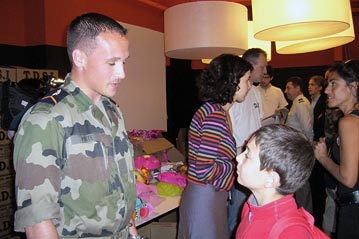
'A small party of officers and men from the army and air force arrived at Quai Branly Museum near the Eiffel Tower on Thursday and helped staff of the UN refugee agency and the museum to load 35 boxloads of toys onto two trucks for transportation to a military airport in Orleans.
The toys, including dolls, model cars, jigsaw puzzles, teddy bears and even a little bicycle, were contributed by French children under a programme run by UNHCR and the museum, which only opened a year ago. Many of the children were at the museum yesterday to send off the toys.
The precious cargo will be flown to the Chad capital, N'Djamena, aboard an air force transport plane on Monday. The toys will then be handed over to UNHCR staff for distribution in refugee camps to children from Sudan's Darfur region and the Central African Republic (CAR).'
Despite telling a thousand words, the caption for the following photo read:
'A French soldier explains to a young boy how the toys he and his friends have donated will reach refugees in Chad.'
Military focuses on development in Africa- CJTF-HOA and AFRICOM | csmonitor.com
CS Monitor has another article on the Horn of Africa CJTF, and how its mixed humanitarian-military mandate is a good model for the evolving AFRICOM structure. There is a continuing stream of articles on AFRICOM (some we have posted on) and also an AFRICOM website.
The article doesn't add much new to the debate. They market the CJTF-HOA in an interesting light:
"CJTF-HOA has served as a test-bed for ideas and concepts, and it has found approaches that work well in several countries on the Horn," says Rear Admiral Robert Moeller, executive director of the AFRICOM Transition Team. "Part of AFRICOM's charter is to be more collaborative, and it's important that our African partners see a consistency in our approach. Whether that's a long-term presence, like CJTF-HOA, or rotational, our engagement needs to be sustained."

Tuesday, June 19, 2007
Navy ship carries hope for the poor
Been a while since we had a post on military involvement in humanitarian activities- odd, considering the spate of such postings globally in the winter season. The USNS Comfort is steaming to the Caribbean and Latin America, with 800 teddy bears and staff (their statistics), on a 12 nation, four-month tour.
The mission of the Comfort was apparently decided by the Commander-in-Chief himself, notably to treat 85,000 people free of charge, and conduct 1,500 surgeries. While the lengthy article highlights the many great deeds that the hospital ship will conduct, it doesn't mention the practical training value that the ship and its 800 member crew will enjoy during their mission.
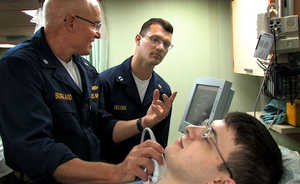
Update: more articles on the USS Comfort- also includes video footage.
The mission of the Comfort was apparently decided by the Commander-in-Chief himself, notably to treat 85,000 people free of charge, and conduct 1,500 surgeries. While the lengthy article highlights the many great deeds that the hospital ship will conduct, it doesn't mention the practical training value that the ship and its 800 member crew will enjoy during their mission.
Update: more articles on the USS Comfort- also includes video footage.
Monday, June 18, 2007
Blast targetting US troops and contractors kills 4 in Afghan capital
Sunday saw another suicide bomber targetting US military personnel and American contract workers travelling by convoy in Kabul. Four civilians were killed in the blast, with one further killed and wounded by a US soldider opening fire after the blast. 'The American soldier in a Humvee "mistakenly" opened fire on the crowd after the suicide attack, killing one civilian and wounding three, said Zalmai Khan, deputy Kabul police chief.'
France begins humanitarian airlift in eastern Chad

France has announced the commencement of a humanitarian airlift in eastern Chad. The announcement is the first gesture by President Sarkozy, but more precisely, the outcome of a visit by the recently nominated Minister of Foreign Affairs, Bernard Kouchner. Kouchner is best known for his posed cameo photos unloading sacks of flour during the Somalia crisis in the early 90's.
Update: WFP welcomed the French contribution, in a press release replete with a picture of a very big plane. 'WFP thanked the French government and particularly Foreign Minister Bernard Kouchner for their support to end the suffering of Sudanese refugees and displaced Chadians.'

Sunday, June 17, 2007
Chronology- Major Insurgent Attacks in Afghanistan
AP published a chronology of major insurgent attacks in Afghanistan since 2002. Major seems to defined by suicide attacks having taken more than 10 lives. Out of the 13 incidents included, only 4 targeted foreign military or diplomatic targets.
UN And African Union Agree to Strengthen Security Cooperation (Page 1 of 1)
The UN Security Council and the African Union (AU) issued a joint communiqué where they underlined the importance of developing the African Standby Force, and bolstering their overall collaboration in addressing conflict and building peace. The press statement was the result of a week-long mission by UN Security Council members to Africa. Following their visit to Addis, the members will visit Sudan, Ghana, Côte d’Ivoire and the Democratic Republic of the Congo (DRC).
Saturday, June 16, 2007
PriceofPeace.org- Video Petition
Couldn't resist posting this flashy video from PriceofPeace.org. Beyond the quality of the product, the message isn't too bad, either- 'Peace. It's cheaper than war.'
Friday, June 15, 2007
NATO says review reducing Afghan civilian casualties
The various pledges to reduce civilian casualties in Afghanistan have given rise to this statistically based rebuttal by NATO. Improved procedures and coordination are apparently the reasons for which civilian casualties have declined. Sadly, the ISAF statistics from ISAF are classified, so no proof could be provided.
Meanwhile, a communications breakdown between US troops and Afghan security forces led to a mistaken air strike of a government checkpoint, killing 8 Afghan police officers.
Update: The Agency Coordinating Body for Afghan Relief (ACBAR), an umbrella of more than 90 humanitarian and development NGOs released the following statement that re-opened criticism of multinational forces operating in Afghanistan:
"We strongly condemn the operations and force protection measures carried out by international military forces in which disproportionate or indiscriminate use of force has resulted in civilian casualties..."
Overview- Darfur's aid lifeline in danger
CSN has a good snapshot piece of the situation in Darfur, and the challenges facing aid agencies. The article is short on specifics but picks the key elements of the degrading situation and a few illustrations of the risks. While the claim is made that 'security is degrading' no concrete indications are given. The article closes with the suggestion that agencies are 'wondering' if it's time to pull back to the relative safety of the cities- the author seems to have missed the mark, the vast majority of agencies are only operating in IDP camps in and around the major cities of the Darfurs.
China to build $150 mln annex for African Union HQ
As part of their expanding foreign aid policy, China has pledged $150 mln to construct an expanded headquarters for the for African Union in Addis Ababa.
Friday, June 01, 2007
Duty of Care Meets R2P: Families of Srebrenica victims to sue Dutch, U.N.
'Families of the victims of the 1995 Srebrenica massacre in Bosnia will sue the Dutch state and the United Nations, which they blame in part for allowing the killings to happen, lawyers said on Friday. The law firm representing a group of about 6,000 family members said it would file a civil suit in the Netherlands on Monday.'
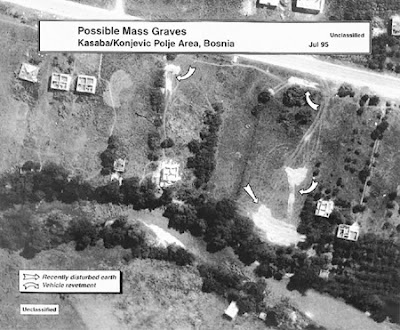
This is the inevitable next chapter, not only for Srebrenica, but also for humanitarian agencies, peacekeeping forces, governments, inter-governmental organizations et al. Clearly, 'doing good' is not enough and we see here a core question of 'How far does this responsibility to protect go? Who is responsible to whom' Are the United Nations, the Department of Peackeeping Operations, a troop-donating agency or their country of origin lialbe for the failure to bring to life the Responsibility to Protect (R2P)?
One place to look for some guidance is the organization IO Watch, who looks at these issues. Specifically, 'Pursuing the rule of law and management accountability in the United Nations and other international organizations.'
UN and AU outline details of proposed hybrid peacekeeping force in Darfur
A joint press release of the UN and AU gave a broad introduction to the hybrid peacekeeping force that has been discussed over months. The full Security Council report is also available for download.
Thursday, May 31, 2007
AFGHANISTAN: UN to track civilian casualties more closely
In its sixth year, the UN Assistance Mission for Afghanistan (UNAMA) announced that it was setting up a database to track civilian casualties more closely. This bold move no doubt follows the spate of high-profile reports of civilians being killed in botched attacks and crossfire, attributed to either ISAF or US-led Coalition forces. As the UN Human Rights expert in Afghanistan is quoted as saying: '"Unfortunately, civilian casualties are unavoidable in conflicts," said Diaz.'
In an IHT article entitled 'Losing the 'other war' in Afghanistan', focuses on the rising civilian death toll in Afghanistan as being a key issue undermining the Afghan and international effort. The metrics they put on the issues gives an understanding of why the problem is so important - and also accepting that this is at best a partial view:
'Since March there have been at least six incidents in which Western troops, mainly those under American command, have been accused of killing Afghan civilians, with more than 135 deaths reported and many more wounded. According to Red Cross, bombing by U.S. forces in western Afghanistan last month destroyed or badly damaged some 170 houses and left almost 2,000 people in four villages homeless.'
For what it's worth, it is sadly not a new problem. 'Karzai has told U.S. and NATO commanders that the patience of the Afghan people is wearing thin. He said civilian deaths and aggressive, arbitrary searches of people's houses have reached an unacceptable level, adding "Afghans cannot put up with it any longer..."' The behavior foreign forces has been a chronic criticism since 2001, surprising that it is only reaching the public consciousness at this point.
A hats off to abu muqawama, who caught a great paragraph in a Washington Post article that shows the Taliban may share some of the same concerns:
'On Tuesday, Taliban leader Mullah Omar said on the group's Web site that the militant group is "concerned" about civilian casualties. Omar called for an independent body to investigate them, saying the group should be guaranteed safe passage from Taliban fighters and from U.S. and NATO troops.'
DPKO- Discipline for peacekeeping troops vital
Yesterday, Under-Secretary-General for Peacekeeping operations, Jean-Marie Guehenno, talked about the upcoming introduction of formal discipline standards for United Nations peacekeepers, standards which troop-contributing nations must accept.
A separate article focused on the staggering budget of DPKO on the International Day of UN Peacekeepers. The article includes a roundup of views on the effectiveness and efficiency of the UN system, and those states who are footing important parts of the overall cost.
A separate article focused on the staggering budget of DPKO on the International Day of UN Peacekeepers. The article includes a roundup of views on the effectiveness and efficiency of the UN system, and those states who are footing important parts of the overall cost.
Sunday, May 27, 2007
Aegis Charitable Foundation- Private Security Companies- Low Cost, High Impact Assistance
Had originally intended to post on a vehicle of British-based security comapny Aegis Specialist Risk Management having been hit by a roadside bomb in Basra.
While visiting the Aegis website, gave a full read to the profile of Aegis' founder, Tim Spicer. Found a glimpse of Aegis [private security companies in general] that hadn't seen before:
'He [Tim Spicer] created the Aegis Charitable Foundation in 2004, a registered UK charity which provides direct assistance to communities through low cost, high impact civil affairs projects. Tim’s effort and support of this charity not only significantly helps communities in great need having suffered from conflict, but has also enhanced the ability of Reconstruction Operations in Iraq to actually implement their programmes successfully. Tim’s concept for the charity has been to carefully target projects that communities need and also want. The Foundation has therefore concentrated its efforts on building relationships with local tribal leaders and communities to provide clean water projects, inoculation programmes, school and health clinic equipment and smaller items such as toys, clothes and shoes. Tim has now expanded the Foundation’s arena to include Afghanistan.'

Sure enough, the Aegis Charitable Foundation enjoys its own pages to show off its good work- replete with images of (presumably) Tim himself delivering life-saving supplies of soccer balls to Iraqi children. [It is recommended to scroll through their projects- it is so rare to see humanitarian marketing photos of the benevolent aid-providing staff and their interlocutors with their faces blurred... Needless to say, the smiling beneficiaries are all lucky enough to have their faces shown without blurring...] Wonder if Aegis considers this as part of their Corporate Social Responsibility (CSR) strategy?

Saturday, May 26, 2007
Darfur- UN Council endorses plans for large Darfur force
Flurry of events around Darfur:
The UN Security Council endorsed a plan for a Darfur Peacekeeping force of more than 23,000 troops and police. 'The proposals, from the United Nations and the African Union, have two troop options: one with 19,500, composed of 18 infantry battalions, and another with 17,605, with 15 infantry battalions. Police would include 3,772 officers and perhaps an additional 2,500 policemen to establish a local police force in refugee camps... One of the main tasks is to provide security to the tens of thousands living in camps and patrol humanitarian supply routes and "where necessary escort humanitarian convoys," which have been attacked regularly by armed groups and militia, the document said.
The UNSC session had to reconvene for when US Ambassador Khalilzad read the wrong statement on the Sudan the first time round. The erroneous statement was a hard-hitting denunciation of Sudanese aerial bombardment in Darfur
The EU released 40 million euros in financing for the AU peacekeeping force.
Finally, the AU has nominated a Nigerian General to lead the Darfur peacekeeping force. '"General Agwai will serve first as the force commander of the African Union Mission in the Sudan and ultimately as the Force Commander for the AU-U.N. hybrid operation," the African Union said in a statement seen by Reuters on Thursday.'
Afghanistan- US Forces interrogating Afghans in Aid Agency Compounds??
The Guardian was stirring things up last week with a series of articles predicting the collapse of Afghanistan along the lines of Iraq, all fueled by comments from OXFAM.
They did seed a rather explosive closing paragraph in the article, which really needs to be expanded:
'Separately, the Guardian has learned that, to the fury of civilian organisations, US forces are using an aid agency's property as a place to interrogate Afghans.'
The accusations seem a bit unlikely that these furious civilian aid agencies haven't already published multiple press releases on the subject... Hey, would be happy to be proven wrong, has anyone seem more details of these allegations?
Wednesday, May 23, 2007
DRC- Accusations that UN troops 'traded gold for guns'
The BBC alleges that a UN investigation concluded that Pakistani peacekeepers in north-eastern Democratic Republic of Congo were trading gold with local militias and selling confiscated weapons back to their previous owners. The incidents, which would have taken place in 2005, were investigated in 2006, though there the article illustrates that the investigators were obstructed in their work. Interestingly, the UN was alerted to the gold trading allegations by Human Rights Watch.
Tuesday, May 22, 2007
Border agents recruited for Iraq duty
In the same vein of outsourcing, a military contractor is actively recruiting Border agents for service in Iraq. DynCorp International already has 700 trainers in Iraq, but received a request from the State Department to augment this force. Not surprisingly, the salary is roughly triple what agents earn at home. DynCorp is not new in this business, its website includes provides further background on this service they provide.


Northrop Grumman Awarded Contract for Global Training of Peacekeeping Forces
Northrop Grumman was awarded the contract for the Global Peace Operations Initaitive (GPOI- more on the initiative here and here). The $200 million US contract over five years is part of the US Department of State initiative to build worldwide capacity for peacekeeping operations. L3 Communications MPRI was also awarded a similar contract.
As the press release makes clear, Northrop Grumman has already been providing similar training under the ACOTA program- African Contingency Operations Training Assistance- since the 1990s.
As the press release makes clear, Northrop Grumman has already been providing similar training under the ACOTA program- African Contingency Operations Training Assistance- since the 1990s.
Friday, May 18, 2007
Africa Command: U.S. Strategic Interests and the Role of the U.S. Military in Africa
The Congressional Research Service published a report entitled 'Africa Command: U.S. Strategic Interests and the Role of the U.S. Military in Africa.' Ths is a great resource that is worth a read. The appendices include a history of US military involvement in Africa.
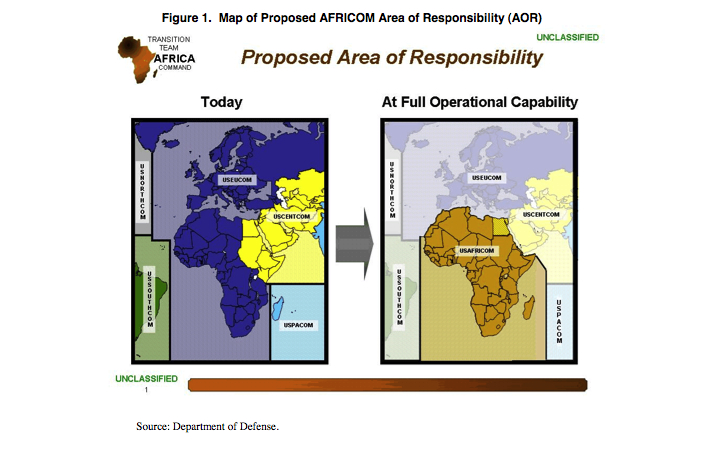
China pledges $20bn for Africa
'China intends to provide about $20bn in infrastructure and trade financing to Africa during the next three years, eclipsing many of the continent’s traditional big donors by a single pledge.'
This article might not seem entirely germane to the civil-military question, but in light of the renewed US focus on Africa through AFRICOM, the Chinese have upped the ante in one foul swoop, and through civilian, financial means.
China's moves haven't gone unnoticed by other donors. 'The World Bank has accused China of financing projects rejected by others because of environmental concerns and rights groups say it lends without regard to standards on governance or corruption.' Sour grapes? The real concern, beyond mere competition, appears to be that China's preference is towards bilateral and not multilateral development initiatives.
Wednesday, May 16, 2007
Female Police in Liberia Hope to Curb Rape Epidemic
ABC reported on the deployment of an female Indian Para-military force serving with the UN Peacekeeping force in Liberia. Theirs is the first deployment of an all-female unit by the United Nations.
A direct impact of this group of peacekeepers has been to give Liberian women the confidence to report assaults directly to them- not a small achievement, given that the UN in Liberia has convicted peacekeepers with 30 cases involving sex for food in 2006 alone.
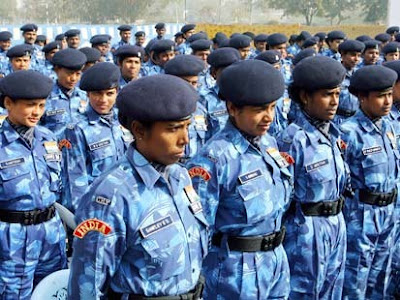
'Part of the policewomen's mission here is to encourage Liberian women to join a national police force of their own. Their belief is that the sight of uniformed women in positions of authority can reduce the level of violence against all women.'
A direct impact of this group of peacekeepers has been to give Liberian women the confidence to report assaults directly to them- not a small achievement, given that the UN in Liberia has convicted peacekeepers with 30 cases involving sex for food in 2006 alone.
'Part of the policewomen's mission here is to encourage Liberian women to join a national police force of their own. Their belief is that the sight of uniformed women in positions of authority can reduce the level of violence against all women.'
Poppy Fields Are Now a Front Line in Afghanistan War - NYT
NYT has an excellent article on the new front line in Afghanistan- the drug war.
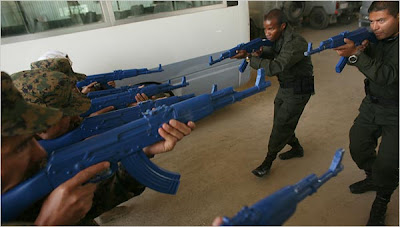
The article doesn't shy away from the evident criticism- that having avoided fighting the opium trade in Afghanistan has seriously eroded the military, political and development progress made elsewhere. The issue of exactly 'who?' should take on the drug war has been a political- and military- hot potato since the 2001 war. At alternating intervals, ISAF, Coalition Forces and the Afghan government have denied their role in the drug war, and often even its importance.
One interlocutor made an interesting parallel with Iraq:
“This is the Afghan equivalent of failing to deal with looting in Baghdad,” said Andre D. Hollis, a former deputy assistant secretary of defense for counternarcotics. “If you are not dealing with those who are threatened by security and who undermine security, namely drug traffickers, all your other grandiose plans will come to naught.”
DoD Announces the ROTC Language and Culture Project
This is an interesting (and overdue) initiative by the US Department of Defense:
In partnership with Indiana University, San Diego State University, the University of Mississippi and the University of Texas at Austin, DoD will promote the linguistic and cultural skills of ROTC cadets:
'As part of this project, Indiana Universitywill offer scholarships for study at their prestigious summer institute in languages including: Arabic, Russian, Azeri, Kazakh, Pashto, Tajik, Turkmen, Uyghur and Uzbek. San Diego StateUniversity plans to re-shape their military science minor while drawing on the resources of the community around them to teach different dialects of Arabic as well as Farsi and Russian. TheUniversity of Mississippi will offer opportunites for study of Chinese including summers of study abroad. The University of Texas at Austin will invest in material and curriculum to expand their programs in Arabic and Farsi.
Originally posted on Abu Muqawama- thanks!
Subscribe to:
Posts (Atom)


