Some 'good news' clips on NATO's work in Afghanistan:
http://ping.fm/2Z4MI
Tuesday, June 08, 2010
Sunday, May 30, 2010
Afghanistan to investigate aid groups for 'spreading Christianity'
Follow-on to an earlier post on the Afghan government asking over 150 NGOs to shut down:
http://ping.fm/9uk03
http://ping.fm/9uk03


U.N. Official to Ask U.S. to End C.I.A. Drone Strike
An expected outcome: increasingly bad press for civilian controlled drones operating in active combat roles-
http://ping.fm/2Dmvi
http://ping.fm/2Dmvi
Wednesday, May 26, 2010
ISAF collaborating with Super Mario?
ISAF seems to be taking the winning of hearts and minds to new levels- http://ping.fm/9wG6V
Security Council votes to end UN mission in Chad and Central African Republic
The trend of reducing peacekeeping missions continues:
http://ping.fm/FoaEA
http://ping.fm/FoaEA
Monday, May 24, 2010
CIMICweb.net- resource
Not sure who is behind this, but an interesting looking resource nonetheless:
http://ping.fm/zXDE6
http://ping.fm/zXDE6
Saturday, May 15, 2010
Eight U.S. Troops Will Remain in Haiti, Down From 20,000+
Looks like a textbook draw-down of the US support to Haiti- captured well in this quote:
'As Nancy Youssef notes in an excellent piece today for McClatchy, the U.S. military, faced with tightening budgets and a lingering economic crisis, seems to be quietly stepping away from large-scale commitments that require lots of money and manpower. Smarter and smaller seem to be the new watchwords.'
http://ping.fm/2JPjs
'As Nancy Youssef notes in an excellent piece today for McClatchy, the U.S. military, faced with tightening budgets and a lingering economic crisis, seems to be quietly stepping away from large-scale commitments that require lots of money and manpower. Smarter and smaller seem to be the new watchwords.'
http://ping.fm/2JPjs
Wednesday, May 12, 2010
Darfur blue helmets to take ‘robust’ defensive action if attacked, says UN-AU envoy
Interesting statement- that attacking peacekeepers 'is a war crime':
http://ping.fm/poSxh
http://ping.fm/poSxh
Tuesday, May 11, 2010
Sunday, May 09, 2010
Friday, May 07, 2010
The new bloggers: security contractors
Have to admit this isn't a source that I've been following: http://ping.fm/vHUUx
Friday, March 12, 2010
How non-lethal weapons could change warfare
'Today, the United States has been actively fighting two wars with high casualty rates for both sides. It would be valuable for the commander in chief and senior military leaders to consider the merits of a nonlethal approach to warfare.'
http://ping.fm/0GANr
http://ping.fm/0GANr
Afghanistan war: New rules of engagement don't pit civilians vs. soldiers
'Military tactics are always balanced against strategic objectives, force protection, and humanitarian imperatives. In Afghanistan, international forces have had more than eight years to figure out what hasn’t worked and what will. The new emphasis on civilian protection is a welcome move toward striking the right balance.'
http://ping.fm/o6ESw
http://ping.fm/o6ESw
Wednesday, March 10, 2010
World Vision Office Attacked in Pakistan
'ISLAMABAD (AP) -- Suspected militants armed with grenades attacked the offices of an international aid group helping earthquake survivors in northwestern Pakistan on Wednesday, killing six employees and wounding several others, police and the organization said.
All the victims of the assault on World Vision, a large Christian humanitarian group, were Pakistanis.'
http://ping.fm/q6P39
All the victims of the assault on World Vision, a large Christian humanitarian group, were Pakistanis.'
http://ping.fm/q6P39
Half of Somalia Food Aid Diverted From the Poor
'As much as half the food aid sent to Somalia is diverted from needy people to a web of corrupt contractors, radical Islamist militants and local United Nations staff members, according to a new Security Council report.
The report, which has not yet been made public but was shown to The New York Times by diplomats, outlines a host of problems so grave that it recommends that Secretary General Ban Ki-moon open an independent investigation into the World Food Program’s Somalia operations. It suggests that the program rebuild the food distribution system — which serves at least 2.5 million people and whose aid was worth about $485 million in 2009 — from scratch to break what it describes as a corrupt cartel of Somali distributors.'
http://ping.fm/X4mRG
The report, which has not yet been made public but was shown to The New York Times by diplomats, outlines a host of problems so grave that it recommends that Secretary General Ban Ki-moon open an independent investigation into the World Food Program’s Somalia operations. It suggests that the program rebuild the food distribution system — which serves at least 2.5 million people and whose aid was worth about $485 million in 2009 — from scratch to break what it describes as a corrupt cartel of Somali distributors.'
http://ping.fm/X4mRG
'U.N. Honors the 101 Who Served and Died in Haiti'
'UNITED NATIONS — It took nearly 15 minutes to read the full roll call of the dead, as a photograph of each person, with the years of their birth and death, flashed on a screen in the darkened hall. White candles flickered on a dais covered with white hydrangeas, orchids and lilies.'
http://ping.fm/WNdML
http://ping.fm/WNdML
Tuesday, March 09, 2010
FP- America Just Isn't Very Good at Nation Building'
This piece doesn't bring up any new points, but stretches the history of US nation building beyond Vietnam to the Thomasites of 1901 in the Philippines. Curious that the focus is always on the inability of the US to develop a civilian corps of deployable expertise- the European experience is not very different:
http://ping.fm/TAHr5
http://ping.fm/TAHr5
Wednesday, February 24, 2010
Afghan civilian deaths: NATO starts to say 'sorry'
'In the Afghanistan war, NATO forces chief Gen. Stanley McChrystal publicly apologized Tuesday for 27 Afghan civilian deaths in a US airstrike. The coalition has begun saying 'sorry' more quickly to civilian deaths, as part of a new hearts and minds strategy.'
http://ping.fm/VIy5a
http://ping.fm/VIy5a
Monday, February 01, 2010
Counterinsurgency, One Stuck Truck at a Time
A new bend on reporting Coalition efforts in Afghanistan, highlighting renewed efforts of soldiers to 'connect' with the civilian populations:
http://ping.fm/0eOmc
http://ping.fm/0eOmc
Thursday, November 26, 2009
'UN Mission in Congo Judged a Failure'
Two similar articles that are joining a pile-on against the UN Mission in DRC:
http://ping.fm/zLEuE
http://ping.fm/CcmOb
http://ping.fm/zLEuE
http://ping.fm/CcmOb
Sunday, November 08, 2009
'Discover UNIFIL' - Episode 1
UNIFIL has released the first episode in a tv series that introduces the mission. Very effective InfoOps material, they actually make an introduction to the UNIFIL HQ interesting...
http://ping.fm/TAyLV
http://ping.fm/TAyLV
Friday, November 06, 2009
Donor caution aid workers
A flip side to Afghanistan- 'Aid agencies operating in Somalia say they need more money but that some donors are holding back, concerned at where resources might end up in areas too dangerous for international staff.'
http://ping.fm/dZHYF
http://ping.fm/dZHYF
Reviews Raise Doubt on Training of Afghan Forces
'A series of internal government reviews have presented the Obama administration with a dire portrait of Afghanistan’s military and police force, bringing into serious question an ambitious goal at the heart of the evolving American war strategy — to speed up their training and send many more Afghans to the fight.'
http://ping.fm/Ag99V
http://ping.fm/Ag99V
UN calling in the big guns to protect AF staff- Gurkas
The punchline is that the UN will bring in foreign security staff, preferably Gurkas, to protect staff and installations.
There are some good snapshots of how staff perceive this- those who increased security measures as impinging on their social lives; those who see the costs as unjustified; those that actually start to question the impact of such robust security on their ability to operate in the context:
'But life is about to get worse. One foreign worker said: "One of the beauties of Afghanistan is we have such an interesting operating environment and some sense of normalcy where we can live with friends and go out in the evening."
... New rules will force UN staff to find accommodation in buildings with room for defensive positions for armed guards, probably foreign guards, preferably Gurkhas, who cost vastly more than Afghan guards. Some UN staff say they have been told a team of Gurkhas would cost £150,000 a year to protect one building.
Jean-Luc Lemahieu, head of the UN Office on Drugs and Crime in Afghanistan, said such a cost could not be justified: "We have to look at ways to keep our security costs down by pooling people into larger buildings. If most of your money goes to your security then there is something wrong with your presence here."
http://ping.fm/RbX15
There are some good snapshots of how staff perceive this- those who increased security measures as impinging on their social lives; those who see the costs as unjustified; those that actually start to question the impact of such robust security on their ability to operate in the context:
'But life is about to get worse. One foreign worker said: "One of the beauties of Afghanistan is we have such an interesting operating environment and some sense of normalcy where we can live with friends and go out in the evening."
... New rules will force UN staff to find accommodation in buildings with room for defensive positions for armed guards, probably foreign guards, preferably Gurkhas, who cost vastly more than Afghan guards. Some UN staff say they have been told a team of Gurkhas would cost £150,000 a year to protect one building.
Jean-Luc Lemahieu, head of the UN Office on Drugs and Crime in Afghanistan, said such a cost could not be justified: "We have to look at ways to keep our security costs down by pooling people into larger buildings. If most of your money goes to your security then there is something wrong with your presence here."
http://ping.fm/RbX15
'The Provincial Reconstruction Teams in Afghanistan: Role model for civil-military relations?'
A new reflection on PRTs:
'EXCERPT: "Since 2003, 26 so-called Provincial Reconstruction Teams (PRTs), currently under the authority of the North Atlantic Treaty Organization (NATO), have been established in Afghanistan. Their objective is to extend the authority of the Afghan central government, enhance security in the provinces, and facilitate humanitarian aid and reconstruction efforts (NATO, 2003). PRTs are relatively small integrated civil-military units designed as a stabilizing force in Afghanistan’s provinces and were first introduced in 2002 by the US army in the context of the 'global war on terror' as Operation Enduring Freedom. The PRTs model is part of the NATO strategy of civil-military cooperation (CIMIC)."'
http://ping.fm/PYY0b
'EXCERPT: "Since 2003, 26 so-called Provincial Reconstruction Teams (PRTs), currently under the authority of the North Atlantic Treaty Organization (NATO), have been established in Afghanistan. Their objective is to extend the authority of the Afghan central government, enhance security in the provinces, and facilitate humanitarian aid and reconstruction efforts (NATO, 2003). PRTs are relatively small integrated civil-military units designed as a stabilizing force in Afghanistan’s provinces and were first introduced in 2002 by the US army in the context of the 'global war on terror' as Operation Enduring Freedom. The PRTs model is part of the NATO strategy of civil-military cooperation (CIMIC)."'
http://ping.fm/PYY0b
'U.S. Needs Hit Squads, ?Manhunting Agency?: Spec Ops Report'
'CIA director Leon Panetta got into hot water with Congress, after he revealed an agency program to hunt down and kill terrorists. A recent report from the U.S. military’s Joint Special Operations University argues that the CIA didn’t go far enough (.pdf). Instead, it suggests the American government should set up something like a “National Manhunting Agency” to go after jihadists, drug dealers, pirates and other enemies of the state.'
http://ping.fm/9vfPl
http://ping.fm/9vfPl
Norwegian Frigate escorts ships including WFP
'A boarding unit from the Norwegian frigate "Fridtjof Nansen" came under fire from pirates, while on an inspection mission close to shore in the Bay of Aden on Saturday. There were no injuries. ...The vessel also carries out escort missions for the World Food Program (WFP), to ensure safe passage for emergency supplies to the victims of the food shortage in Somalia.'
http://ping.fm/dT6Ev
http://ping.fm/dT6Ev
'UN: Congolese Army Killed 62 Civilians in E. Congo'
Following the recent articles criticising UN support and mentoring of the Congolese Armed Forces ('...for every rebel who has been disarmed this year, one civilian has been killed, seven women or girls raped, and 900,000 people made homeless...'
- http://ping.fm/zMREs) the UN finally starts to distance itself: http://ping.fm/eK0nB
- http://ping.fm/zMREs) the UN finally starts to distance itself: http://ping.fm/eK0nB
Afghan Police Officer Kills Five British Soldiers
A number of hard-hitting articles following the killing of five British Soldiers by a 'rogue' Afghan Police officer:
- 'British army responds to killing of five soldiers in Afghanistan' - http://ping.fm/QEMXF
- 'Meet Afghanistan's model police force: inexperience, drugs and double agents' - http://ping.fm/gCLCe
- 'Soldiers' forum reveals anger and disbelief over latest Afghan deaths' - http://ping.fm/7mYOH
- 'British army responds to killing of five soldiers in Afghanistan' - http://ping.fm/QEMXF
- 'Meet Afghanistan's model police force: inexperience, drugs and double agents' - http://ping.fm/gCLCe
- 'Soldiers' forum reveals anger and disbelief over latest Afghan deaths' - http://ping.fm/7mYOH
UN peacekeepers involved in abuse are being punished, world body says
'Dozens of United Nations peacekeepers implicated in cases of sexual abuse and exploitation have been disciplined and punished, a spokesperson for the world body said today.'
http://ping.fm/qUcuc
http://ping.fm/qUcuc
Saturday, October 31, 2009
South Korea Plans New Afghan Deployment
'The South Korean government announced plans on Friday to send troops and police officers to Afghanistan to help protect its aid workers.
South Korea also plans to expand a reconstruction team now helping to rebuild Afghanistan to 130 to 150 workers, the report said. Currently there are 25 government-assigned aid workers in hospitals and job-training centers in Afghanistan.
“Our troops will not engage in battles except for the security of our workers and for self-defense,” Mr. Moon said.'
http://ping.fm/rAnVu
South Korea also plans to expand a reconstruction team now helping to rebuild Afghanistan to 130 to 150 workers, the report said. Currently there are 25 government-assigned aid workers in hospitals and job-training centers in Afghanistan.
“Our troops will not engage in battles except for the security of our workers and for self-defense,” Mr. Moon said.'
http://ping.fm/rAnVu
Friday, October 30, 2009
'U.S. official resigns over Afghan war'
Quite a thoughtful piece; interesting in that the official is exactly the 'civil-military hybrid' that is in such short supply:
'Foreign Service officer and former Marine captain says he no longer knows why his nation is fighting.
When Matthew Hoh joined the Foreign Service early this year, he was exactly the kind of smart civil-military hybrid the administration was looking for to help expand its development efforts in Afghanistan.'
http://ping.fm/CY3rM
'Foreign Service officer and former Marine captain says he no longer knows why his nation is fighting.
When Matthew Hoh joined the Foreign Service early this year, he was exactly the kind of smart civil-military hybrid the administration was looking for to help expand its development efforts in Afghanistan.'
http://ping.fm/CY3rM
Thursday, October 29, 2009
51st Aid Worker Killed in Eastern Chad
'The U.N. refugee agency reports a Chadian colleague working in eastern Chad was killed in an ambush during the weekend. The UNHCR says dozens of humanitarian aid workers have been killed in eastern Chad this year.'
http://ping.fm/YQ0iW
http://ping.fm/YQ0iW
Re-visiting the guidelines for civ-mil interaction in Afghanistan
A good snapshot of duelling perspectives on whether the 2008 guidelines on civ-mil interaction in Afghanistan are truly being respected- let alone understood- by its stakeholders-
http://ping.fm/FnffF
http://ping.fm/FnffF
Wednesday, October 28, 2009
Attack on UN Guest House in Kabul
'The UN said at least five of its international staff were killed in the attack early on Wednesday on the Bakhtar guest house, but did not release their identities.'
http://ping.fm/a4DgL
http://ping.fm/a4DgL
Thursday, October 22, 2009
Shift aid base to "safe" areas in-country, urges UN official
'Humanitarian agencies should move from Nairobi to "relatively safe" areas of Somalia to be able to better serve more than 1.5 million internally displaced people (IDPs) caught up in a "deepening" humanitarian crisis, Walter Kälin, Representative of the UN Secretary-General on the Human Rights of IDPs, said on 21 October.'
http://ping.fm/LHtnP
http://ping.fm/LHtnP
Wednesday, October 21, 2009
Security Fears Prompt Closure of WFP Food Hubs in Pakistan
Decision is framed by growing security concerns and not the recent suicide bomb attack on the WFP office:
http://ping.fm/UIpbj
http://ping.fm/UIpbj
Tuesday, October 20, 2009
Marine Corps takes hearts and minds one step further- Female Engagement Teams (FET)
'According to a September Marine Corps After Action Review, the teams have been most effective when Afghans perceive their intent as one of establishing a relationship of mutual trust and interest, rather than one of gathering intelligence. They often are welcomed into village homes while dressed in military drab and headscarves. Afghans purportedly view these American women as a “third gender” — female marines are extended the respect shown to men, but granted the access reserved for women. This access has shown the Americans that indigenous women wield significant influence with their husbands, brothers and, especially, their adolescent sons. The presence of F.E.T.’s sends a strong signal of peaceful engagement to local villages. As one village elder put it, “Your men come to fight, but we know the women are here to help.”'
http://ping.fm/64cAH
http://ping.fm/64cAH
Increasing attacks on aid workers hampering relief efforts in DR Congo, says UN
A good complement to the recent statistics on security incidents in Darfur- 108 attacks on humanitarian staff in 2009:
http://ping.fm/Rue1n
http://ping.fm/Rue1n
Monday, October 19, 2009
Italians bribed Taliban to not attack their forces?
An interesting twist: did Italians bribe the Taliban to not attack their forces? Even more interesting, the French claim that this had a negative impact on their security environment...http://ping.fm/xzWz3
Crisis of confidence around the Afghan campaign
The Guardian has a good article comparing the current Afghan campaign to the pitfalls of the Soviet occupation: http://ping.fm/DgZQw
Not surprisingly, the media is now seeing Kabul as the new Baghdad, and giving it much higher priority: http://ping.fm/Zwjer
Tough to say whether Pakistan is in the fore- or background at this point...: http://ping.fm/A19ez
Not surprisingly, the media is now seeing Kabul as the new Baghdad, and giving it much higher priority: http://ping.fm/Zwjer
Tough to say whether Pakistan is in the fore- or background at this point...: http://ping.fm/A19ez
Tuesday, October 13, 2009
Civilian Goals Largely Unmet in Afghanistan
'WASHINGTON — Even as President Obama leads an intense debate over whether to send more troops to Afghanistan, administration officials say the United States is falling far short of his goals to fight the country’s endemic corruption, create a functioning government and legal system and train a police force currently riddled with incompetence.'
http://ping.fm/Kv7Wb
http://ping.fm/Kv7Wb
Norwegian Security Contractors Death Sentence - DRC
'Two Norwegian security contractors convicted of murder and espionage in the Democratic Republic of the Congo will tomorrow begin an appeal against their death sentences. Joshua French, 27, who spent part of his early childhood in Margate and holds dual British citizenship, was arrested with Tjostolv Moland, 28, in eastern Congo in May after their driver was found shot dead. The men denied shooting Abedi Kasongo in the head, and said he had been killed during an attack by unknown gunmen.'
More here: http://ping.fm/SLPml
More here: http://ping.fm/SLPml
UN-backed Congo military offensive a 'humanitarian disaster'
UN-backed Congo military offensive a 'humanitarian disaster' - http://htxt.it/m40n
Saturday, September 19, 2009
'Afghanistan - the Civil-Military Fusion Centre'
Nothing new in this article, but digs into a new NATO concept of the 'Civil-Military Fusion Centre' - http://htxt.it/ibyr
Tuesday, September 15, 2009
Civilian 'surge' in
Civilian 'surge' in Afghanistan fails to meet expectations - http://htxt.it/Pp7L
Friday, September 11, 2009
VOICE seems to have
VOICE seems to have published their position on civil-military relations in humanitarian action in May 2009 - http://htxt.it/hpCH
Thursday, September 10, 2009
Quantitative look at
Quantitative look at security incidents in Darfur over 2009 - 10 dead, 22 wounded, 95 carjackings... read on - http://htxt.it/OOaO
Saturday, September 05, 2009
Always on the cusp o
Always on the cusp of new technology, NATO considers a Second Life virtual world for training and day-to-day business of the Alliance: http://htxt.it/9T1W
Wednesday, September 02, 2009
NATO adopts defensive driving to win Afghan hearts and minds
'Top general in Afghanistan directs troops to respect Afghan traffic rules, drive defensively at appropriate speeds in an effort to win over population' - http://htxt.it/q9cP
Afghan insurgent forces are becoming “narco-cartels”
'There is growing evidence that some Afghan insurgent forces are becoming “narco-cartels” — that view drug profits as more important than ideology. http://htxt.it/imO1
Year 8 in Afghanista
Year 8 in Afghanistan, UN SRSG announces: "The piecemeal approach is not going to get results. Enough is enough with the piecemeal approach." http://htxt.it/n0We
Monday, August 31, 2009
Aid Workers to support intelligence training for Af-Pak?
Wired has a good article on the not-very-new concerns about mixing up the civilian and military realms - 'Spooks to Tap Aid Workers for Af-Pak Knowledge?' - http://htxt.it/99iB
Sunday, August 30, 2009
Interesting glimpse
Interesting glimpse of how the Pentagon (potentially) profiles reporters to help shape their war coverage: http://htxt.it/Piyk
Saturday, August 29, 2009
OXFAM issues a sermo
OXFAM issues a sermon on poverty, security spending and famine in Afghanistan, the punch line apparently being 'more aid needed, must be spent better': http://htxt.it/1e58
Wednesday, August 05, 2009
UN considers broad r
UN considers broad rethink of peacekeeping strategy - 'an increasingly costly operation that in some parts of the world is failing to meet the tough challenges set for it' - http://htxt.it/rktQ
Wednesday, July 15, 2009
UNAMA: Terrorism Kills More Afghan Civilians Than Military Action-
UNAMA: Terrorism Kills More Afghan Civilians Than Military Action- http://htxt.it/DIRO
French security advisers kidnapped in Somalia
Two French government security advisers kidnapped in Somalia: http://htxt.it/1GUf
Tuesday, July 14, 2009
AFGHANISTAN: Cost of insecurity impedes humanitarian work
AFGHANISTAN: Cost of insecurity impedes humanitarian work - analysis- http://htxt.it/2LMk
Sunday, July 05, 2009
The Metrics of the AfPak Conflict
Interesting article: The Dynamics Of The "AfPak" Conflict: Metrics and Status Report- http://htxt.it/It1B
Wednesday, June 24, 2009
Collection of Links on Military-Civil Reconstruction Projects
Received the following collection of links which merits posting: a broad selection of resources showing the humanitarian and civic action projects being undertaken in Afghanistan by US forces. Might be useful to those of you engaged in the endless debate around Afghanistan, civ-mil debates, involvement of armed forces in humanitarian action, etc.
On the Ground: U.S. Troops, Civilians Bring Goodwill to Afghanistan
http://www.defenselink.mil/news/newsarticle.aspx?id=52841
Team Helps to Fight Polio in Konar Province
http://www.defenselink.mil/news/newsarticle.aspx?id=52820
U.S. Soldiers Bridge Access for Remote Afghans
http://www.defenselink.mil/news/newsarticle.aspx?id=52809
Team Improves Future Prospects for Afghan Village
http://www.defenselink.mil/news/newsarticle.aspx?id=52742
School Project Brings Hope to Afghan Province
http://www.defenselink.mil/news/newsarticle.aspx?id=52689
Team Holds Weekly Shoe Drive for Afghan Children
http://www.defenselink.mil/news/newsarticle.aspx?id=52668
Command Provides Ambulances for Afghan Police Medics
http://www.defenselink.mil/news/newsarticle.aspx?id=52662
Afghan, Coalition Leaders Unveil Bridge With Hopes of Prosperity
http://www.defenselink.mil/news/newsarticle.aspx?id=52534
Hope is Victory in Afghanistan, PRT Commander Says
http://www.defenselink.mil/news/newsarticle.aspx?id=53259
New Roads to Open Up Eastern Afghanistan Province
http://www.defenselink.mil/news/newsarticle.aspx?id=53258
Security Forces Provide Safety Net for Reconstruction Mission
http://www.defenselink.mil/news/newsarticle.aspx?id=53234
On the Ground: U.S. Forces Help Afghans Combat Winter Weather
http://www.defenselink.mil/news/newsarticle.aspx?id=53218
On the Ground: Industry Day, Power Plant Project Attract Afghan Contractors
http://www.defenselink.mil/news/newsarticle.aspx?id=53169
Team in Afghanistan Looks to Double Health Care Access
http://www.defenselink.mil/news/newsarticle.aspx?id=53155
Program Builds Better Health Care System in Afghanistan
http://www.defenselink.mil/news/newsarticle.aspx?id=53152
Paktia Provincial Reconstruction Team Reaches Out to Remote Village
http://www.defenselink.mil/news/newsarticle.aspx?id=53107
On the Ground: Americans Help Burned Girl, Train Afghans
http://www.defenselink.mil/news/newsarticle.aspx?id=53099
Projects Prove Difficult, But Key to Rebuilding Efforts
http://www.defenselink.mil/news/newsarticle.aspx?id=53072
Agribusiness Teams Plant Seeds for Economic Growth in Afghanistan
http://www.defenselink.mil/news/newsarticle.aspx?id=53065
Reconstruction Team Serves on Front Line of War on Terror
http://www.defenselink.mil/news/newsarticle.aspx?id=53029
Clinic Gives ‘Hope’ to Afghan Village
http://www.defenselink.mil/news/newsarticle.aspx?id=53025
On the Ground: Coalition, Afghan Troops Give Fuel, Food, Collect Munitions
http://www.defenselink.mil/news/newsarticle.aspx?id=52956
New Bridge Brings Hope, Safety to Afghanistan’s Panjshir Valley
http://www.defenselink.mil/news/newsarticle.aspx?id=52920
Empowerment Program Helps to Educate Afghans
http://www.defenselink.mil/news/newsarticle.aspx?id=53712
On the Ground: Troops Provide Medical Care, Necessities to Afghans
http://www.defenselink.mil/news/newsarticle.aspx?id=53705
New Afghan Program Supports Community-based Approach to Security
http://www.defenselink.mil/news/newsarticle.aspx?id=53686
Coalition Mentors Afghan Army, Police on Jurisprudence
http://www.defenselink.mil/news/newsarticle.aspx?id=53661
Special Operations Troops Deliver Smiles to Bagram Children
http://www.defenselink.mil/news/newsarticle.aspx?id=53569
On the Ground: Troops Aid Afghans With Security, Supplies
http://www.defenselink.mil/news/newsarticle.aspx?id=53520
U.S. Team Helps to Plant Seeds for Afghan Farmers’ Success
http://www.defenselink.mil/news/newsarticle.aspx?id=53457
Afghan Women Celebrate Culture, Achievements at Women’s Day Event
http://www.defenselink.mil/news/newsarticle.aspx?id=53455
Resource Center to Provide Training, Education for Afghan Women
http://www.defenselink.mil/news/newsarticle.aspx?id=53426
Afghan Soldiers Train to Save Lives
http://www.defenselink.mil/news/newsarticle.aspx?id=53394
Afghanistan Fight Turns to Economy, Governance
http://www.defenselink.mil/news/newsarticle.aspx?id=53369
Coalition, Afghans Find Goodwill at Traditional Afghan Games
http://www.defenselink.mil/news/newsarticle.aspx?id=53309
Team Provides Medical Care to Afghan Students, Villagers
http://www.defenselink.mil/news/newsarticle.aspx?id=53304
Coalition Troops Care for Afghan People
http://www.defenselink.mil/news/newsarticle.aspx?id=53282
Human Terrain Teams Build Friendships, Future
http://www.defenselink.mil/news/newsarticle.aspx?id=53281
Soldiers Bring Light to Afghan Marketplace
http://www.defenselink.mil/news/newsarticle.aspx?id=54098
Troops Give Afghan Baby Second Chance at Life
http://www.defenselink.mil/news/newsarticle.aspx?id=54063
Afghans Bid on Brighter Future
http://www.defenselink.mil/news/newsarticle.aspx?id=54041
Afghan Women Find Support in Wardak Province
http://www.defenselink.mil/news/newsarticle.aspx?id=54010
Reconstruction Team Completes Afghanistan Canal Project
http://www.defenselink.mil/news/newsarticle.aspx?id=53992
International Effort Benefits Afghanistan’s Alasay Valley
http://www.defenselink.mil/news/newsarticle.aspx?id=53978
On the Ground: Coalition Medics Treat Afghan Troops, Civilians, Prevent Diseases
http://www.defenselink.mil/news/newsarticle.aspx?id=53945
U.S., French, Afghan Forces Team Up to Aid Afghan Villages
http://www.defenselink.mil/news/newsarticle.aspx?id=53925
Route-clearance Team Clears Way to Commerce in Afghan Province
http://www.defenselink.mil/news/newsarticle.aspx?id=53903
Team Opens Six New Schools for Afghan Children
http://www.defenselink.mil/news/newsarticle.aspx?id=53885
Medics Turn Aid Station Into Afghan Emergency Room
http://www.defenselink.mil/news/newsarticle.aspx?id=53883
Afghan Girl Gets Help from Soldiers, Americans
http://www.defenselink.mil/news/newsarticle.aspx?id=53855
Team Fosters Self-Sufficiency in Afghanistan
http://www.defenselink.mil/news/newsarticle.aspx?id=53802
Civil Affairs Team Brings Change to Afghan Province
http://www.defenselink.mil/news/newsarticle.aspx?id=54441
Rural Village Sees Brighter Future With Coalition’s Help
http://www.defenselink.mil/news/newsarticle.aspx?id=54371
Health, Security Officials Look to Improve Afghan Health System
http://www.defenselink.mil/news/newsarticle.aspx?id=54353
Coalition Team Gives Temporary Shelter to Afghan Students
http://www.defenselink.mil/news/newsarticle.aspx?id=54276
Doctor Confronts Maternal Mortality in Afghanistan
http://www.defenselink.mil/news/newsarticle.aspx?id=54263
Kansas Agribusiness Development Team Arrives in Afghanistan
http://www.defenselink.mil/news/newsarticle.aspx?id=54254
Afghan, Coalition Medics Help People of Herat District
http://www.defenselink.mil/news/newsarticle.aspx?id=54188
Special Operations Forces Save Lives After Bomb Attack
http://www.defenselink.mil/news/newsarticle.aspx?id=54286
On the Ground: U.S. Troops, Civilians Bring Goodwill to Afghanistan
http://www.defenselink.mil/news/newsarticle.aspx?id=52841
Team Helps to Fight Polio in Konar Province
http://www.defenselink.mil/news/newsarticle.aspx?id=52820
U.S. Soldiers Bridge Access for Remote Afghans
http://www.defenselink.mil/news/newsarticle.aspx?id=52809
Team Improves Future Prospects for Afghan Village
http://www.defenselink.mil/news/newsarticle.aspx?id=52742
School Project Brings Hope to Afghan Province
http://www.defenselink.mil/news/newsarticle.aspx?id=52689
Team Holds Weekly Shoe Drive for Afghan Children
http://www.defenselink.mil/news/newsarticle.aspx?id=52668
Command Provides Ambulances for Afghan Police Medics
http://www.defenselink.mil/news/newsarticle.aspx?id=52662
Afghan, Coalition Leaders Unveil Bridge With Hopes of Prosperity
http://www.defenselink.mil/news/newsarticle.aspx?id=52534
Hope is Victory in Afghanistan, PRT Commander Says
http://www.defenselink.mil/news/newsarticle.aspx?id=53259
New Roads to Open Up Eastern Afghanistan Province
http://www.defenselink.mil/news/newsarticle.aspx?id=53258
Security Forces Provide Safety Net for Reconstruction Mission
http://www.defenselink.mil/news/newsarticle.aspx?id=53234
On the Ground: U.S. Forces Help Afghans Combat Winter Weather
http://www.defenselink.mil/news/newsarticle.aspx?id=53218
On the Ground: Industry Day, Power Plant Project Attract Afghan Contractors
http://www.defenselink.mil/news/newsarticle.aspx?id=53169
Team in Afghanistan Looks to Double Health Care Access
http://www.defenselink.mil/news/newsarticle.aspx?id=53155
Program Builds Better Health Care System in Afghanistan
http://www.defenselink.mil/news/newsarticle.aspx?id=53152
Paktia Provincial Reconstruction Team Reaches Out to Remote Village
http://www.defenselink.mil/news/newsarticle.aspx?id=53107
On the Ground: Americans Help Burned Girl, Train Afghans
http://www.defenselink.mil/news/newsarticle.aspx?id=53099
Projects Prove Difficult, But Key to Rebuilding Efforts
http://www.defenselink.mil/news/newsarticle.aspx?id=53072
Agribusiness Teams Plant Seeds for Economic Growth in Afghanistan
http://www.defenselink.mil/news/newsarticle.aspx?id=53065
Reconstruction Team Serves on Front Line of War on Terror
http://www.defenselink.mil/news/newsarticle.aspx?id=53029
Clinic Gives ‘Hope’ to Afghan Village
http://www.defenselink.mil/news/newsarticle.aspx?id=53025
On the Ground: Coalition, Afghan Troops Give Fuel, Food, Collect Munitions
http://www.defenselink.mil/news/newsarticle.aspx?id=52956
New Bridge Brings Hope, Safety to Afghanistan’s Panjshir Valley
http://www.defenselink.mil/news/newsarticle.aspx?id=52920
Empowerment Program Helps to Educate Afghans
http://www.defenselink.mil/news/newsarticle.aspx?id=53712
On the Ground: Troops Provide Medical Care, Necessities to Afghans
http://www.defenselink.mil/news/newsarticle.aspx?id=53705
New Afghan Program Supports Community-based Approach to Security
http://www.defenselink.mil/news/newsarticle.aspx?id=53686
Coalition Mentors Afghan Army, Police on Jurisprudence
http://www.defenselink.mil/news/newsarticle.aspx?id=53661
Special Operations Troops Deliver Smiles to Bagram Children
http://www.defenselink.mil/news/newsarticle.aspx?id=53569
On the Ground: Troops Aid Afghans With Security, Supplies
http://www.defenselink.mil/news/newsarticle.aspx?id=53520
U.S. Team Helps to Plant Seeds for Afghan Farmers’ Success
http://www.defenselink.mil/news/newsarticle.aspx?id=53457
Afghan Women Celebrate Culture, Achievements at Women’s Day Event
http://www.defenselink.mil/news/newsarticle.aspx?id=53455
Resource Center to Provide Training, Education for Afghan Women
http://www.defenselink.mil/news/newsarticle.aspx?id=53426
Afghan Soldiers Train to Save Lives
http://www.defenselink.mil/news/newsarticle.aspx?id=53394
Afghanistan Fight Turns to Economy, Governance
http://www.defenselink.mil/news/newsarticle.aspx?id=53369
Coalition, Afghans Find Goodwill at Traditional Afghan Games
http://www.defenselink.mil/news/newsarticle.aspx?id=53309
Team Provides Medical Care to Afghan Students, Villagers
http://www.defenselink.mil/news/newsarticle.aspx?id=53304
Coalition Troops Care for Afghan People
http://www.defenselink.mil/news/newsarticle.aspx?id=53282
Human Terrain Teams Build Friendships, Future
http://www.defenselink.mil/news/newsarticle.aspx?id=53281
Soldiers Bring Light to Afghan Marketplace
http://www.defenselink.mil/news/newsarticle.aspx?id=54098
Troops Give Afghan Baby Second Chance at Life
http://www.defenselink.mil/news/newsarticle.aspx?id=54063
Afghans Bid on Brighter Future
http://www.defenselink.mil/news/newsarticle.aspx?id=54041
Afghan Women Find Support in Wardak Province
http://www.defenselink.mil/news/newsarticle.aspx?id=54010
Reconstruction Team Completes Afghanistan Canal Project
http://www.defenselink.mil/news/newsarticle.aspx?id=53992
International Effort Benefits Afghanistan’s Alasay Valley
http://www.defenselink.mil/news/newsarticle.aspx?id=53978
On the Ground: Coalition Medics Treat Afghan Troops, Civilians, Prevent Diseases
http://www.defenselink.mil/news/newsarticle.aspx?id=53945
U.S., French, Afghan Forces Team Up to Aid Afghan Villages
http://www.defenselink.mil/news/newsarticle.aspx?id=53925
Route-clearance Team Clears Way to Commerce in Afghan Province
http://www.defenselink.mil/news/newsarticle.aspx?id=53903
Team Opens Six New Schools for Afghan Children
http://www.defenselink.mil/news/newsarticle.aspx?id=53885
Medics Turn Aid Station Into Afghan Emergency Room
http://www.defenselink.mil/news/newsarticle.aspx?id=53883
Afghan Girl Gets Help from Soldiers, Americans
http://www.defenselink.mil/news/newsarticle.aspx?id=53855
Team Fosters Self-Sufficiency in Afghanistan
http://www.defenselink.mil/news/newsarticle.aspx?id=53802
Civil Affairs Team Brings Change to Afghan Province
http://www.defenselink.mil/news/newsarticle.aspx?id=54441
Rural Village Sees Brighter Future With Coalition’s Help
http://www.defenselink.mil/news/newsarticle.aspx?id=54371
Health, Security Officials Look to Improve Afghan Health System
http://www.defenselink.mil/news/newsarticle.aspx?id=54353
Coalition Team Gives Temporary Shelter to Afghan Students
http://www.defenselink.mil/news/newsarticle.aspx?id=54276
Doctor Confronts Maternal Mortality in Afghanistan
http://www.defenselink.mil/news/newsarticle.aspx?id=54263
Kansas Agribusiness Development Team Arrives in Afghanistan
http://www.defenselink.mil/news/newsarticle.aspx?id=54254
Afghan, Coalition Medics Help People of Herat District
http://www.defenselink.mil/news/newsarticle.aspx?id=54188
Special Operations Forces Save Lives After Bomb Attack
http://www.defenselink.mil/news/newsarticle.aspx?id=54286
Sunday, October 14, 2007
Training - Senior Security Management Workshop
The Harvard University Program on Humanitarian Policy and Conflict Research (HPCR) is offering a Senior Security Management Workshop in cooperation with the Geneva Centre for Security Policy (GCSP) in Geneva, Switzerland. The course is part of the Security Management Initiative (SMI).
The registration form for the event can be downloaded here.
The registration form for the event can be downloaded here.
Training - UK Corridors of Power
The British Overseas NGO's for Development (BOND) is offering an innovative course entitle, 'UK Corridors of Power'. The course intends to:
'To develop participant's knowledge and understanding of the UK political process (Westminster and Whitehall) and improve their ability to navigate the UK policy-making arena.
A key skill that applies itself to a variety of NGO work is an understanding of the UK political process. Knowing how the decision-making process really works and how to get key political players on side, is vital if your advocacy is to change policy.'
While UK-focussed, the course is an interesting initiative to arm institutions and individuals on how to better arm themselves in promoting policy change with states.
'To develop participant's knowledge and understanding of the UK political process (Westminster and Whitehall) and improve their ability to navigate the UK policy-making arena.
A key skill that applies itself to a variety of NGO work is an understanding of the UK political process. Knowing how the decision-making process really works and how to get key political players on side, is vital if your advocacy is to change policy.'
While UK-focussed, the course is an interesting initiative to arm institutions and individuals on how to better arm themselves in promoting policy change with states.
AFGHANISTANICA - Afghanistan’s Security Deterioration in Visual and Quantitative Form
AFGHANISTANICA has a great compilation post looking at Afghanistan’s Security Deterioration in Visual and Quantitative Form.

The post makes clear that the UNDSS report is very focused on the security of humanitarian aid worker:
'The report makes it obvious that the “Anti-Government Elements” aren’t giving aid workers any special treatment. Incidents in 2007 up to early August:
Aid convoys attacked/ambushed/looted: 41.
Aid facilities attacked looted: 29.
Aid workers abducted: 69 (44 Afghans, 25 international).
Later killed by captors: 7 (5 Afghans, 2 foreigners).
Total aid workers killed: 41 (34 Afghans, 7 international).
These numbers are of course much less than deaths suffered by Afghan civilians, police and military and less than the losses by foreign troops. But these NGO workers are desperately needed in Afghanistan, and many of them need to be out in the field to be effective.'

The post makes clear that the UNDSS report is very focused on the security of humanitarian aid worker:
'The report makes it obvious that the “Anti-Government Elements” aren’t giving aid workers any special treatment. Incidents in 2007 up to early August:
Aid convoys attacked/ambushed/looted: 41.
Aid facilities attacked looted: 29.
Aid workers abducted: 69 (44 Afghans, 25 international).
Later killed by captors: 7 (5 Afghans, 2 foreigners).
Total aid workers killed: 41 (34 Afghans, 7 international).
These numbers are of course much less than deaths suffered by Afghan civilians, police and military and less than the losses by foreign troops. But these NGO workers are desperately needed in Afghanistan, and many of them need to be out in the field to be effective.'
Darfur - Peacekeepers Without a Peace to Keep
The New York Times has a short piece entitled, 'Peacekeepers Without a Peace to Keep'.
The article continues the debate on how damaging the attack on AU peacekeepers in Haskanita will be in the short- and mid-term. While this take on the incident isn't new, the author does start to pose some more critical questions about whether military intervention in Darfur is already too late?- Or, is it too early?
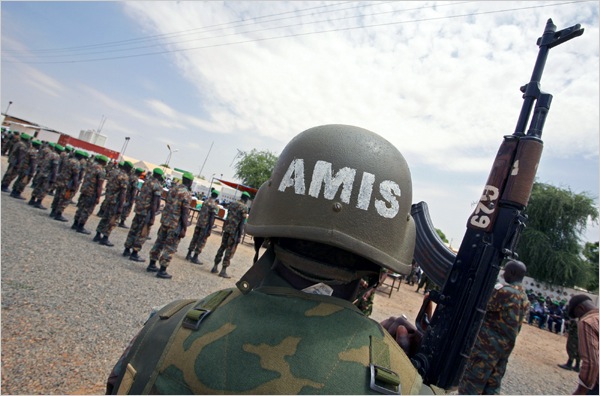
A recent statement by the AU force commander captured the challenge facing peackeepers- 'AU outnumbered, outgunned in Darfur'. It is easy to make calls for peacekeepers to enforce the 'Responsibility to Protect', as Roméo Dallaire does: '...the troops must “go inside the camps, do night patrols and snap inspections, essentially go wherever they need to, without the Sudanese Army or police blocking them.” He said they also need to go after “every one of those splinter groups” and they’ll need the proper gear to do so.' How realistic are these calls?
A number of uncomfortable comparisons in the article are made between Darfur and Somalia. Yet perhaps a better comparison would be the early days of UNPROFOR in the former Yugoslavia? The lack of political will in FRY crippled even relatively well-equipped peackeepers. Can UNAMID hope for better?
The article continues the debate on how damaging the attack on AU peacekeepers in Haskanita will be in the short- and mid-term. While this take on the incident isn't new, the author does start to pose some more critical questions about whether military intervention in Darfur is already too late?- Or, is it too early?
A recent statement by the AU force commander captured the challenge facing peackeepers- 'AU outnumbered, outgunned in Darfur'. It is easy to make calls for peacekeepers to enforce the 'Responsibility to Protect', as Roméo Dallaire does: '...the troops must “go inside the camps, do night patrols and snap inspections, essentially go wherever they need to, without the Sudanese Army or police blocking them.” He said they also need to go after “every one of those splinter groups” and they’ll need the proper gear to do so.' How realistic are these calls?
A number of uncomfortable comparisons in the article are made between Darfur and Somalia. Yet perhaps a better comparison would be the early days of UNPROFOR in the former Yugoslavia? The lack of political will in FRY crippled even relatively well-equipped peackeepers. Can UNAMID hope for better?
Monday, October 01, 2007
Sudan- Peacekeepers Look for Missing in Darfur
There are numerous articles chronicling a rebel attack on an African Union base in Haskanita, northern Darfur yesterday. Apparently 1,000 rebel gunmen overwhelmed the base and its 150 troops before dawn. At least 10 peackeepers have been killed, and between 20 and 50 are still missing.

The rebels looted vehicles and ammunition, and it took Sudanese government troops to chase them away. Photos show government troops looting the leftovers, and burnt armoured vehicles. A quote from an anonymous officer underlines the stakes for the AU Force:
'"It may not be the right political thing to say, but the government forces saved us," said an AU officer, who also asked not to be named because of military regulations.'
The IHT published the first obvious article on the future of Darfur and peacekeeping, namely, whether this tragic incident won't un-nerve other nations considering contributing to the more robust hybrid AU-UN force for Darfur. A spokeman for OXFAM framed the attack in light of the kinds of threats that humanitarian agencies are facing:
'"It's indicative of the complete insecurity," said Alun McDonald, a spokesman for the Oxfam aid organization in Sudan. "These groups are attacking anybody and everybody with total impunity."
McDonald added that armed groups were "increasingly targeting aid workers to steal their vehicles, radios and logistical stuff."
He said the attack on the peacekeepers "sounds quite similar to that, just on a much larger scale."'
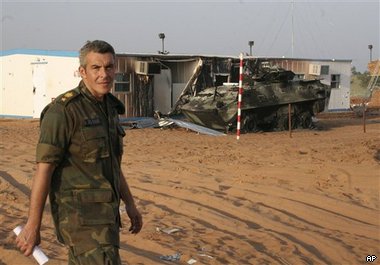

The rebels looted vehicles and ammunition, and it took Sudanese government troops to chase them away. Photos show government troops looting the leftovers, and burnt armoured vehicles. A quote from an anonymous officer underlines the stakes for the AU Force:
'"It may not be the right political thing to say, but the government forces saved us," said an AU officer, who also asked not to be named because of military regulations.'
The IHT published the first obvious article on the future of Darfur and peacekeeping, namely, whether this tragic incident won't un-nerve other nations considering contributing to the more robust hybrid AU-UN force for Darfur. A spokeman for OXFAM framed the attack in light of the kinds of threats that humanitarian agencies are facing:
'"It's indicative of the complete insecurity," said Alun McDonald, a spokesman for the Oxfam aid organization in Sudan. "These groups are attacking anybody and everybody with total impunity."
McDonald added that armed groups were "increasingly targeting aid workers to steal their vehicles, radios and logistical stuff."
He said the attack on the peacekeepers "sounds quite similar to that, just on a much larger scale."'
Tuesday, September 25, 2007
Sudan Advises Aid Agencies to Accept Military Escort Offer
VOA reports that the Sudanese government is warning UN agencies and aid groups that they should accept military escorts to travel through the Darfur region. This offer follows a day after OXFAM reported they would consider withdrawal from Darfur if the security situation did not improve.
Monday, September 24, 2007
NATO retreats from establishment of rapid-reaction force - International Herald Tribune
After months of telegraphing the difficulties of having non-troop contributing nations to shoulder the costs of deployments in Afghanistan, it is perhaps little surprising that NATO member-states have sunk the dream of a NATO Response Force.
"NATO has a problem that affects the EU as well. There are simply not enough troops. NATO is asking member states to sign up to the Response Force at a time when more troops are needed for Afghanistan. NATO has hit a ceiling. The Response Force is a luxury member states cannot afford."
Politics aside, it seems a sad ending that undermines efforts to bolster the Responsibility to Protect and support sustainable peacebuilding and peace support operations. If NATO member-states can't afford this 'luxury', who can?
"NATO has a problem that affects the EU as well. There are simply not enough troops. NATO is asking member states to sign up to the Response Force at a time when more troops are needed for Afghanistan. NATO has hit a ceiling. The Response Force is a luxury member states cannot afford."
Politics aside, it seems a sad ending that undermines efforts to bolster the Responsibility to Protect and support sustainable peacebuilding and peace support operations. If NATO member-states can't afford this 'luxury', who can?
UNDP Jobs- Consultant- Head of Security Unit, Moldova/Ukraine
UNDP is recruiting for a Head of Security Unit to serve as the Mission Security Advisor.
United States Insitute for Peace- US Police in Peace and Stability Operations
USIP has a recent publication examining why the US should carry through on plans to create a federal-level police reserve for international peace and stability operations.
Summary:
• The first obligation of an international intervention force in a peace or stability operation is to provide security for the civilian population. Inevitably the arrival of foreign military forces is followed by a breakdown of public order.
• Historically U.S. military forces have been unable or unwilling to perform police functions to control large-scale civil unrest. This was true in Iraq, where looters destroyed government buildings, cultural centers, and commercial areas.
• The United States lacks civilian constabulary (gendarmes) or other national police forces specially trained for crowd and riot control. Instead the U.S. relies on civil police provided by commercial contractors that do not perform this function.
• Fortunately the U.S. government is taking steps to address this deficiency. Current State Department plans call for creation of a Civilian Reserve Corps that would have a police component.
• There is no agreement on the ultimate size and character of this police capacity. However, the history of U.S. interventions from Panama to Iraq argues for a robust capability.
• A review of U.S. interventions in post-conflict environments demonstrates that the United States has repeatedly needed highly capable police forces but has lacked the capacity to respond effectively. The case studies in this report provide lessons applicable to future operations.
• The State Department’s current efforts are a useful first step that will give an opportunity to create the basic infrastructure for expansion of U.S. capabilities in peace and stability operations.
Summary:
• The first obligation of an international intervention force in a peace or stability operation is to provide security for the civilian population. Inevitably the arrival of foreign military forces is followed by a breakdown of public order.
• Historically U.S. military forces have been unable or unwilling to perform police functions to control large-scale civil unrest. This was true in Iraq, where looters destroyed government buildings, cultural centers, and commercial areas.
• The United States lacks civilian constabulary (gendarmes) or other national police forces specially trained for crowd and riot control. Instead the U.S. relies on civil police provided by commercial contractors that do not perform this function.
• Fortunately the U.S. government is taking steps to address this deficiency. Current State Department plans call for creation of a Civilian Reserve Corps that would have a police component.
• There is no agreement on the ultimate size and character of this police capacity. However, the history of U.S. interventions from Panama to Iraq argues for a robust capability.
• A review of U.S. interventions in post-conflict environments demonstrates that the United States has repeatedly needed highly capable police forces but has lacked the capacity to respond effectively. The case studies in this report provide lessons applicable to future operations.
• The State Department’s current efforts are a useful first step that will give an opportunity to create the basic infrastructure for expansion of U.S. capabilities in peace and stability operations.
UNAMA- Suicide Attacks in Afghanistan, 2001-2007
The United Nations Mission to Afghanistan has published an overview of Suicide Attacks in Afghanistan, 2001- 2007.
The paper notes that suicide attacks remain an alien phenomenon in Afghanistan. UNAMA has set out to raise awareness on the impact of the continuing conflict on Afghan civilians, and highlights that the victims of suicide attacks around 80% civilian. As has been reported elsewhere, the study notes that the death toll has remained relatively low, given the general ineptness of the bombers themselves.
The resulting guidelines revert to the typically big-picture ambitions associated with the Afghanistan nation-building project.
Immediate efforts are needed to diminish perceptions of a foreign military occupation:
- the counter insurgency forces must reduce civilian casualties and conscientiously work to uphold the dignity and honour of Afghans, to avoid provoking an outraged population into volunteering for jihad
- the Afghan national forces must be supported to increasingly assume responsibility for the provision of more effective security
- means must be found to engage other Muslim countries to help provide security and reconstruction in Afghanistan
Military approaches alone may have only marginal short-term impacts. Immediate political efforts are needed to undermine, contain and even constrict the insurgents’ support base. This will require the Afghan Government to:
- meet the demands of the population whose concerns and frustrations might otherwise drive them embrace the armed resistance
- reduce corruption, oversee fair judicial processes and focus on the provision of public services
- engage all relevant civil society groups - including religious authorities - to build a consensus against suicide attacks and their perpetrators. However, for such civil society actors to step up, their safety must be ensured
Eliminate suicide attacks cells through a mix of law and order, military operations and engagement:
- efforts must be made to compel volunteers to reject violence and adopt more constructive forces of change
- insurgents should be encouraged to express their grievances through political and democratic means
Address the cross border dimension of suicide attacks in Afghanistan:
- Pakistani supportiveness is required to eliminate domestic support for the insurgency in Afghanistan, to address militancy within its own borders, to reform governance in the tribal areas and invest in development
- the international community should encourage Pakistan and Afghanistan to embark upon a process through which all outstanding bilateral concerns are addressed and eventually resolved
The paper notes that suicide attacks remain an alien phenomenon in Afghanistan. UNAMA has set out to raise awareness on the impact of the continuing conflict on Afghan civilians, and highlights that the victims of suicide attacks around 80% civilian. As has been reported elsewhere, the study notes that the death toll has remained relatively low, given the general ineptness of the bombers themselves.
The resulting guidelines revert to the typically big-picture ambitions associated with the Afghanistan nation-building project.
Immediate efforts are needed to diminish perceptions of a foreign military occupation:
- the counter insurgency forces must reduce civilian casualties and conscientiously work to uphold the dignity and honour of Afghans, to avoid provoking an outraged population into volunteering for jihad
- the Afghan national forces must be supported to increasingly assume responsibility for the provision of more effective security
- means must be found to engage other Muslim countries to help provide security and reconstruction in Afghanistan
Military approaches alone may have only marginal short-term impacts. Immediate political efforts are needed to undermine, contain and even constrict the insurgents’ support base. This will require the Afghan Government to:
- meet the demands of the population whose concerns and frustrations might otherwise drive them embrace the armed resistance
- reduce corruption, oversee fair judicial processes and focus on the provision of public services
- engage all relevant civil society groups - including religious authorities - to build a consensus against suicide attacks and their perpetrators. However, for such civil society actors to step up, their safety must be ensured
Eliminate suicide attacks cells through a mix of law and order, military operations and engagement:
- efforts must be made to compel volunteers to reject violence and adopt more constructive forces of change
- insurgents should be encouraged to express their grievances through political and democratic means
Address the cross border dimension of suicide attacks in Afghanistan:
- Pakistani supportiveness is required to eliminate domestic support for the insurgency in Afghanistan, to address militancy within its own borders, to reform governance in the tribal areas and invest in development
- the international community should encourage Pakistan and Afghanistan to embark upon a process through which all outstanding bilateral concerns are addressed and eventually resolved
Doug Brooks' Ruthless Logic | Human Security Review
Human Security Review blogs an article by Doug Brooks that they describe as 'short and idiotic'- a perspective that we have to echo.
The idea of commercializing human security or military intervention is in itself not new- look at the grand successes in Iraq and Afghanistan, to take the most evident examples. That said, labelling humanitarian organizations and advocacy groups as ruthless is an odd comment, and one that is written from the uniquely integrationist approach to how the international community operates. This school of thought imagines that all actors, whatever their origin, raison d'etre, politics or principles, should join the 'one team, one mission' concept, and wear the same t-shirts. This school has some merits, while it is also terribly naive- the range of stakeholders, politics, means, resources, donors, politicians, regional groups, local dynamics, national politics, ethnic divisions, etc., etc. all overwhelm such simplistic concepts.
Perhaps Brooks' speculations would seem more credible if the private security sector had a real success story to trumpet their claims of being the 'all singing, all dancing' solution to the world's problems.
The idea of commercializing human security or military intervention is in itself not new- look at the grand successes in Iraq and Afghanistan, to take the most evident examples. That said, labelling humanitarian organizations and advocacy groups as ruthless is an odd comment, and one that is written from the uniquely integrationist approach to how the international community operates. This school of thought imagines that all actors, whatever their origin, raison d'etre, politics or principles, should join the 'one team, one mission' concept, and wear the same t-shirts. This school has some merits, while it is also terribly naive- the range of stakeholders, politics, means, resources, donors, politicians, regional groups, local dynamics, national politics, ethnic divisions, etc., etc. all overwhelm such simplistic concepts.
Perhaps Brooks' speculations would seem more credible if the private security sector had a real success story to trumpet their claims of being the 'all singing, all dancing' solution to the world's problems.
Coordinating Chaos - Peace and Conflict Society (PACS), Trudeau Centre for the Study of Peace and Conflict, University of Toronto
The Peace and Conflict Society (PACS) at the Trudeau Centre for the Study of Peace and Conflict at the University of Toronto is organizing a conference entitled 'Coordinating Choas' which might be of interest to readers.
'The Peace and Conflict Society’s third annual conference entitled Coordinating Chaos: Taking a Multi-Dimensional Approach to Stabilization Operations, focuses on the changing nature of humanitarian intervention and on how to integrate the multiple actors operating within conflict zones in order to foster a lasting peace. The conference seeks to advance the academic dialogue surrounding conflict intervention and to expand potential policy options available to global leaders whose decisions determine the fate of nations and directly impact global stability. Coordinating Chaos will examine the challenges of integrating political, military, economic, and humanitarian actors within conflict zones so as to develop coherent, multi-dimensional strategies for peace support and counterinsurgency operations.'
'The Peace and Conflict Society’s third annual conference entitled Coordinating Chaos: Taking a Multi-Dimensional Approach to Stabilization Operations, focuses on the changing nature of humanitarian intervention and on how to integrate the multiple actors operating within conflict zones in order to foster a lasting peace. The conference seeks to advance the academic dialogue surrounding conflict intervention and to expand potential policy options available to global leaders whose decisions determine the fate of nations and directly impact global stability. Coordinating Chaos will examine the challenges of integrating political, military, economic, and humanitarian actors within conflict zones so as to develop coherent, multi-dimensional strategies for peace support and counterinsurgency operations.'
Fight Less, Win More - the Afghanistan Counterinsurgency Academy
An interesting Washington Post article written by an instructor at the Afghanistan Counterinsurgency Academy.
'The grandly misnamed "academy" is a tiny collection of huts and tents on Kabul's dusty southern outskirts. Since May, motley classes of several dozen Afghan army officers, Afghan policemen, NATO officers, American officers and civilians have been learning and living side by side there for a week at a time.
The academy does much more than teach the theory and tactics of fighting the Taliban insurgents who are trying to unseat President Hamid Karzai and claw their way back to power. It is also a rare forum for military officers, civilian aid workers, academics and diplomats -- from Afghanistan and all 37 countries in NATO's International Security Assistance Force -- to unite in trying to bring good governance, prosperity and security to Afghanistan. The curriculum is based on the Army and Marine Corps' new counterinsurgency doctrine, released in December. Classes revolve around four so-called paradoxes of counterinsurgency. Unless we learn all four well, we'll continue to win battles in Afghanistan while losing the war.'
The theory sounds great, shame there isn't more online about this 'academy'. Where does one sign up for this week-long love-in of soldiers, aid workers and others??
'The grandly misnamed "academy" is a tiny collection of huts and tents on Kabul's dusty southern outskirts. Since May, motley classes of several dozen Afghan army officers, Afghan policemen, NATO officers, American officers and civilians have been learning and living side by side there for a week at a time.
The academy does much more than teach the theory and tactics of fighting the Taliban insurgents who are trying to unseat President Hamid Karzai and claw their way back to power. It is also a rare forum for military officers, civilian aid workers, academics and diplomats -- from Afghanistan and all 37 countries in NATO's International Security Assistance Force -- to unite in trying to bring good governance, prosperity and security to Afghanistan. The curriculum is based on the Army and Marine Corps' new counterinsurgency doctrine, released in December. Classes revolve around four so-called paradoxes of counterinsurgency. Unless we learn all four well, we'll continue to win battles in Afghanistan while losing the war.'
The theory sounds great, shame there isn't more online about this 'academy'. Where does one sign up for this week-long love-in of soldiers, aid workers and others??
UN INSTRAW - Gender, Peace and Security- Gender Training for Peacekeepers
 A good resource site that has a comprehensive overview of available gender training for peacekeepers. Curious to see how little is available in the Americas and East/South East Asia.
Standoff with Taliban leaves big Afghan dam project in limbo - International Herald Tribune
IHT has a great article on the seemingly desperate efforts to bring stability to Helmand Province via reconstruction projects. The cycle seems like that experienced in Iraq: initial attempts were made with a variety of largely private sector actors; insurgents/rebels starting direct attacks on the projects; civilian operators fled, and now a militarized USAID project does all it can to try and rebuild under fire.


Al Jazeera- Video of Taliban
With all the talk of hearts and minds, Al Jazeera embedded a cameraman with Taliban forces wandering about Northern Afghanistan.
Friday, September 14, 2007
The International Geneva Peacebuilding Guide- An Inventory of Geneva-based capacity and expertise
A new resource was launched this week by the Geneva Centre for Security Policy:
'This conference presents the preliminary findings of an analytical mapping that was undertaken as an integral part of ‘The UN Peacebuilding Commission and International Geneva’ project. Since late 2005, the GCSP and its partners have organised a series of events and public discussions looking at the implications for International Geneva of the work of the UN Peacebuilding Commission. The project has been developed by the Geneva Centre for Security Policy (GCSP) in collaboration with its partners, the Quaker United Nations Office in Geneva (QUNO), the Graduate Institute for International Studies (HEI/PSIS) and the Geneva Centre for Democratic Control of Armed Forces (DCAF). Financial support has been provided by the Swiss Federal Department of Foreign Affairs (FDFA) and the Geneva International Academic Network (GIAN).
Since 2006, the project and its partners have engaged a broad range of International Geneva stakeholders in discussions, workshops and public events, aimed at examining the importance of peacebuilding, and the formation of the UN Peacebuilding Commission (PBC). These events and discussions led to a number of findings and recommendations that looked at how International Geneva could influence peacebuilding issues including questions of financing, local ownership, civil society, expertise, analysis, networks and coordination. Please refer to Annex 3 for more details activities of the project to date.
To complement the ongoing discussions and events of 2006, it was decided to undertake an analytical mapping of the peacebuilding capacities and expertise of Geneva-based stakeholders. The results of this mapping have been made public in an online database, the ‘International Geneva Peacebuilding Guide’. This Guide allows users to conduct complex searches and filtering of the data collected from the mapping. The International Geneva Peacebuidlding Guide can be consulted at the following link: http://www.gcsp.ch/e/publications/IGPeaceProject/Guide/index.htm.
The preliminary findings of the project to date are included in this document, and offer a first glimpse of the data collected as of 09 September 2007. We are able to have a comprehensive look at the topography of the International Geneva peacebuilding landscape, the types of organisations present, the countries in which these organisations are engaged, the peacebuilding sectors in which they are active, and the types of activities they undertake. A total of 69 organisations have provided detailed information on on up to 3 peacebuilding sectors where they feel they have the greatest added value, and have also elaborated on how they engage in these priority sectors in the actual and potential PBC focus countries.'
The Guide can be accessed here.
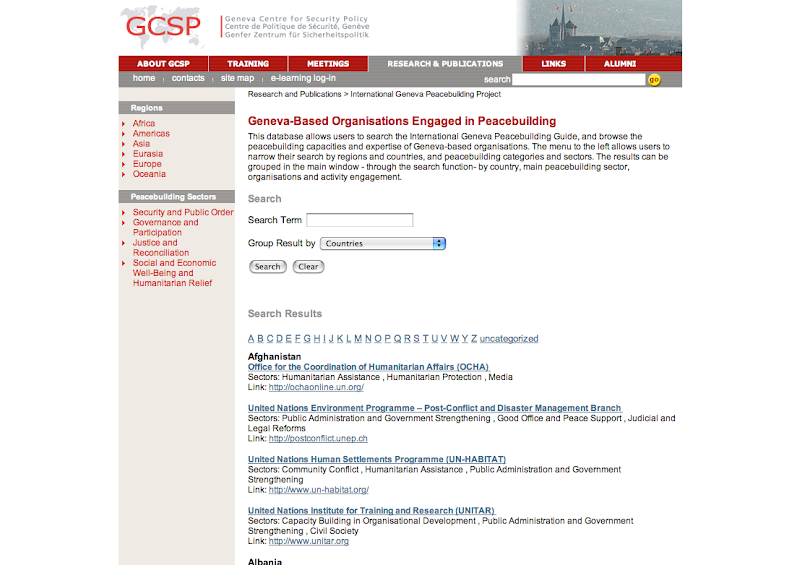
'This conference presents the preliminary findings of an analytical mapping that was undertaken as an integral part of ‘The UN Peacebuilding Commission and International Geneva’ project. Since late 2005, the GCSP and its partners have organised a series of events and public discussions looking at the implications for International Geneva of the work of the UN Peacebuilding Commission. The project has been developed by the Geneva Centre for Security Policy (GCSP) in collaboration with its partners, the Quaker United Nations Office in Geneva (QUNO), the Graduate Institute for International Studies (HEI/PSIS) and the Geneva Centre for Democratic Control of Armed Forces (DCAF). Financial support has been provided by the Swiss Federal Department of Foreign Affairs (FDFA) and the Geneva International Academic Network (GIAN).
Since 2006, the project and its partners have engaged a broad range of International Geneva stakeholders in discussions, workshops and public events, aimed at examining the importance of peacebuilding, and the formation of the UN Peacebuilding Commission (PBC). These events and discussions led to a number of findings and recommendations that looked at how International Geneva could influence peacebuilding issues including questions of financing, local ownership, civil society, expertise, analysis, networks and coordination. Please refer to Annex 3 for more details activities of the project to date.
To complement the ongoing discussions and events of 2006, it was decided to undertake an analytical mapping of the peacebuilding capacities and expertise of Geneva-based stakeholders. The results of this mapping have been made public in an online database, the ‘International Geneva Peacebuilding Guide’. This Guide allows users to conduct complex searches and filtering of the data collected from the mapping. The International Geneva Peacebuidlding Guide can be consulted at the following link: http://www.gcsp.ch/e/publications/IGPeaceProject/Guide/index.htm.
The preliminary findings of the project to date are included in this document, and offer a first glimpse of the data collected as of 09 September 2007. We are able to have a comprehensive look at the topography of the International Geneva peacebuilding landscape, the types of organisations present, the countries in which these organisations are engaged, the peacebuilding sectors in which they are active, and the types of activities they undertake. A total of 69 organisations have provided detailed information on on up to 3 peacebuilding sectors where they feel they have the greatest added value, and have also elaborated on how they engage in these priority sectors in the actual and potential PBC focus countries.'
The Guide can be accessed here.
Monday, August 20, 2007
UN praises Indian women police officers deployed in Liberia - Yahoo! India News
We posted earlier on the deployment of 125 Indian Para-military forces soliders to Liberia. Great to see that they are receiving well-deserved praise for their work:
'New York, Aug 19 (PTI) Indian women police officers - members of the first ever all female unit deployed by the UN - have come in for high praise from the world body's officials who commended their work in emergency situations as also in crime prevention in Liberia where they are posted.
As a mark of the appreciation, UN Secretary-General Ban Ki-moon's Special Representative Alan Doss decorated the officers - who have also been praised for their unflinching support to the National Police in Liberia (NPL) - with the UN Peacekeeping Medals at an impressive ceremony in the Liberian capital, Monrovia.
"Though a new beginning for gender equality in peacekeeping, this deployment is a continuation of India's consistent commitment to peacekeeping operations," Doss said. "All of you standing here represent a proud tradition of service to international peace." Also present at the ceremony were Force Commander Lt Gen Chikadibia Isaac Obiakor, Director of Administration Stephen Lieberman, the Inspector-General of the Liberia National Police Beatrice Munah Sieh, UNPOL Acting Commissioner, General Maritz Du Toit; the Consul-General of India Upjit Singh Sachdeva and other Government officials.
The United Nations Mission in Liberia (UNMIL) is currently assisting the NPL to attract more women into the police.'
'New York, Aug 19 (PTI) Indian women police officers - members of the first ever all female unit deployed by the UN - have come in for high praise from the world body's officials who commended their work in emergency situations as also in crime prevention in Liberia where they are posted.
As a mark of the appreciation, UN Secretary-General Ban Ki-moon's Special Representative Alan Doss decorated the officers - who have also been praised for their unflinching support to the National Police in Liberia (NPL) - with the UN Peacekeeping Medals at an impressive ceremony in the Liberian capital, Monrovia.
"Though a new beginning for gender equality in peacekeeping, this deployment is a continuation of India's consistent commitment to peacekeeping operations," Doss said. "All of you standing here represent a proud tradition of service to international peace." Also present at the ceremony were Force Commander Lt Gen Chikadibia Isaac Obiakor, Director of Administration Stephen Lieberman, the Inspector-General of the Liberia National Police Beatrice Munah Sieh, UNPOL Acting Commissioner, General Maritz Du Toit; the Consul-General of India Upjit Singh Sachdeva and other Government officials.
The United Nations Mission in Liberia (UNMIL) is currently assisting the NPL to attract more women into the police.'
Sunday, August 19, 2007
East African and Southern African Nations Creating Regional Peacekeeping Force
Voice of America has a piece introducing the new Eastern African Standby Brigade (EASBRIG).
'Kenyan President Mwai Kibaki opened the defense ministers' council meeting in Nairobi with a call for financial support and troop contributions to a new stand-by force. Mr. Kibaki said that troops should be available within three years to handle any crisis, from terrorist attacks to natural disasters, on the African continent.
The new force, to be called the Eastern Africa Standby Brigade (EASBRIG) has its headquarters in Ethiopia's capital, Addis Ababa, as well as a planning department in Kenya. Though exact numbers of soldiers have yet to be announced, military officials have said EASBRIG will be made up of five brigades.
Officials of the Inter-Governmental Authority on Development (IGAD), a seven-country regional development organization in East Africa, say the new force is needed, because they are overwhelmed with demands for troops to be sent to war-torn areas on the continent, including Sudan's Darfur region, Somalia and Democratic Republic of Congo.'
In a case of duelling-launches, the SADC announced the creation of their own Southern African peacekeeping brigade on the same day.
'Kenyan President Mwai Kibaki opened the defense ministers' council meeting in Nairobi with a call for financial support and troop contributions to a new stand-by force. Mr. Kibaki said that troops should be available within three years to handle any crisis, from terrorist attacks to natural disasters, on the African continent.
The new force, to be called the Eastern Africa Standby Brigade (EASBRIG) has its headquarters in Ethiopia's capital, Addis Ababa, as well as a planning department in Kenya. Though exact numbers of soldiers have yet to be announced, military officials have said EASBRIG will be made up of five brigades.
Officials of the Inter-Governmental Authority on Development (IGAD), a seven-country regional development organization in East Africa, say the new force is needed, because they are overwhelmed with demands for troops to be sent to war-torn areas on the continent, including Sudan's Darfur region, Somalia and Democratic Republic of Congo.'
In a case of duelling-launches, the SADC announced the creation of their own Southern African peacekeeping brigade on the same day.
Afghanistan
A German woman was kidnapped in broad daylight from a Kabul bakery popular with foreigners. Her male expatriate colleague was not taken.
Canadian Prime Minister Harper continue to trumpet his armed forces 'humanitarian' work in Afghanistan to his electorate in an attempt to maintain public support for the deployment. Germany is not ruling out further troop contributions for Afghanistan, despite sharing similar Canadian reticence to go down the road of combat deployments.
Great piece entitled, 'Professors on the Battlefield', showcasing the deployment of social scientists with US forces in Iraq and Afghanistan as cultural advisors to Brigade Commanders. If it isn't enough that humanitarians denounce the blurring of lines between military and humanitarian action, the American Anthropological Association recalls the irreparable damage done to academia by 'militarization of the social sciences' that affected their profession in the 60's and 70's. The article captures the worrying comparison to that which humanitarian organizations face in speaking with donors, diplomats and armed forces:
'In recent years, the annual meetings of the American Psychiatric Association, the American Psychological Association and the American Anthropological Association have been dominated by discussion about what ethical responsibilities scholars have in relation to war, terrorism and torture. At such events, Ms. McFate and her rare sympathizers often sound like a lone voice in the wilderness.'
Finally, it seems that PRTs are in season again: a DefenseLink 'good news' piece on PRTs in Afghanistan.
More YouTube- Australian PRTs in Afghanistan
Two personal interest pieces on YouTube, showcasing Australian PRT successes in Afghanistan:
Thanks to Warisboring for the links.
Thanks to Warisboring for the links.
Thursday, August 09, 2007
PRTs in Iraq | MountainRunner
MountainRunner has a comprehensive post that includes the best overview of PRTs (Provincial Reconstruction Teams) of the US armed forces in Iraq that we have seen thus far.
Afghanistan- NGOs question new government directive on armed escorts IRIN Asia | Asia | Afghanistan | AFGHANISTAN: NGOs question new government directive on armed escorts | Governance Conflict Aid Policy | News Item
'Afghanistan’s Ministry of Interior has ordered Afghan security forces not to allow foreign aid workers to travel outside Kabul without an armed escort.'
In the aftermath of the ongoing hostage crises in Afghanistan, the move was probably inevitable, as are the reactions by NGOs:
'...The Afghan security authorities have repeatedly requested all foreign aid workers to seek their advice before travelling beyond Kabul city.
“We would not be facing the current crisis if the Koreans had informed us about their travel plans in advance,” said Zemarai Bashari, a spokesman for the Interior Ministry (MoI). “We could have provided them with an armed escort for their protection,” he added.
The government of Afghanistan has expressed it readiness to provide armed police escorts for international staff who would like to drive out of the capital, officials said.
However, representatives of local and international NGOs have dubbed the government’s extra security measures “disproportionate” and “counterproductive”.
“Armed escorts will undoubtedly make NGOs a legitimate target for anti-government elements,” said Hashim Mayar, deputy director of ACBAR - a coordination umbrella for NGOs in Afghanistan.
Mayar also said that in light of criticisms of widespread corruption and inefficiency within the MoI, many NGOs fear disclosing an advanced itinerary to the Afghan police, fearing it would increase possible risks.
Matt Waldman, an adviser to the UK charity Oxfam, said: “Whilst we understand the reasons for this move, we believe it is disproportionate and could have adverse consequences for development works, particularly in rural areas.”'
Disproportionate does seem to characterize many aspects of this story. In particular, how many agencies were truly working far outside the relative safety of Kabul (or other urban centres...) and as such would truly be affected by this travel restriction- if we can even call it that- ?
In the aftermath of the ongoing hostage crises in Afghanistan, the move was probably inevitable, as are the reactions by NGOs:
'...The Afghan security authorities have repeatedly requested all foreign aid workers to seek their advice before travelling beyond Kabul city.
“We would not be facing the current crisis if the Koreans had informed us about their travel plans in advance,” said Zemarai Bashari, a spokesman for the Interior Ministry (MoI). “We could have provided them with an armed escort for their protection,” he added.
The government of Afghanistan has expressed it readiness to provide armed police escorts for international staff who would like to drive out of the capital, officials said.
However, representatives of local and international NGOs have dubbed the government’s extra security measures “disproportionate” and “counterproductive”.
“Armed escorts will undoubtedly make NGOs a legitimate target for anti-government elements,” said Hashim Mayar, deputy director of ACBAR - a coordination umbrella for NGOs in Afghanistan.
Mayar also said that in light of criticisms of widespread corruption and inefficiency within the MoI, many NGOs fear disclosing an advanced itinerary to the Afghan police, fearing it would increase possible risks.
Matt Waldman, an adviser to the UK charity Oxfam, said: “Whilst we understand the reasons for this move, we believe it is disproportionate and could have adverse consequences for development works, particularly in rural areas.”'
Disproportionate does seem to characterize many aspects of this story. In particular, how many agencies were truly working far outside the relative safety of Kabul (or other urban centres...) and as such would truly be affected by this travel restriction- if we can even call it that- ?
Wednesday, August 08, 2007
Iraq- Video: Inside the Surge
The Guardian's Sean Smith has a good short film on the surge in Iraq. Part II can be found here.
Afghanistan- Servicemembers Volunteer to Convoy Supplies to Needy Afghans
'Every other week, servicemembers from all branches of the military conduct convoys from this base to deliver clothing and supplies to needy Afghans in the surrounding areas. But they're not doing it because they have to. They're doing it because they want to help.
Members of the Combined Security Transition Command Afghanistan unload a truck full of donations from the U.S. at a refugee camp outside of Kabul, Afghanistan. Photo by Air Force Master Sgt. Jim Varhegyi
(Click photo for screen-resolution image);high-resolution image available.
“These are military and coalition members who volunteer,” said Air Force Lt. Col. Michael Weber, Camp Eggers garrison chaplain. “They participate on their own time and at their own risk to do something good for the people of Afghanistan.”
The chaplains on Camp Eggers have organized the deliveries as part of a community relations program. Working with local religious leaders, as well as various government and relief agencies, the program organizers plan their missions to deliver aid to areas most in need of the assistance.'
Members of the Combined Security Transition Command Afghanistan unload a truck full of donations from the U.S. at a refugee camp outside of Kabul, Afghanistan. Photo by Air Force Master Sgt. Jim Varhegyi
(Click photo for screen-resolution image);high-resolution image available.
“These are military and coalition members who volunteer,” said Air Force Lt. Col. Michael Weber, Camp Eggers garrison chaplain. “They participate on their own time and at their own risk to do something good for the people of Afghanistan.”
The chaplains on Camp Eggers have organized the deliveries as part of a community relations program. Working with local religious leaders, as well as various government and relief agencies, the program organizers plan their missions to deliver aid to areas most in need of the assistance.'
US Civil Affairs- Peace Through Puppets
One article lead us to dig deeper into this phenomenon: Peace Through Puppets.
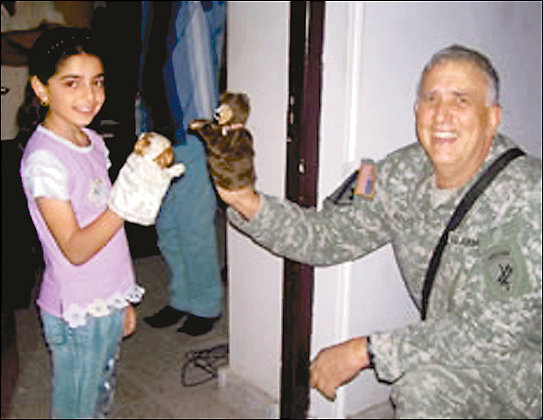
'The reaction was immediate when Army 1st Sgt. Bruce L. Reges strode into the classroom in the Baghdad suburb of Baqubah, in the volatile Diyala province.
At 6-foot-5 and wearing full body armor, Reges, 57, looked fearsome to the schoolchildren. Outside, two Stryker armored vehicles blocked the street. A heavily armed security detail was checking out the roof and other classrooms.
Reges is assigned to an Army civil affairs unit out of Fort Bragg, N.C., working to reconstruct and support schools, irrigation projects and honey farms in Diyala. The team was visiting the school to assess what could be done to help, but the young students were terrified.
"Two of the girls started to cry and escape somehow, and the teacher had to calm them down and tell them that we were there to help them, not to hurt them," Reges recalled. "It was emotionally tough for me to see a child so traumatized by U.S. soldiers that they reacted that way."'
You can guess at the rest of the article- an email to his mom, the inevitable shipment of handpuppets assembled by concerned mothers in Reston, Louisiana and now Civl Affairs soldiers in Afghanistan and Iraq are not to be found without a 'puppet in their pocket', so to speak. As with the best things in life, you can donoate money via PayPal on the website (20 USD = 12 soft puppets), in addition to enjoying photos of thoroughly softened US troops in body armor, wrap-around sunglasses and hand puppets... Other armed forces can seemingly request their own puppets with a simple mail to peacethrupuppets@aol.com.
'The reaction was immediate when Army 1st Sgt. Bruce L. Reges strode into the classroom in the Baghdad suburb of Baqubah, in the volatile Diyala province.
At 6-foot-5 and wearing full body armor, Reges, 57, looked fearsome to the schoolchildren. Outside, two Stryker armored vehicles blocked the street. A heavily armed security detail was checking out the roof and other classrooms.
Reges is assigned to an Army civil affairs unit out of Fort Bragg, N.C., working to reconstruct and support schools, irrigation projects and honey farms in Diyala. The team was visiting the school to assess what could be done to help, but the young students were terrified.
"Two of the girls started to cry and escape somehow, and the teacher had to calm them down and tell them that we were there to help them, not to hurt them," Reges recalled. "It was emotionally tough for me to see a child so traumatized by U.S. soldiers that they reacted that way."'
You can guess at the rest of the article- an email to his mom, the inevitable shipment of handpuppets assembled by concerned mothers in Reston, Louisiana and now Civl Affairs soldiers in Afghanistan and Iraq are not to be found without a 'puppet in their pocket', so to speak. As with the best things in life, you can donoate money via PayPal on the website (20 USD = 12 soft puppets), in addition to enjoying photos of thoroughly softened US troops in body armor, wrap-around sunglasses and hand puppets... Other armed forces can seemingly request their own puppets with a simple mail to peacethrupuppets@aol.com.
SOMALIA: Call for agencies to scale up aid operations in capital
UN official makes the call for aid agencies to step up their activities in Somalia, taking advantage of military escorts and protected compounds in Somalia:
'A senior UN official has urged humanitarian agencies to take advantage of security provided by African Union troops in Mogadishu to improve the delivery of aid to tens of thousands of displaced people camped in surrounding areas.
"Response [to the crisis] has not been adequate because of difficulties of access and too many security incidents," Eric Laroche, the UN Resident and Humanitarian Coordinator for Somalia, said on 2 August, a day after a visit to Mogadishu.
Aid agencies should be mobilised to scale up their operations in the Somali capital, he said, adding that this would help get relief supplies both to the city and the surrounding areas.
He said the availability of African Union security escorts facilitated his visit to Mogadishu and the Afgoye.
"We are starting to have access and we need to use it," Laroche said. "If we can operate from Mogadishu, we can reach more people."'
'A senior UN official has urged humanitarian agencies to take advantage of security provided by African Union troops in Mogadishu to improve the delivery of aid to tens of thousands of displaced people camped in surrounding areas.
"Response [to the crisis] has not been adequate because of difficulties of access and too many security incidents," Eric Laroche, the UN Resident and Humanitarian Coordinator for Somalia, said on 2 August, a day after a visit to Mogadishu.
Aid agencies should be mobilised to scale up their operations in the Somali capital, he said, adding that this would help get relief supplies both to the city and the surrounding areas.
He said the availability of African Union security escorts facilitated his visit to Mogadishu and the Afgoye.
"We are starting to have access and we need to use it," Laroche said. "If we can operate from Mogadishu, we can reach more people."'
Thursday, August 02, 2007
AFRICOM: A Wolf in Sheep's Clothing?
Refugees International was invited to testify before the Subcommittee on African Affairs, Committee on Foreign Relations. They have posted the complete testimony entitled AFRICOM: A Wolf in Sheep's Clothing here. Have cut a few clips from the presentation, Mark Malan doesn't waste many words on niceties and gives a comprehensive view of how AFRICOM risks undermining US (and more globally, NGO) interests in Africa:
'In some parts of the world, like Iraq and Afghanistan, the face of US foreign policy is clearly a military one. In Africa, the DoD appears to be putting a civilian mask on the face of a combatant command, with its marketing pitch for AFRICOM. This disingenuous strategy is not working. The veneer of the mask is simply too thin, and attempts to patch the holes that have emerged—by telling us “what AFRICOM is not about” and re-emphasizing a humanitarian and developmental role for the US military in Africa—simply make the face of US foreign policy much shadier....
There is much sense in the argument for inter-agency cooperation; what does not make sense is linking this to a combatant command. According to one of Africa’s leading security analysts, AFRICOM should be orientated to an appropriate and clearly delineated role, with non-military issues kept outside of its grasp: “The much-vaunted inter-agency staff to be included in AFRICOM should be seen for what it is—the further co-option and subjugation of US foreign and development policy to a neocolonial agenda which is inimical to Africa and ironically, to the US itself.”
...The main concern of operational NGOs is that AFRICOM will increase the trend towards the militarization of humanitarian action, which raises fundamental concerns about the purpose of such assistance. Security objectives envisioned in the short term can run at cross purposes to the longer-term vision of creating stable and sustainable institutions that are accountable and responsive to the needs and aspirations of all segments of the population. Such concerns are amplified by the way AFRICOM is being presented as a tool for integrating US military, political, and humanitarian objectives under a unified military command.'
Malan's conclusions are good ones: he proposes that AFRICOM limit its purely extra-miliary role fo defence sector reform and support to the building o African peacekeeping and Standby Force capacity- already a significant workload.
'In some parts of the world, like Iraq and Afghanistan, the face of US foreign policy is clearly a military one. In Africa, the DoD appears to be putting a civilian mask on the face of a combatant command, with its marketing pitch for AFRICOM. This disingenuous strategy is not working. The veneer of the mask is simply too thin, and attempts to patch the holes that have emerged—by telling us “what AFRICOM is not about” and re-emphasizing a humanitarian and developmental role for the US military in Africa—simply make the face of US foreign policy much shadier....
There is much sense in the argument for inter-agency cooperation; what does not make sense is linking this to a combatant command. According to one of Africa’s leading security analysts, AFRICOM should be orientated to an appropriate and clearly delineated role, with non-military issues kept outside of its grasp: “The much-vaunted inter-agency staff to be included in AFRICOM should be seen for what it is—the further co-option and subjugation of US foreign and development policy to a neocolonial agenda which is inimical to Africa and ironically, to the US itself.”
...The main concern of operational NGOs is that AFRICOM will increase the trend towards the militarization of humanitarian action, which raises fundamental concerns about the purpose of such assistance. Security objectives envisioned in the short term can run at cross purposes to the longer-term vision of creating stable and sustainable institutions that are accountable and responsive to the needs and aspirations of all segments of the population. Such concerns are amplified by the way AFRICOM is being presented as a tool for integrating US military, political, and humanitarian objectives under a unified military command.'
Malan's conclusions are good ones: he proposes that AFRICOM limit its purely extra-miliary role fo defence sector reform and support to the building o African peacekeeping and Standby Force capacity- already a significant workload.
Wednesday, August 01, 2007
Haiti- UN Peacekeeping Force Evolving to a Policing Role
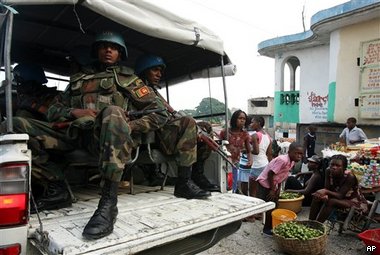
In the lead-up to the UN Secretary General's visit, Haiti is getting some long-merited attention. This AP article takes a balanced look at the challenges facing peacekeeping and peacebuilding in the Haitian state.
Haiti is in a transitional phase, where it is out of immediate crisis, but where, 'The senior U.N. envoy to Haiti says it is too soon for the U.N. to consider withdrawing its 8,800-strong, Brazil-led peacekeeping force, noting past failed attempts to help the country... "An early withdrawal right now would be a big mistake, 'Big' with a capital letter," Edmond Mulet said in a recent interview with The Associated Press. "This is a time to hold on, to make this work this time."'
The challenge is that UN military peacekeepers are obliged to undertake what is essentially a policing function. '... the U.N. mission eventually hopes to use more civilian police than soldiers but is hampered by a world shortage of trained, French-speaking officers... The peacekeepers provide more than 80 percent of Haiti's security needs, but the government is working to eventually take over that responsibility. The national police academy is pumping out hundreds of recruits, trying bolster the nation's small police force of 6,000.'
Chronic poverty and gangs, drug-traffickers still pose a threat to real peace and stability in Haiti, with official suggesting that a UN force will be need until President Preval's term ends in 2011.
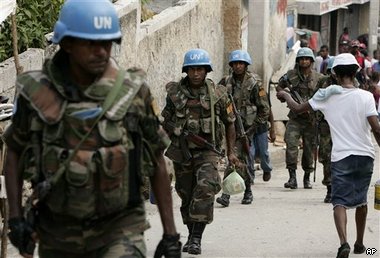
Resource- Guidelines for Relations Between US Armed Forces and Non-Governmental Humanitarian Organizations
The United States Institute of Peace launched their Guidelines for Relations Between US Armed Forces and Non-Governmental Humanitarian Organizations on 24 July 2007.
Have pasted in the broad recommendations for armed forces and humanitarian agencies. Taken out of context, it might look a bit simplistic. There's much more in the guidelines, and the processes aspect is particularly well done. One can only guess at how difficult it was in finding 'lowest common denominators' for such a diverse audience. One can quickly find some issues of contention, such as: 'In situations in which there is no actor to servea as a bridge, a US military Civil Affairs cell could serve as a temporary point-of-contact between NGHOs and other elements of the US Armed Forces.' What about OCHA's CMCS?
To be seen how US stakeholders will implement this- and who will enforce it?
'On July 24, 2007, leaders of the U.S. military and NGO community celebrated a promising moment for civil-military relations in peace operations: the rollout of Guidelines that will serve as “rules of the road” for how the two entities operate in hostile environments.
Facilitated by the U.S. Institute of Peace, the Guidelines seek to mitigate frictions between military and NGO personnel over the preservation of humanitarian space in places like Afghanistan and Iraq. Principles in the Guidelines include ensuring that military personnel wear uniforms when conducting relief activities to avoid being mistaken for nongovernmental humanitarian organization representatives. Conversely, it recommends that humanitarian relief personnel avoid traveling in U.S. Armed Forces vehicles with the exception of liaison personnel to the extent practical.
The heads of both the U.S. military and InterAction (an umbrella organization for U.S. NGOs) have endorsed the Guidelines and will be disseminating them throughout their organizations. Two years in the making, the effort represents “a desire from both sides to move beyond polemics to proactive problem solving,” said Jeb Nadaner, Deputy Assistant Secretary of Defense for Stability Operations at the Pentagon. NGO leaders likewise expressed optimism at the potential for change. “We do not want to understate the importance of this document for us,” said Sam Worthington, InterAction President and CEO. “We believe that these guidelines will serve a purpose beyond U.S. NGOs to our global partners.”
The initiative was launched in March 2005 when Amb. Carlos Pascual, Coordinator for Reconstruction and Stabilization at the U.S. State Department, asked the Institute to establish a Working Group on Civil-Military Relations in Non-permissive Environments. What began as a dialogue between military and NGO leaders has resulted in a pioneering effort upon which both sides hope to expand. Military and NGO leaders intend to promulgate the Guidelines throughout their communities via media and education channels: NGOs will publish the Guidelines in their newsletters and literature; the military will incorporate the Guidelines into joint military doctrine publications. The next challenge lies in implementing the Guidelines in the field and creating a monitoring mechanism by which the Guidelines can be continuously tested and revised.
For the U.S. Armed Forces, the following guidelines should be observed consistent with military force protection, mission accomplishment, and operational requirements:
1. When conducting relief activities, military personnel should wear uniforms or other distinctive clothing to avoid being mis taken for NGHO representatives. U.S. Armed Forces personnel and units should not display NGHO logos on any military cloth ing, vehicles, or equipment. This does not preclude the appro priate use of symbols recognized under the law of war, such as a red cross, when appropriate. U.S. Armed Forces may use such symbols on military clothing, vehicles, and equipment in appropriate situations.
2. Visits by U.S. Armed Forces personnel to NGHO sites should be by prior arrangement.
3. U.S. Armed Forces should respect NGHO views on the bearing of arms within NGHO sites.
4. U.S. Armed Forces should give NGHOs the option of meeting with U.S. Armed Forces personnel outside military installations for information exchanges.
5. U.S. Armed Forces should not describe NGHOs as “force mul tipliers” or “partners” of the military, or in any other fashion.
6. U.S. Armed Forces personnel and units should avoid interfer ing with NGHO relief efforts directed toward segments of the civilian population that the military may regard as unfriendly.
7. U.S. Armed Forces personnel and units should respect the de sire of NGHOs not to serve as implementing partners for the military in conducting relief activities. However, individual NGOs may seek to cooperate with the military, in which case such cooperation will be carried out with due regard to avoid ing compromise of the security, safety, and independence of the NGHO community at large, NGHO representatives, or public perceptions of their independence.
For NGHOs, the following guidelines should be observed:
1. NGHO personnel should not wear military-style clothing. This is not meant to preclude NGHO personnel from wearing protec tive gear, such as helmets and protective vests, provided that such items are distinguishable in color/appearance from U.S. Armed Forces issue items.
2. NGHO travel in U.S. Armed Forces vehicles should be limited to liaison personnel to the extent practical.
3. NGHOs should not have facilities co-located with facilities in habited by U.S. Armed Forces personnel.
4. NGHOs should use their own logos on clothing, vehicles, and buildings when security conditions permit.
5. NGHO personnel’s visits to military facilities/sites should be by prior arrangement.
6. Except for liaison arrangements detailed in the sections that follow, NGHOs should minimize their activities at military bases and with U.S. Armed Forces personnel of a nature that might compromise their independence.
7. NGHOs may, as a last resort, request military protection for convoys delivering humanitarian assistance, take advantage of essential logistics support available only from the military, or accept evacuation assistance for medical treatment or to evacuate from a hostile environment. Provision of such mili tary support to NGHOs rests solely within the discretion of the military forces and will not be undertaken if it interferes with higher priority military activities. Support generally will be provided on a reimbursable basis in accordance with appli cable U.S. law.'
Have pasted in the broad recommendations for armed forces and humanitarian agencies. Taken out of context, it might look a bit simplistic. There's much more in the guidelines, and the processes aspect is particularly well done. One can only guess at how difficult it was in finding 'lowest common denominators' for such a diverse audience. One can quickly find some issues of contention, such as: 'In situations in which there is no actor to servea as a bridge, a US military Civil Affairs cell could serve as a temporary point-of-contact between NGHOs and other elements of the US Armed Forces.' What about OCHA's CMCS?
To be seen how US stakeholders will implement this- and who will enforce it?
'On July 24, 2007, leaders of the U.S. military and NGO community celebrated a promising moment for civil-military relations in peace operations: the rollout of Guidelines that will serve as “rules of the road” for how the two entities operate in hostile environments.
Facilitated by the U.S. Institute of Peace, the Guidelines seek to mitigate frictions between military and NGO personnel over the preservation of humanitarian space in places like Afghanistan and Iraq. Principles in the Guidelines include ensuring that military personnel wear uniforms when conducting relief activities to avoid being mistaken for nongovernmental humanitarian organization representatives. Conversely, it recommends that humanitarian relief personnel avoid traveling in U.S. Armed Forces vehicles with the exception of liaison personnel to the extent practical.
The heads of both the U.S. military and InterAction (an umbrella organization for U.S. NGOs) have endorsed the Guidelines and will be disseminating them throughout their organizations. Two years in the making, the effort represents “a desire from both sides to move beyond polemics to proactive problem solving,” said Jeb Nadaner, Deputy Assistant Secretary of Defense for Stability Operations at the Pentagon. NGO leaders likewise expressed optimism at the potential for change. “We do not want to understate the importance of this document for us,” said Sam Worthington, InterAction President and CEO. “We believe that these guidelines will serve a purpose beyond U.S. NGOs to our global partners.”
The initiative was launched in March 2005 when Amb. Carlos Pascual, Coordinator for Reconstruction and Stabilization at the U.S. State Department, asked the Institute to establish a Working Group on Civil-Military Relations in Non-permissive Environments. What began as a dialogue between military and NGO leaders has resulted in a pioneering effort upon which both sides hope to expand. Military and NGO leaders intend to promulgate the Guidelines throughout their communities via media and education channels: NGOs will publish the Guidelines in their newsletters and literature; the military will incorporate the Guidelines into joint military doctrine publications. The next challenge lies in implementing the Guidelines in the field and creating a monitoring mechanism by which the Guidelines can be continuously tested and revised.
For the U.S. Armed Forces, the following guidelines should be observed consistent with military force protection, mission accomplishment, and operational requirements:
1. When conducting relief activities, military personnel should wear uniforms or other distinctive clothing to avoid being mis taken for NGHO representatives. U.S. Armed Forces personnel and units should not display NGHO logos on any military cloth ing, vehicles, or equipment. This does not preclude the appro priate use of symbols recognized under the law of war, such as a red cross, when appropriate. U.S. Armed Forces may use such symbols on military clothing, vehicles, and equipment in appropriate situations.
2. Visits by U.S. Armed Forces personnel to NGHO sites should be by prior arrangement.
3. U.S. Armed Forces should respect NGHO views on the bearing of arms within NGHO sites.
4. U.S. Armed Forces should give NGHOs the option of meeting with U.S. Armed Forces personnel outside military installations for information exchanges.
5. U.S. Armed Forces should not describe NGHOs as “force mul tipliers” or “partners” of the military, or in any other fashion.
6. U.S. Armed Forces personnel and units should avoid interfer ing with NGHO relief efforts directed toward segments of the civilian population that the military may regard as unfriendly.
7. U.S. Armed Forces personnel and units should respect the de sire of NGHOs not to serve as implementing partners for the military in conducting relief activities. However, individual NGOs may seek to cooperate with the military, in which case such cooperation will be carried out with due regard to avoid ing compromise of the security, safety, and independence of the NGHO community at large, NGHO representatives, or public perceptions of their independence.
For NGHOs, the following guidelines should be observed:
1. NGHO personnel should not wear military-style clothing. This is not meant to preclude NGHO personnel from wearing protec tive gear, such as helmets and protective vests, provided that such items are distinguishable in color/appearance from U.S. Armed Forces issue items.
2. NGHO travel in U.S. Armed Forces vehicles should be limited to liaison personnel to the extent practical.
3. NGHOs should not have facilities co-located with facilities in habited by U.S. Armed Forces personnel.
4. NGHOs should use their own logos on clothing, vehicles, and buildings when security conditions permit.
5. NGHO personnel’s visits to military facilities/sites should be by prior arrangement.
6. Except for liaison arrangements detailed in the sections that follow, NGHOs should minimize their activities at military bases and with U.S. Armed Forces personnel of a nature that might compromise their independence.
7. NGHOs may, as a last resort, request military protection for convoys delivering humanitarian assistance, take advantage of essential logistics support available only from the military, or accept evacuation assistance for medical treatment or to evacuate from a hostile environment. Provision of such mili tary support to NGHOs rests solely within the discretion of the military forces and will not be undertaken if it interferes with higher priority military activities. Support generally will be provided on a reimbursable basis in accordance with appli cable U.S. law.'
Subscribe to:
Posts (Atom)


