Voice of America has a piece introducing the new Eastern African Standby Brigade (EASBRIG).
'Kenyan President Mwai Kibaki opened the defense ministers' council meeting in Nairobi with a call for financial support and troop contributions to a new stand-by force. Mr. Kibaki said that troops should be available within three years to handle any crisis, from terrorist attacks to natural disasters, on the African continent.
The new force, to be called the Eastern Africa Standby Brigade (EASBRIG) has its headquarters in Ethiopia's capital, Addis Ababa, as well as a planning department in Kenya. Though exact numbers of soldiers have yet to be announced, military officials have said EASBRIG will be made up of five brigades.
Officials of the Inter-Governmental Authority on Development (IGAD), a seven-country regional development organization in East Africa, say the new force is needed, because they are overwhelmed with demands for troops to be sent to war-torn areas on the continent, including Sudan's Darfur region, Somalia and Democratic Republic of Congo.'
In a case of duelling-launches, the SADC announced the creation of their own Southern African peacekeeping brigade on the same day.
Sunday, August 19, 2007
Afghanistan
A German woman was kidnapped in broad daylight from a Kabul bakery popular with foreigners. Her male expatriate colleague was not taken.
Canadian Prime Minister Harper continue to trumpet his armed forces 'humanitarian' work in Afghanistan to his electorate in an attempt to maintain public support for the deployment. Germany is not ruling out further troop contributions for Afghanistan, despite sharing similar Canadian reticence to go down the road of combat deployments.
Great piece entitled, 'Professors on the Battlefield', showcasing the deployment of social scientists with US forces in Iraq and Afghanistan as cultural advisors to Brigade Commanders. If it isn't enough that humanitarians denounce the blurring of lines between military and humanitarian action, the American Anthropological Association recalls the irreparable damage done to academia by 'militarization of the social sciences' that affected their profession in the 60's and 70's. The article captures the worrying comparison to that which humanitarian organizations face in speaking with donors, diplomats and armed forces:
'In recent years, the annual meetings of the American Psychiatric Association, the American Psychological Association and the American Anthropological Association have been dominated by discussion about what ethical responsibilities scholars have in relation to war, terrorism and torture. At such events, Ms. McFate and her rare sympathizers often sound like a lone voice in the wilderness.'
Finally, it seems that PRTs are in season again: a DefenseLink 'good news' piece on PRTs in Afghanistan.


More YouTube- Australian PRTs in Afghanistan
Two personal interest pieces on YouTube, showcasing Australian PRT successes in Afghanistan:
Thanks to Warisboring for the links.
Thanks to Warisboring for the links.
Thursday, August 09, 2007
PRTs in Iraq | MountainRunner
MountainRunner has a comprehensive post that includes the best overview of PRTs (Provincial Reconstruction Teams) of the US armed forces in Iraq that we have seen thus far.
Afghanistan- NGOs question new government directive on armed escorts IRIN Asia | Asia | Afghanistan | AFGHANISTAN: NGOs question new government directive on armed escorts | Governance Conflict Aid Policy | News Item
'Afghanistan’s Ministry of Interior has ordered Afghan security forces not to allow foreign aid workers to travel outside Kabul without an armed escort.'
In the aftermath of the ongoing hostage crises in Afghanistan, the move was probably inevitable, as are the reactions by NGOs:
'...The Afghan security authorities have repeatedly requested all foreign aid workers to seek their advice before travelling beyond Kabul city.
“We would not be facing the current crisis if the Koreans had informed us about their travel plans in advance,” said Zemarai Bashari, a spokesman for the Interior Ministry (MoI). “We could have provided them with an armed escort for their protection,” he added.
The government of Afghanistan has expressed it readiness to provide armed police escorts for international staff who would like to drive out of the capital, officials said.
However, representatives of local and international NGOs have dubbed the government’s extra security measures “disproportionate” and “counterproductive”.
“Armed escorts will undoubtedly make NGOs a legitimate target for anti-government elements,” said Hashim Mayar, deputy director of ACBAR - a coordination umbrella for NGOs in Afghanistan.
Mayar also said that in light of criticisms of widespread corruption and inefficiency within the MoI, many NGOs fear disclosing an advanced itinerary to the Afghan police, fearing it would increase possible risks.
Matt Waldman, an adviser to the UK charity Oxfam, said: “Whilst we understand the reasons for this move, we believe it is disproportionate and could have adverse consequences for development works, particularly in rural areas.”'
Disproportionate does seem to characterize many aspects of this story. In particular, how many agencies were truly working far outside the relative safety of Kabul (or other urban centres...) and as such would truly be affected by this travel restriction- if we can even call it that- ?
In the aftermath of the ongoing hostage crises in Afghanistan, the move was probably inevitable, as are the reactions by NGOs:
'...The Afghan security authorities have repeatedly requested all foreign aid workers to seek their advice before travelling beyond Kabul city.
“We would not be facing the current crisis if the Koreans had informed us about their travel plans in advance,” said Zemarai Bashari, a spokesman for the Interior Ministry (MoI). “We could have provided them with an armed escort for their protection,” he added.
The government of Afghanistan has expressed it readiness to provide armed police escorts for international staff who would like to drive out of the capital, officials said.
However, representatives of local and international NGOs have dubbed the government’s extra security measures “disproportionate” and “counterproductive”.
“Armed escorts will undoubtedly make NGOs a legitimate target for anti-government elements,” said Hashim Mayar, deputy director of ACBAR - a coordination umbrella for NGOs in Afghanistan.
Mayar also said that in light of criticisms of widespread corruption and inefficiency within the MoI, many NGOs fear disclosing an advanced itinerary to the Afghan police, fearing it would increase possible risks.
Matt Waldman, an adviser to the UK charity Oxfam, said: “Whilst we understand the reasons for this move, we believe it is disproportionate and could have adverse consequences for development works, particularly in rural areas.”'
Disproportionate does seem to characterize many aspects of this story. In particular, how many agencies were truly working far outside the relative safety of Kabul (or other urban centres...) and as such would truly be affected by this travel restriction- if we can even call it that- ?
Wednesday, August 08, 2007
Iraq- Video: Inside the Surge
The Guardian's Sean Smith has a good short film on the surge in Iraq. Part II can be found here.
Afghanistan- Servicemembers Volunteer to Convoy Supplies to Needy Afghans
'Every other week, servicemembers from all branches of the military conduct convoys from this base to deliver clothing and supplies to needy Afghans in the surrounding areas. But they're not doing it because they have to. They're doing it because they want to help.
Members of the Combined Security Transition Command Afghanistan unload a truck full of donations from the U.S. at a refugee camp outside of Kabul, Afghanistan. Photo by Air Force Master Sgt. Jim Varhegyi
(Click photo for screen-resolution image);high-resolution image available.
“These are military and coalition members who volunteer,” said Air Force Lt. Col. Michael Weber, Camp Eggers garrison chaplain. “They participate on their own time and at their own risk to do something good for the people of Afghanistan.”
The chaplains on Camp Eggers have organized the deliveries as part of a community relations program. Working with local religious leaders, as well as various government and relief agencies, the program organizers plan their missions to deliver aid to areas most in need of the assistance.'
Members of the Combined Security Transition Command Afghanistan unload a truck full of donations from the U.S. at a refugee camp outside of Kabul, Afghanistan. Photo by Air Force Master Sgt. Jim Varhegyi
(Click photo for screen-resolution image);high-resolution image available.
“These are military and coalition members who volunteer,” said Air Force Lt. Col. Michael Weber, Camp Eggers garrison chaplain. “They participate on their own time and at their own risk to do something good for the people of Afghanistan.”
The chaplains on Camp Eggers have organized the deliveries as part of a community relations program. Working with local religious leaders, as well as various government and relief agencies, the program organizers plan their missions to deliver aid to areas most in need of the assistance.'
US Civil Affairs- Peace Through Puppets
One article lead us to dig deeper into this phenomenon: Peace Through Puppets.
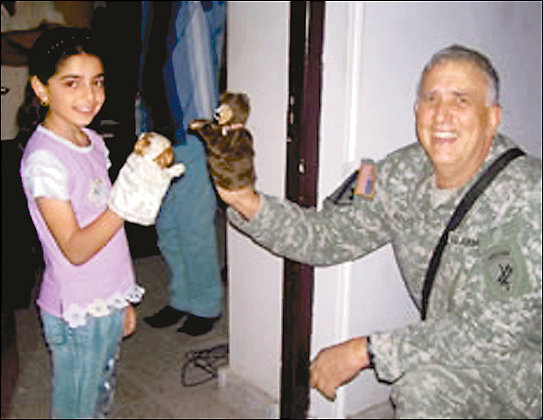
'The reaction was immediate when Army 1st Sgt. Bruce L. Reges strode into the classroom in the Baghdad suburb of Baqubah, in the volatile Diyala province.
At 6-foot-5 and wearing full body armor, Reges, 57, looked fearsome to the schoolchildren. Outside, two Stryker armored vehicles blocked the street. A heavily armed security detail was checking out the roof and other classrooms.
Reges is assigned to an Army civil affairs unit out of Fort Bragg, N.C., working to reconstruct and support schools, irrigation projects and honey farms in Diyala. The team was visiting the school to assess what could be done to help, but the young students were terrified.
"Two of the girls started to cry and escape somehow, and the teacher had to calm them down and tell them that we were there to help them, not to hurt them," Reges recalled. "It was emotionally tough for me to see a child so traumatized by U.S. soldiers that they reacted that way."'
You can guess at the rest of the article- an email to his mom, the inevitable shipment of handpuppets assembled by concerned mothers in Reston, Louisiana and now Civl Affairs soldiers in Afghanistan and Iraq are not to be found without a 'puppet in their pocket', so to speak. As with the best things in life, you can donoate money via PayPal on the website (20 USD = 12 soft puppets), in addition to enjoying photos of thoroughly softened US troops in body armor, wrap-around sunglasses and hand puppets... Other armed forces can seemingly request their own puppets with a simple mail to peacethrupuppets@aol.com.
'The reaction was immediate when Army 1st Sgt. Bruce L. Reges strode into the classroom in the Baghdad suburb of Baqubah, in the volatile Diyala province.
At 6-foot-5 and wearing full body armor, Reges, 57, looked fearsome to the schoolchildren. Outside, two Stryker armored vehicles blocked the street. A heavily armed security detail was checking out the roof and other classrooms.
Reges is assigned to an Army civil affairs unit out of Fort Bragg, N.C., working to reconstruct and support schools, irrigation projects and honey farms in Diyala. The team was visiting the school to assess what could be done to help, but the young students were terrified.
"Two of the girls started to cry and escape somehow, and the teacher had to calm them down and tell them that we were there to help them, not to hurt them," Reges recalled. "It was emotionally tough for me to see a child so traumatized by U.S. soldiers that they reacted that way."'
You can guess at the rest of the article- an email to his mom, the inevitable shipment of handpuppets assembled by concerned mothers in Reston, Louisiana and now Civl Affairs soldiers in Afghanistan and Iraq are not to be found without a 'puppet in their pocket', so to speak. As with the best things in life, you can donoate money via PayPal on the website (20 USD = 12 soft puppets), in addition to enjoying photos of thoroughly softened US troops in body armor, wrap-around sunglasses and hand puppets... Other armed forces can seemingly request their own puppets with a simple mail to peacethrupuppets@aol.com.
SOMALIA: Call for agencies to scale up aid operations in capital
UN official makes the call for aid agencies to step up their activities in Somalia, taking advantage of military escorts and protected compounds in Somalia:
'A senior UN official has urged humanitarian agencies to take advantage of security provided by African Union troops in Mogadishu to improve the delivery of aid to tens of thousands of displaced people camped in surrounding areas.
"Response [to the crisis] has not been adequate because of difficulties of access and too many security incidents," Eric Laroche, the UN Resident and Humanitarian Coordinator for Somalia, said on 2 August, a day after a visit to Mogadishu.
Aid agencies should be mobilised to scale up their operations in the Somali capital, he said, adding that this would help get relief supplies both to the city and the surrounding areas.
He said the availability of African Union security escorts facilitated his visit to Mogadishu and the Afgoye.
"We are starting to have access and we need to use it," Laroche said. "If we can operate from Mogadishu, we can reach more people."'
'A senior UN official has urged humanitarian agencies to take advantage of security provided by African Union troops in Mogadishu to improve the delivery of aid to tens of thousands of displaced people camped in surrounding areas.
"Response [to the crisis] has not been adequate because of difficulties of access and too many security incidents," Eric Laroche, the UN Resident and Humanitarian Coordinator for Somalia, said on 2 August, a day after a visit to Mogadishu.
Aid agencies should be mobilised to scale up their operations in the Somali capital, he said, adding that this would help get relief supplies both to the city and the surrounding areas.
He said the availability of African Union security escorts facilitated his visit to Mogadishu and the Afgoye.
"We are starting to have access and we need to use it," Laroche said. "If we can operate from Mogadishu, we can reach more people."'
Thursday, August 02, 2007
AFRICOM: A Wolf in Sheep's Clothing?
Refugees International was invited to testify before the Subcommittee on African Affairs, Committee on Foreign Relations. They have posted the complete testimony entitled AFRICOM: A Wolf in Sheep's Clothing here. Have cut a few clips from the presentation, Mark Malan doesn't waste many words on niceties and gives a comprehensive view of how AFRICOM risks undermining US (and more globally, NGO) interests in Africa:
'In some parts of the world, like Iraq and Afghanistan, the face of US foreign policy is clearly a military one. In Africa, the DoD appears to be putting a civilian mask on the face of a combatant command, with its marketing pitch for AFRICOM. This disingenuous strategy is not working. The veneer of the mask is simply too thin, and attempts to patch the holes that have emerged—by telling us “what AFRICOM is not about” and re-emphasizing a humanitarian and developmental role for the US military in Africa—simply make the face of US foreign policy much shadier....
There is much sense in the argument for inter-agency cooperation; what does not make sense is linking this to a combatant command. According to one of Africa’s leading security analysts, AFRICOM should be orientated to an appropriate and clearly delineated role, with non-military issues kept outside of its grasp: “The much-vaunted inter-agency staff to be included in AFRICOM should be seen for what it is—the further co-option and subjugation of US foreign and development policy to a neocolonial agenda which is inimical to Africa and ironically, to the US itself.”
...The main concern of operational NGOs is that AFRICOM will increase the trend towards the militarization of humanitarian action, which raises fundamental concerns about the purpose of such assistance. Security objectives envisioned in the short term can run at cross purposes to the longer-term vision of creating stable and sustainable institutions that are accountable and responsive to the needs and aspirations of all segments of the population. Such concerns are amplified by the way AFRICOM is being presented as a tool for integrating US military, political, and humanitarian objectives under a unified military command.'
Malan's conclusions are good ones: he proposes that AFRICOM limit its purely extra-miliary role fo defence sector reform and support to the building o African peacekeeping and Standby Force capacity- already a significant workload.
'In some parts of the world, like Iraq and Afghanistan, the face of US foreign policy is clearly a military one. In Africa, the DoD appears to be putting a civilian mask on the face of a combatant command, with its marketing pitch for AFRICOM. This disingenuous strategy is not working. The veneer of the mask is simply too thin, and attempts to patch the holes that have emerged—by telling us “what AFRICOM is not about” and re-emphasizing a humanitarian and developmental role for the US military in Africa—simply make the face of US foreign policy much shadier....
There is much sense in the argument for inter-agency cooperation; what does not make sense is linking this to a combatant command. According to one of Africa’s leading security analysts, AFRICOM should be orientated to an appropriate and clearly delineated role, with non-military issues kept outside of its grasp: “The much-vaunted inter-agency staff to be included in AFRICOM should be seen for what it is—the further co-option and subjugation of US foreign and development policy to a neocolonial agenda which is inimical to Africa and ironically, to the US itself.”
...The main concern of operational NGOs is that AFRICOM will increase the trend towards the militarization of humanitarian action, which raises fundamental concerns about the purpose of such assistance. Security objectives envisioned in the short term can run at cross purposes to the longer-term vision of creating stable and sustainable institutions that are accountable and responsive to the needs and aspirations of all segments of the population. Such concerns are amplified by the way AFRICOM is being presented as a tool for integrating US military, political, and humanitarian objectives under a unified military command.'
Malan's conclusions are good ones: he proposes that AFRICOM limit its purely extra-miliary role fo defence sector reform and support to the building o African peacekeeping and Standby Force capacity- already a significant workload.
Wednesday, August 01, 2007
Haiti- UN Peacekeeping Force Evolving to a Policing Role
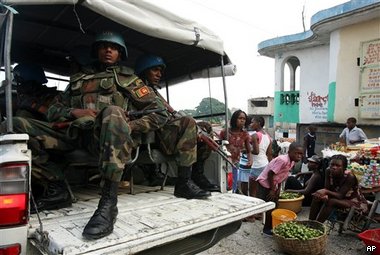
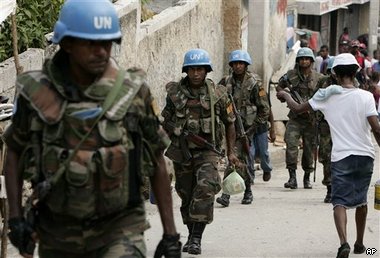
In the lead-up to the UN Secretary General's visit, Haiti is getting some long-merited attention. This AP article takes a balanced look at the challenges facing peacekeeping and peacebuilding in the Haitian state.
Haiti is in a transitional phase, where it is out of immediate crisis, but where, 'The senior U.N. envoy to Haiti says it is too soon for the U.N. to consider withdrawing its 8,800-strong, Brazil-led peacekeeping force, noting past failed attempts to help the country... "An early withdrawal right now would be a big mistake, 'Big' with a capital letter," Edmond Mulet said in a recent interview with The Associated Press. "This is a time to hold on, to make this work this time."'
The challenge is that UN military peacekeepers are obliged to undertake what is essentially a policing function. '... the U.N. mission eventually hopes to use more civilian police than soldiers but is hampered by a world shortage of trained, French-speaking officers... The peacekeepers provide more than 80 percent of Haiti's security needs, but the government is working to eventually take over that responsibility. The national police academy is pumping out hundreds of recruits, trying bolster the nation's small police force of 6,000.'
Chronic poverty and gangs, drug-traffickers still pose a threat to real peace and stability in Haiti, with official suggesting that a UN force will be need until President Preval's term ends in 2011.
Resource- Guidelines for Relations Between US Armed Forces and Non-Governmental Humanitarian Organizations
The United States Institute of Peace launched their Guidelines for Relations Between US Armed Forces and Non-Governmental Humanitarian Organizations on 24 July 2007.
Have pasted in the broad recommendations for armed forces and humanitarian agencies. Taken out of context, it might look a bit simplistic. There's much more in the guidelines, and the processes aspect is particularly well done. One can only guess at how difficult it was in finding 'lowest common denominators' for such a diverse audience. One can quickly find some issues of contention, such as: 'In situations in which there is no actor to servea as a bridge, a US military Civil Affairs cell could serve as a temporary point-of-contact between NGHOs and other elements of the US Armed Forces.' What about OCHA's CMCS?
To be seen how US stakeholders will implement this- and who will enforce it?
'On July 24, 2007, leaders of the U.S. military and NGO community celebrated a promising moment for civil-military relations in peace operations: the rollout of Guidelines that will serve as “rules of the road” for how the two entities operate in hostile environments.
Facilitated by the U.S. Institute of Peace, the Guidelines seek to mitigate frictions between military and NGO personnel over the preservation of humanitarian space in places like Afghanistan and Iraq. Principles in the Guidelines include ensuring that military personnel wear uniforms when conducting relief activities to avoid being mistaken for nongovernmental humanitarian organization representatives. Conversely, it recommends that humanitarian relief personnel avoid traveling in U.S. Armed Forces vehicles with the exception of liaison personnel to the extent practical.
The heads of both the U.S. military and InterAction (an umbrella organization for U.S. NGOs) have endorsed the Guidelines and will be disseminating them throughout their organizations. Two years in the making, the effort represents “a desire from both sides to move beyond polemics to proactive problem solving,” said Jeb Nadaner, Deputy Assistant Secretary of Defense for Stability Operations at the Pentagon. NGO leaders likewise expressed optimism at the potential for change. “We do not want to understate the importance of this document for us,” said Sam Worthington, InterAction President and CEO. “We believe that these guidelines will serve a purpose beyond U.S. NGOs to our global partners.”
The initiative was launched in March 2005 when Amb. Carlos Pascual, Coordinator for Reconstruction and Stabilization at the U.S. State Department, asked the Institute to establish a Working Group on Civil-Military Relations in Non-permissive Environments. What began as a dialogue between military and NGO leaders has resulted in a pioneering effort upon which both sides hope to expand. Military and NGO leaders intend to promulgate the Guidelines throughout their communities via media and education channels: NGOs will publish the Guidelines in their newsletters and literature; the military will incorporate the Guidelines into joint military doctrine publications. The next challenge lies in implementing the Guidelines in the field and creating a monitoring mechanism by which the Guidelines can be continuously tested and revised.
For the U.S. Armed Forces, the following guidelines should be observed consistent with military force protection, mission accomplishment, and operational requirements:
1. When conducting relief activities, military personnel should wear uniforms or other distinctive clothing to avoid being mis taken for NGHO representatives. U.S. Armed Forces personnel and units should not display NGHO logos on any military cloth ing, vehicles, or equipment. This does not preclude the appro priate use of symbols recognized under the law of war, such as a red cross, when appropriate. U.S. Armed Forces may use such symbols on military clothing, vehicles, and equipment in appropriate situations.
2. Visits by U.S. Armed Forces personnel to NGHO sites should be by prior arrangement.
3. U.S. Armed Forces should respect NGHO views on the bearing of arms within NGHO sites.
4. U.S. Armed Forces should give NGHOs the option of meeting with U.S. Armed Forces personnel outside military installations for information exchanges.
5. U.S. Armed Forces should not describe NGHOs as “force mul tipliers” or “partners” of the military, or in any other fashion.
6. U.S. Armed Forces personnel and units should avoid interfer ing with NGHO relief efforts directed toward segments of the civilian population that the military may regard as unfriendly.
7. U.S. Armed Forces personnel and units should respect the de sire of NGHOs not to serve as implementing partners for the military in conducting relief activities. However, individual NGOs may seek to cooperate with the military, in which case such cooperation will be carried out with due regard to avoid ing compromise of the security, safety, and independence of the NGHO community at large, NGHO representatives, or public perceptions of their independence.
For NGHOs, the following guidelines should be observed:
1. NGHO personnel should not wear military-style clothing. This is not meant to preclude NGHO personnel from wearing protec tive gear, such as helmets and protective vests, provided that such items are distinguishable in color/appearance from U.S. Armed Forces issue items.
2. NGHO travel in U.S. Armed Forces vehicles should be limited to liaison personnel to the extent practical.
3. NGHOs should not have facilities co-located with facilities in habited by U.S. Armed Forces personnel.
4. NGHOs should use their own logos on clothing, vehicles, and buildings when security conditions permit.
5. NGHO personnel’s visits to military facilities/sites should be by prior arrangement.
6. Except for liaison arrangements detailed in the sections that follow, NGHOs should minimize their activities at military bases and with U.S. Armed Forces personnel of a nature that might compromise their independence.
7. NGHOs may, as a last resort, request military protection for convoys delivering humanitarian assistance, take advantage of essential logistics support available only from the military, or accept evacuation assistance for medical treatment or to evacuate from a hostile environment. Provision of such mili tary support to NGHOs rests solely within the discretion of the military forces and will not be undertaken if it interferes with higher priority military activities. Support generally will be provided on a reimbursable basis in accordance with appli cable U.S. law.'
Have pasted in the broad recommendations for armed forces and humanitarian agencies. Taken out of context, it might look a bit simplistic. There's much more in the guidelines, and the processes aspect is particularly well done. One can only guess at how difficult it was in finding 'lowest common denominators' for such a diverse audience. One can quickly find some issues of contention, such as: 'In situations in which there is no actor to servea as a bridge, a US military Civil Affairs cell could serve as a temporary point-of-contact between NGHOs and other elements of the US Armed Forces.' What about OCHA's CMCS?
To be seen how US stakeholders will implement this- and who will enforce it?
'On July 24, 2007, leaders of the U.S. military and NGO community celebrated a promising moment for civil-military relations in peace operations: the rollout of Guidelines that will serve as “rules of the road” for how the two entities operate in hostile environments.
Facilitated by the U.S. Institute of Peace, the Guidelines seek to mitigate frictions between military and NGO personnel over the preservation of humanitarian space in places like Afghanistan and Iraq. Principles in the Guidelines include ensuring that military personnel wear uniforms when conducting relief activities to avoid being mistaken for nongovernmental humanitarian organization representatives. Conversely, it recommends that humanitarian relief personnel avoid traveling in U.S. Armed Forces vehicles with the exception of liaison personnel to the extent practical.
The heads of both the U.S. military and InterAction (an umbrella organization for U.S. NGOs) have endorsed the Guidelines and will be disseminating them throughout their organizations. Two years in the making, the effort represents “a desire from both sides to move beyond polemics to proactive problem solving,” said Jeb Nadaner, Deputy Assistant Secretary of Defense for Stability Operations at the Pentagon. NGO leaders likewise expressed optimism at the potential for change. “We do not want to understate the importance of this document for us,” said Sam Worthington, InterAction President and CEO. “We believe that these guidelines will serve a purpose beyond U.S. NGOs to our global partners.”
The initiative was launched in March 2005 when Amb. Carlos Pascual, Coordinator for Reconstruction and Stabilization at the U.S. State Department, asked the Institute to establish a Working Group on Civil-Military Relations in Non-permissive Environments. What began as a dialogue between military and NGO leaders has resulted in a pioneering effort upon which both sides hope to expand. Military and NGO leaders intend to promulgate the Guidelines throughout their communities via media and education channels: NGOs will publish the Guidelines in their newsletters and literature; the military will incorporate the Guidelines into joint military doctrine publications. The next challenge lies in implementing the Guidelines in the field and creating a monitoring mechanism by which the Guidelines can be continuously tested and revised.
For the U.S. Armed Forces, the following guidelines should be observed consistent with military force protection, mission accomplishment, and operational requirements:
1. When conducting relief activities, military personnel should wear uniforms or other distinctive clothing to avoid being mis taken for NGHO representatives. U.S. Armed Forces personnel and units should not display NGHO logos on any military cloth ing, vehicles, or equipment. This does not preclude the appro priate use of symbols recognized under the law of war, such as a red cross, when appropriate. U.S. Armed Forces may use such symbols on military clothing, vehicles, and equipment in appropriate situations.
2. Visits by U.S. Armed Forces personnel to NGHO sites should be by prior arrangement.
3. U.S. Armed Forces should respect NGHO views on the bearing of arms within NGHO sites.
4. U.S. Armed Forces should give NGHOs the option of meeting with U.S. Armed Forces personnel outside military installations for information exchanges.
5. U.S. Armed Forces should not describe NGHOs as “force mul tipliers” or “partners” of the military, or in any other fashion.
6. U.S. Armed Forces personnel and units should avoid interfer ing with NGHO relief efforts directed toward segments of the civilian population that the military may regard as unfriendly.
7. U.S. Armed Forces personnel and units should respect the de sire of NGHOs not to serve as implementing partners for the military in conducting relief activities. However, individual NGOs may seek to cooperate with the military, in which case such cooperation will be carried out with due regard to avoid ing compromise of the security, safety, and independence of the NGHO community at large, NGHO representatives, or public perceptions of their independence.
For NGHOs, the following guidelines should be observed:
1. NGHO personnel should not wear military-style clothing. This is not meant to preclude NGHO personnel from wearing protec tive gear, such as helmets and protective vests, provided that such items are distinguishable in color/appearance from U.S. Armed Forces issue items.
2. NGHO travel in U.S. Armed Forces vehicles should be limited to liaison personnel to the extent practical.
3. NGHOs should not have facilities co-located with facilities in habited by U.S. Armed Forces personnel.
4. NGHOs should use their own logos on clothing, vehicles, and buildings when security conditions permit.
5. NGHO personnel’s visits to military facilities/sites should be by prior arrangement.
6. Except for liaison arrangements detailed in the sections that follow, NGHOs should minimize their activities at military bases and with U.S. Armed Forces personnel of a nature that might compromise their independence.
7. NGHOs may, as a last resort, request military protection for convoys delivering humanitarian assistance, take advantage of essential logistics support available only from the military, or accept evacuation assistance for medical treatment or to evacuate from a hostile environment. Provision of such mili tary support to NGHOs rests solely within the discretion of the military forces and will not be undertaken if it interferes with higher priority military activities. Support generally will be provided on a reimbursable basis in accordance with appli cable U.S. law.'
Monday, July 30, 2007
Afghanistan: The World's Worst Suicide Bombers?
Our thanks to TIME for uncovering an excellent essay that asks whether, statistically speaking, the Afghans are not the world's worst suicide bombers?
An excerpt from the essay shows the science and helps us understand there is more than just some black humour at play here:
'Missing the Target
An analysis of the attacks carried out in the last two years reveals a curious fact. In 43% of the bombings conducted last year and in 26 of the 57 bombings traced in this study up to June 15, the only death caused by the bombing was that of the bomber himself. Astoundingly, approximately 90 suicide bombers in this two year period succeeded in killing only themselves. This number exceeds 100 when you factor in those who succeeded in killing only one person in addition to themselves. There was one period in the spring of 2006 (February 20 to June 21) when a stunning 26 of the 36 suicide bombers in Afghanistan (72%) only killed themselves. This puts the kill average for Afghan suicide bombers far below that of suicide bombers in other theaters of action in the area (Israel, Chechnya, Iraq and the Kurdish areas of Turkey). Such unusual bomber-to-victim death statistics are, of course, heartening for both coalition troops—who have described the Afghan suicide bombers as "amateurs"—and the Afghan people—who are usually the victims of the clumsy bombings.
These statistics also represent a uniquely Afghan phenomenon that warrants investigation. In the first portion of this study, it was demonstrated that a part of the reason for this low kill ratio lies in the Taliban's unique targeting sets (Terrorism Monitor, March 1). As Pashtuns with a strong code (Pashtunwali) that glorifies acts of martial valor and badal (revenge), the Afghan suicide bombers are more prone to hit "hard" military targets than callously obliterate innocent civilians in the Iraqi fashion. On the rare occasions where there have been high casualty bombings of Afghan civilians, they tend to have been carried out by Arab al-Qaeda bombers.'
An excerpt from the essay shows the science and helps us understand there is more than just some black humour at play here:
'Missing the Target
An analysis of the attacks carried out in the last two years reveals a curious fact. In 43% of the bombings conducted last year and in 26 of the 57 bombings traced in this study up to June 15, the only death caused by the bombing was that of the bomber himself. Astoundingly, approximately 90 suicide bombers in this two year period succeeded in killing only themselves. This number exceeds 100 when you factor in those who succeeded in killing only one person in addition to themselves. There was one period in the spring of 2006 (February 20 to June 21) when a stunning 26 of the 36 suicide bombers in Afghanistan (72%) only killed themselves. This puts the kill average for Afghan suicide bombers far below that of suicide bombers in other theaters of action in the area (Israel, Chechnya, Iraq and the Kurdish areas of Turkey). Such unusual bomber-to-victim death statistics are, of course, heartening for both coalition troops—who have described the Afghan suicide bombers as "amateurs"—and the Afghan people—who are usually the victims of the clumsy bombings.
These statistics also represent a uniquely Afghan phenomenon that warrants investigation. In the first portion of this study, it was demonstrated that a part of the reason for this low kill ratio lies in the Taliban's unique targeting sets (Terrorism Monitor, March 1). As Pashtuns with a strong code (Pashtunwali) that glorifies acts of martial valor and badal (revenge), the Afghan suicide bombers are more prone to hit "hard" military targets than callously obliterate innocent civilians in the Iraqi fashion. On the rare occasions where there have been high casualty bombings of Afghan civilians, they tend to have been carried out by Arab al-Qaeda bombers.'
NATO, Afghanistan- Smaller bombs, fewer civilian casualties?
Seems the attempt to win good press around respecting IHL in Afghanistan isn't getting very far. Now the calculus seems to be, 'smaller bombs, fewer casualties'.
'NATO plans more restrained tactics in its war against Taliban guerrillas, including smaller bomb loads on aircraft, in an effort to cut civilian casualties, the alliance's head said in an interview published on Monday.
The Financial Times said NATO Secretary-General Jaap de Hoop Scheffer had acknowledged that mounting Afghan civilian casualties had hurt support for NATO, and had said commanders had ordered troops to hold off on attacks in some situations where civilians were at risk.
"We realise that, if we cannot neutralise our enemy today without harming civilians, our enemy will give us the opportunity tomorrow," the paper quoted him as saying in an interview.
"If that means going after the Taliban not on Wednesday but on Thursday, we will get him then."
De Hoop Scheffer said that while it was impossible to avoid civilian casualties entirely, NATO was "working with weapons load on aircraft to reduce collateral damage".
More than 330 civilians have been killed in operations involving foreign troops in Afghanistan this year, according to Afghan officials and Western aid workers.
Afghan President Hamid Karzai has warned that the casualties could damage support for the presence of foreign forces in his country.
The Financial Times quoted a NATO diplomat as saying that using smaller bombs could cut civilian casualties. "If you put a 250 kg bomb rather than a 500 kg bomb on the plane, that could make a huge amount of difference," the unnamed diplomat said.
The paper quoted other NATO officials as saying the alliance would increasingly leave house-to-house searches to the Afghan army to avoid confrontations.
Seems to pick up on our earlier comments around the same subject. The Guardian is following the same story with a bit more depth.
'NATO plans more restrained tactics in its war against Taliban guerrillas, including smaller bomb loads on aircraft, in an effort to cut civilian casualties, the alliance's head said in an interview published on Monday.
The Financial Times said NATO Secretary-General Jaap de Hoop Scheffer had acknowledged that mounting Afghan civilian casualties had hurt support for NATO, and had said commanders had ordered troops to hold off on attacks in some situations where civilians were at risk.
"We realise that, if we cannot neutralise our enemy today without harming civilians, our enemy will give us the opportunity tomorrow," the paper quoted him as saying in an interview.
"If that means going after the Taliban not on Wednesday but on Thursday, we will get him then."
De Hoop Scheffer said that while it was impossible to avoid civilian casualties entirely, NATO was "working with weapons load on aircraft to reduce collateral damage".
More than 330 civilians have been killed in operations involving foreign troops in Afghanistan this year, according to Afghan officials and Western aid workers.
Afghan President Hamid Karzai has warned that the casualties could damage support for the presence of foreign forces in his country.
The Financial Times quoted a NATO diplomat as saying that using smaller bombs could cut civilian casualties. "If you put a 250 kg bomb rather than a 500 kg bomb on the plane, that could make a huge amount of difference," the unnamed diplomat said.
The paper quoted other NATO officials as saying the alliance would increasingly leave house-to-house searches to the Afghan army to avoid confrontations.
Seems to pick up on our earlier comments around the same subject. The Guardian is following the same story with a bit more depth.
Civil Affairs- YouTube
Credit where credit is due- Small Wars Journal had a selection of YouTube clips on Civil Affairs in action in the field. If you look under the 'Related' tab on the YouTube site, you can find a substantial amount of other similar videos.
Friday, July 27, 2007
Training- NATO Basic CIMIC Course
NATO is offering a Basic CIMIC Course in Italy, open to civilians as well as military staff. Having taken a similar NATO course, can highly recommend it to those in IOs//NGOs to get a better idea of how the military sees its role in undertaking traditionally civilian tasks. They are kind enough to heavily subsidize the course for participants.
IraqSlogger: Fighting an Insurgency With F-16s
IraqSlogger has a great post entitled 'Fighting an Insurgency with F-16s: Need to Minimize Collateral Damage Leads to Tough Choices'. It gives some real insight on how limiting collateral damages and respecting IHL can in fact 'complicate' war-fighting. Have copied out the text from Michael Yon's observatino of watching an F-16 and a Shadow circling a house where an insurgent ran after shooting a gun at US forces:
'The F-16 and Shadow both beamed down live images of the house where the terrorists had hidden after firing on US forces. Now was option time. Which weapon to use? There were so many choices: mortars, missiles, and cannons of various sorts, among others. With the enemy hiding in the building, an F-16 and a Shadow orbiting in the black above, both peering down on thermal mode, the Battle Captain asked the Air Force experts,(the JTACs) what weapons the F-16 was carrying. As a JTAC started ticking off a long list, I was thinking, “How in the world to do those little jets carry all that?” In fact, I believe they were reading down the list for two jets flying in the same package. They carry a mixture of weapons cross loaded between the jets so that they will have the black magic needed for a likely situation.
In addition to the F-16’s bombs of various sorts, there was the MLRS rocket system dozens of miles away that had been precisely punching rockets through Baqubah rooftops for days. The MLRS had been flattening buildings that were rigged as giant bombs. There were the 155mm cannons on this base that can hit and flatten anything in Baqubah and beyond. The Apache helicopters could spin up with their rockets and cannons. Infantrymen could just roll in. Or tanks. Or Bradleys. Or Strykers. Even Humvees. The idea was to use just the amount of force to kill the enemy fighters, but leave everyone in the surrounds unscathed, if possible. If that was not possible, often they would simply not fire, but other times they would. Judgment call.
By about 0400, the Battle Captain had decided to use 120mm mortars. As a reference, if a 120mm were to land on a car, the car would be obliterated, but a 120mm would not be enough to flatten a decent house. The first round was shot, and the explosion left a black-hot thermal cloud on the two video screens. The impact looked hundreds of yards off target. Successive shots did not hone it, but got worse. It was starting to look like a turkey shoot, so the Battle Captain ordered the mortars to cease fire and refused to consider using the mortars again for that mission.
They discussed dropping a JDAM (a special type of bomb from one of the jets), but were worried about CD (collateral damage). The idea of a strafe run came up but that would likely cause even more CD, and so that idea was also nixed. Things sure look different from the comfort and safety of the TOC, even though the TOC is still so close to the battlefield that often the explosions can be felt from there. Still it’s like being a thousand miles away by comparison to being with the infantry in the dark and danger. (TOCs do get hit by rockets or mortars sometimes.)
The MLRS rockets and JDAMs were good enough to actually hit buried IEDs, and could easily take the house. The F-16 was carrying at least one concrete bomb—literally, just a bomb made from concrete, like throwing boulders at people—but a JTAC said, “We are not dropping a concrete bomb.” For some reason he didn’t want to just throw a rock. Personally, I don’t like to see bombs explode because it means we are still at war. But a strange feeling came over me: I wanted to see the F-16 drop a boulder on the people that shot at our guys. I knew if the rock hit them, the neighbors would be fine.
While they were discussing how best to kill the guys, the F-16 was running low on fuel. The jets flew low in a show of force and rumbled away. I walked to breakfast at 0515 while they were still plotting. I have no idea if they killed them and if they did, what method they finally settled on. But I know that when there is that kind of careful deliberation in the TOC, combined with excellent combat soldiers on the streets, (the low number of civilian casualties) that otherwise would seem unbelievable are believable.'
'The F-16 and Shadow both beamed down live images of the house where the terrorists had hidden after firing on US forces. Now was option time. Which weapon to use? There were so many choices: mortars, missiles, and cannons of various sorts, among others. With the enemy hiding in the building, an F-16 and a Shadow orbiting in the black above, both peering down on thermal mode, the Battle Captain asked the Air Force experts,(the JTACs) what weapons the F-16 was carrying. As a JTAC started ticking off a long list, I was thinking, “How in the world to do those little jets carry all that?” In fact, I believe they were reading down the list for two jets flying in the same package. They carry a mixture of weapons cross loaded between the jets so that they will have the black magic needed for a likely situation.
In addition to the F-16’s bombs of various sorts, there was the MLRS rocket system dozens of miles away that had been precisely punching rockets through Baqubah rooftops for days. The MLRS had been flattening buildings that were rigged as giant bombs. There were the 155mm cannons on this base that can hit and flatten anything in Baqubah and beyond. The Apache helicopters could spin up with their rockets and cannons. Infantrymen could just roll in. Or tanks. Or Bradleys. Or Strykers. Even Humvees. The idea was to use just the amount of force to kill the enemy fighters, but leave everyone in the surrounds unscathed, if possible. If that was not possible, often they would simply not fire, but other times they would. Judgment call.
By about 0400, the Battle Captain had decided to use 120mm mortars. As a reference, if a 120mm were to land on a car, the car would be obliterated, but a 120mm would not be enough to flatten a decent house. The first round was shot, and the explosion left a black-hot thermal cloud on the two video screens. The impact looked hundreds of yards off target. Successive shots did not hone it, but got worse. It was starting to look like a turkey shoot, so the Battle Captain ordered the mortars to cease fire and refused to consider using the mortars again for that mission.
They discussed dropping a JDAM (a special type of bomb from one of the jets), but were worried about CD (collateral damage). The idea of a strafe run came up but that would likely cause even more CD, and so that idea was also nixed. Things sure look different from the comfort and safety of the TOC, even though the TOC is still so close to the battlefield that often the explosions can be felt from there. Still it’s like being a thousand miles away by comparison to being with the infantry in the dark and danger. (TOCs do get hit by rockets or mortars sometimes.)
The MLRS rockets and JDAMs were good enough to actually hit buried IEDs, and could easily take the house. The F-16 was carrying at least one concrete bomb—literally, just a bomb made from concrete, like throwing boulders at people—but a JTAC said, “We are not dropping a concrete bomb.” For some reason he didn’t want to just throw a rock. Personally, I don’t like to see bombs explode because it means we are still at war. But a strange feeling came over me: I wanted to see the F-16 drop a boulder on the people that shot at our guys. I knew if the rock hit them, the neighbors would be fine.
While they were discussing how best to kill the guys, the F-16 was running low on fuel. The jets flew low in a show of force and rumbled away. I walked to breakfast at 0515 while they were still plotting. I have no idea if they killed them and if they did, what method they finally settled on. But I know that when there is that kind of careful deliberation in the TOC, combined with excellent combat soldiers on the streets, (the low number of civilian casualties) that otherwise would seem unbelievable are believable.'
Movie Review: No End in Sight
Mountainrunner has a great post on the film No End in Sight, we post it below:
Movie Review: No End in Sight: "

Charles Ferguson has made a strong picture that will likely get strong traction by not playing on emotion but telling it like it was. Through 3,000 pages of interview transcripts over'70 interviews, plus 40 more in Iraq, he creates a riveting narrative with smart interviews spliced with press conference footage'to make this film. The result is some pretty incredible, and damning,'statements from former Deputy Secretary of State Richard Armitage, Ambassador Barbara Bodine, General Jay Garner, Col. Lawrence Wilkerson, Col. Paul Hughes, Nir Rosen, George Packer and others. Splicing in news conferences from Donald Rumsfeld, Richard Cheney, President George W. Bush, and others helped tell the story of OHRA, CPA, and after. Needless to say, Rumsfeld plays a significant role in the movie through his press conferences.
If you'read Imperial Life in the Emerald City,'you already have an idea the charlie foxtrot the movie describes. If you read Packer's The Assassins' Gate, you already have an idea of what the movie's about, especially since it was over dinner with Packer in 2004 that Ferguson decided he needed to make this film.
The movie begins with the post-9/11 attempts to link Saddam with al-Qaeda, through'Shinseki's testimony,'the selection of Chalabi, the creation of OHRA, then the CPA, Bremer's four fateful orders (including de-Baathification and disbanding the military), but stops before the Golden Mosque Bombing. By then, as Ferguson said in the panel discussion after the movie (also on the panel were Greg Treverton from RAND and Nicholas Cull from USC), the die had been cast and the purpose of the movie fulfilled: highlighting the'mismanagement, the ignoring of sage and local advice, and the venality of the policy makers that created the environment of tinder the Golden Mosque bombing ignited.
Because of its strategic focus, there are areas the movie does not delve into, such as the private military contractor debate, save some brief comments and the showing of part of the Aegis Trophy Video. It also does not delve too far into the privatization of the rebuilding, save a few penetrating examples such as Marines working with local Iraqi's to build a frontier fort in 5 months for $200,000 while Parson's required over 17 months and spent well over $1 million more. But in truth, it doesn't need to get into these specifics as it instead focuses on a strategic leadership that created its own reality.
Speaking with Ferguson after the movie, it seems the distributor will put on the website interviews not included in the movie, such one with Larry Diamond. But don't hold your breath, it seems those won't be online for a long time, possibly a year.
This is a must see movie even if you have been paying attention. This is not Michael Moore emotional'hyperbole but a factual account of failed leadership. If you haven't been paying attention, which is probably not many readers of this blog, Ferguson creates an easily digested synopsis of how America managed to create an insurgency in Iraq.'''
Iraq- PRTs Help Iraqis with Rule of Law and Connecting With Central Government
Good glimpse of how the PRT concept has evolved in Iraq- whether it's evolved in theory or reality is difficult to ascertain. The notions are interesting, particularly the concept that PRTs have become a 'bridge-builder' that accompanies provincial authorities in improving rule of law activities.
'About 70 percent of the $506 million Iraqi reconstruction relief fund budget has been spent to build or renovate courthouses, corrections facilities, police and fire stations and training academies, a witness protection facility, and other related structures, Wolf said.'
The article also includes a video of a press conference on the subject, link is found in the text.
A second press release applauds the 25 PRTs as showing local authorities how to work more effectively with the central government.
'There is at least one PRT in each of Iraq’s 18 provinces, Reeker said, noting that Baghdad has several PRTs. Many PRT specialists come from the National Guard or reserves. These organizations help establish stability in Iraq by building capacity in areas such as government, economics, rule of law, services, infrastructure and public diplomacy.
The 25 PRTs in Iraq have more than doubled in number from the 10 that existed in April, as part of the president’s new way-forward strategy, Reeker said. The PRT effort is a joint coalition endeavor, he pointed out, noting that British-, Italian- and Korean-led PRTs also are working in Iraq.'
Interesting to see the evolution of the civil-military link of the Coalition surge in Iraq, months ago it remained merely vague concepts of how the civilian branch would complement the military aspect.
'About 70 percent of the $506 million Iraqi reconstruction relief fund budget has been spent to build or renovate courthouses, corrections facilities, police and fire stations and training academies, a witness protection facility, and other related structures, Wolf said.'
The article also includes a video of a press conference on the subject, link is found in the text.
A second press release applauds the 25 PRTs as showing local authorities how to work more effectively with the central government.
'There is at least one PRT in each of Iraq’s 18 provinces, Reeker said, noting that Baghdad has several PRTs. Many PRT specialists come from the National Guard or reserves. These organizations help establish stability in Iraq by building capacity in areas such as government, economics, rule of law, services, infrastructure and public diplomacy.
The 25 PRTs in Iraq have more than doubled in number from the 10 that existed in April, as part of the president’s new way-forward strategy, Reeker said. The PRT effort is a joint coalition endeavor, he pointed out, noting that British-, Italian- and Korean-led PRTs also are working in Iraq.'
Interesting to see the evolution of the civil-military link of the Coalition surge in Iraq, months ago it remained merely vague concepts of how the civilian branch would complement the military aspect.
Monday, July 23, 2007
Afghanistan- Kites for Hearts and Minds?
Polish troops serving with ISAF in Afghanistan have started distributing ISAF-logoed kites to poor children in Ghazni province.
'With big grins and excited chattering, the children jumped up and down shouting, "Patang! Patang!" (the Pashto word for kite.) Soon the sky had several of the yellow, green and red kites with International Security Assitance Forces logos flying, much to the delight of the children dancing around below.
"These kites are so much fun," said Mahmad-Amid Hahn, a 12-year- old boy, as he made whooping sounds while his kite dipped and swerved in the air. "The Taliban would never give us these things." For the children who had never seen a kite before, some of the Polish soldiers stepped in to assist, unfolding the kites and showing them how to take off with a running start to get it airborne.'
One has to wonder if the ISAF-flags won't be yet another magnet for Taliban forces looking to see who has colluded with foreign forces, that violence will provoke more visits by foreign troops... the cycle of accusations of collusion will continue.
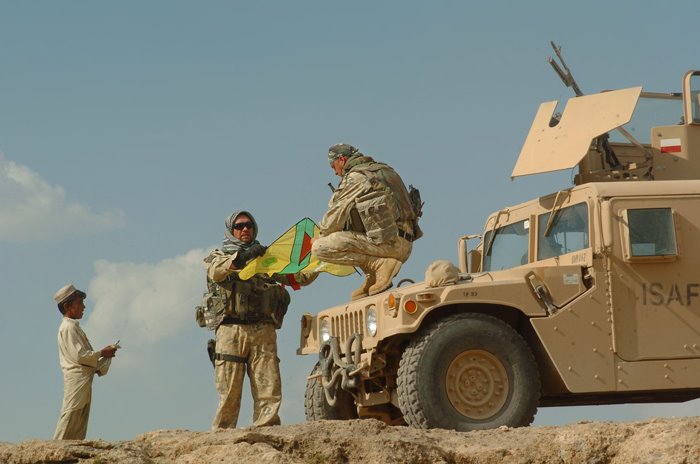
'With big grins and excited chattering, the children jumped up and down shouting, "Patang! Patang!" (the Pashto word for kite.) Soon the sky had several of the yellow, green and red kites with International Security Assitance Forces logos flying, much to the delight of the children dancing around below.
"These kites are so much fun," said Mahmad-Amid Hahn, a 12-year- old boy, as he made whooping sounds while his kite dipped and swerved in the air. "The Taliban would never give us these things." For the children who had never seen a kite before, some of the Polish soldiers stepped in to assist, unfolding the kites and showing them how to take off with a running start to get it airborne.'
One has to wonder if the ISAF-flags won't be yet another magnet for Taliban forces looking to see who has colluded with foreign forces, that violence will provoke more visits by foreign troops... the cycle of accusations of collusion will continue.
Subscribe to:
Posts (Atom)


