Sunday, July 05, 2009
Wednesday, June 24, 2009
Collection of Links on Military-Civil Reconstruction Projects
Received the following collection of links which merits posting: a broad selection of resources showing the humanitarian and civic action projects being undertaken in Afghanistan by US forces. Might be useful to those of you engaged in the endless debate around Afghanistan, civ-mil debates, involvement of armed forces in humanitarian action, etc.
On the Ground: U.S. Troops, Civilians Bring Goodwill to Afghanistan
http://www.defenselink.mil/news/newsarticle.aspx?id=52841
Team Helps to Fight Polio in Konar Province
http://www.defenselink.mil/news/newsarticle.aspx?id=52820
U.S. Soldiers Bridge Access for Remote Afghans
http://www.defenselink.mil/news/newsarticle.aspx?id=52809
Team Improves Future Prospects for Afghan Village
http://www.defenselink.mil/news/newsarticle.aspx?id=52742
School Project Brings Hope to Afghan Province
http://www.defenselink.mil/news/newsarticle.aspx?id=52689
Team Holds Weekly Shoe Drive for Afghan Children
http://www.defenselink.mil/news/newsarticle.aspx?id=52668
Command Provides Ambulances for Afghan Police Medics
http://www.defenselink.mil/news/newsarticle.aspx?id=52662
Afghan, Coalition Leaders Unveil Bridge With Hopes of Prosperity
http://www.defenselink.mil/news/newsarticle.aspx?id=52534
Hope is Victory in Afghanistan, PRT Commander Says
http://www.defenselink.mil/news/newsarticle.aspx?id=53259
New Roads to Open Up Eastern Afghanistan Province
http://www.defenselink.mil/news/newsarticle.aspx?id=53258
Security Forces Provide Safety Net for Reconstruction Mission
http://www.defenselink.mil/news/newsarticle.aspx?id=53234
On the Ground: U.S. Forces Help Afghans Combat Winter Weather
http://www.defenselink.mil/news/newsarticle.aspx?id=53218
On the Ground: Industry Day, Power Plant Project Attract Afghan Contractors
http://www.defenselink.mil/news/newsarticle.aspx?id=53169
Team in Afghanistan Looks to Double Health Care Access
http://www.defenselink.mil/news/newsarticle.aspx?id=53155
Program Builds Better Health Care System in Afghanistan
http://www.defenselink.mil/news/newsarticle.aspx?id=53152
Paktia Provincial Reconstruction Team Reaches Out to Remote Village
http://www.defenselink.mil/news/newsarticle.aspx?id=53107
On the Ground: Americans Help Burned Girl, Train Afghans
http://www.defenselink.mil/news/newsarticle.aspx?id=53099
Projects Prove Difficult, But Key to Rebuilding Efforts
http://www.defenselink.mil/news/newsarticle.aspx?id=53072
Agribusiness Teams Plant Seeds for Economic Growth in Afghanistan
http://www.defenselink.mil/news/newsarticle.aspx?id=53065
Reconstruction Team Serves on Front Line of War on Terror
http://www.defenselink.mil/news/newsarticle.aspx?id=53029
Clinic Gives ‘Hope’ to Afghan Village
http://www.defenselink.mil/news/newsarticle.aspx?id=53025
On the Ground: Coalition, Afghan Troops Give Fuel, Food, Collect Munitions
http://www.defenselink.mil/news/newsarticle.aspx?id=52956
New Bridge Brings Hope, Safety to Afghanistan’s Panjshir Valley
http://www.defenselink.mil/news/newsarticle.aspx?id=52920
Empowerment Program Helps to Educate Afghans
http://www.defenselink.mil/news/newsarticle.aspx?id=53712
On the Ground: Troops Provide Medical Care, Necessities to Afghans
http://www.defenselink.mil/news/newsarticle.aspx?id=53705
New Afghan Program Supports Community-based Approach to Security
http://www.defenselink.mil/news/newsarticle.aspx?id=53686
Coalition Mentors Afghan Army, Police on Jurisprudence
http://www.defenselink.mil/news/newsarticle.aspx?id=53661
Special Operations Troops Deliver Smiles to Bagram Children
http://www.defenselink.mil/news/newsarticle.aspx?id=53569
On the Ground: Troops Aid Afghans With Security, Supplies
http://www.defenselink.mil/news/newsarticle.aspx?id=53520
U.S. Team Helps to Plant Seeds for Afghan Farmers’ Success
http://www.defenselink.mil/news/newsarticle.aspx?id=53457
Afghan Women Celebrate Culture, Achievements at Women’s Day Event
http://www.defenselink.mil/news/newsarticle.aspx?id=53455
Resource Center to Provide Training, Education for Afghan Women
http://www.defenselink.mil/news/newsarticle.aspx?id=53426
Afghan Soldiers Train to Save Lives
http://www.defenselink.mil/news/newsarticle.aspx?id=53394
Afghanistan Fight Turns to Economy, Governance
http://www.defenselink.mil/news/newsarticle.aspx?id=53369
Coalition, Afghans Find Goodwill at Traditional Afghan Games
http://www.defenselink.mil/news/newsarticle.aspx?id=53309
Team Provides Medical Care to Afghan Students, Villagers
http://www.defenselink.mil/news/newsarticle.aspx?id=53304
Coalition Troops Care for Afghan People
http://www.defenselink.mil/news/newsarticle.aspx?id=53282
Human Terrain Teams Build Friendships, Future
http://www.defenselink.mil/news/newsarticle.aspx?id=53281
Soldiers Bring Light to Afghan Marketplace
http://www.defenselink.mil/news/newsarticle.aspx?id=54098
Troops Give Afghan Baby Second Chance at Life
http://www.defenselink.mil/news/newsarticle.aspx?id=54063
Afghans Bid on Brighter Future
http://www.defenselink.mil/news/newsarticle.aspx?id=54041
Afghan Women Find Support in Wardak Province
http://www.defenselink.mil/news/newsarticle.aspx?id=54010
Reconstruction Team Completes Afghanistan Canal Project
http://www.defenselink.mil/news/newsarticle.aspx?id=53992
International Effort Benefits Afghanistan’s Alasay Valley
http://www.defenselink.mil/news/newsarticle.aspx?id=53978
On the Ground: Coalition Medics Treat Afghan Troops, Civilians, Prevent Diseases
http://www.defenselink.mil/news/newsarticle.aspx?id=53945
U.S., French, Afghan Forces Team Up to Aid Afghan Villages
http://www.defenselink.mil/news/newsarticle.aspx?id=53925
Route-clearance Team Clears Way to Commerce in Afghan Province
http://www.defenselink.mil/news/newsarticle.aspx?id=53903
Team Opens Six New Schools for Afghan Children
http://www.defenselink.mil/news/newsarticle.aspx?id=53885
Medics Turn Aid Station Into Afghan Emergency Room
http://www.defenselink.mil/news/newsarticle.aspx?id=53883
Afghan Girl Gets Help from Soldiers, Americans
http://www.defenselink.mil/news/newsarticle.aspx?id=53855
Team Fosters Self-Sufficiency in Afghanistan
http://www.defenselink.mil/news/newsarticle.aspx?id=53802
Civil Affairs Team Brings Change to Afghan Province
http://www.defenselink.mil/news/newsarticle.aspx?id=54441
Rural Village Sees Brighter Future With Coalition’s Help
http://www.defenselink.mil/news/newsarticle.aspx?id=54371
Health, Security Officials Look to Improve Afghan Health System
http://www.defenselink.mil/news/newsarticle.aspx?id=54353
Coalition Team Gives Temporary Shelter to Afghan Students
http://www.defenselink.mil/news/newsarticle.aspx?id=54276
Doctor Confronts Maternal Mortality in Afghanistan
http://www.defenselink.mil/news/newsarticle.aspx?id=54263
Kansas Agribusiness Development Team Arrives in Afghanistan
http://www.defenselink.mil/news/newsarticle.aspx?id=54254
Afghan, Coalition Medics Help People of Herat District
http://www.defenselink.mil/news/newsarticle.aspx?id=54188
Special Operations Forces Save Lives After Bomb Attack
http://www.defenselink.mil/news/newsarticle.aspx?id=54286
On the Ground: U.S. Troops, Civilians Bring Goodwill to Afghanistan
http://www.defenselink.mil/news/newsarticle.aspx?id=52841
Team Helps to Fight Polio in Konar Province
http://www.defenselink.mil/news/newsarticle.aspx?id=52820
U.S. Soldiers Bridge Access for Remote Afghans
http://www.defenselink.mil/news/newsarticle.aspx?id=52809
Team Improves Future Prospects for Afghan Village
http://www.defenselink.mil/news/newsarticle.aspx?id=52742
School Project Brings Hope to Afghan Province
http://www.defenselink.mil/news/newsarticle.aspx?id=52689
Team Holds Weekly Shoe Drive for Afghan Children
http://www.defenselink.mil/news/newsarticle.aspx?id=52668
Command Provides Ambulances for Afghan Police Medics
http://www.defenselink.mil/news/newsarticle.aspx?id=52662
Afghan, Coalition Leaders Unveil Bridge With Hopes of Prosperity
http://www.defenselink.mil/news/newsarticle.aspx?id=52534
Hope is Victory in Afghanistan, PRT Commander Says
http://www.defenselink.mil/news/newsarticle.aspx?id=53259
New Roads to Open Up Eastern Afghanistan Province
http://www.defenselink.mil/news/newsarticle.aspx?id=53258
Security Forces Provide Safety Net for Reconstruction Mission
http://www.defenselink.mil/news/newsarticle.aspx?id=53234
On the Ground: U.S. Forces Help Afghans Combat Winter Weather
http://www.defenselink.mil/news/newsarticle.aspx?id=53218
On the Ground: Industry Day, Power Plant Project Attract Afghan Contractors
http://www.defenselink.mil/news/newsarticle.aspx?id=53169
Team in Afghanistan Looks to Double Health Care Access
http://www.defenselink.mil/news/newsarticle.aspx?id=53155
Program Builds Better Health Care System in Afghanistan
http://www.defenselink.mil/news/newsarticle.aspx?id=53152
Paktia Provincial Reconstruction Team Reaches Out to Remote Village
http://www.defenselink.mil/news/newsarticle.aspx?id=53107
On the Ground: Americans Help Burned Girl, Train Afghans
http://www.defenselink.mil/news/newsarticle.aspx?id=53099
Projects Prove Difficult, But Key to Rebuilding Efforts
http://www.defenselink.mil/news/newsarticle.aspx?id=53072
Agribusiness Teams Plant Seeds for Economic Growth in Afghanistan
http://www.defenselink.mil/news/newsarticle.aspx?id=53065
Reconstruction Team Serves on Front Line of War on Terror
http://www.defenselink.mil/news/newsarticle.aspx?id=53029
Clinic Gives ‘Hope’ to Afghan Village
http://www.defenselink.mil/news/newsarticle.aspx?id=53025
On the Ground: Coalition, Afghan Troops Give Fuel, Food, Collect Munitions
http://www.defenselink.mil/news/newsarticle.aspx?id=52956
New Bridge Brings Hope, Safety to Afghanistan’s Panjshir Valley
http://www.defenselink.mil/news/newsarticle.aspx?id=52920
Empowerment Program Helps to Educate Afghans
http://www.defenselink.mil/news/newsarticle.aspx?id=53712
On the Ground: Troops Provide Medical Care, Necessities to Afghans
http://www.defenselink.mil/news/newsarticle.aspx?id=53705
New Afghan Program Supports Community-based Approach to Security
http://www.defenselink.mil/news/newsarticle.aspx?id=53686
Coalition Mentors Afghan Army, Police on Jurisprudence
http://www.defenselink.mil/news/newsarticle.aspx?id=53661
Special Operations Troops Deliver Smiles to Bagram Children
http://www.defenselink.mil/news/newsarticle.aspx?id=53569
On the Ground: Troops Aid Afghans With Security, Supplies
http://www.defenselink.mil/news/newsarticle.aspx?id=53520
U.S. Team Helps to Plant Seeds for Afghan Farmers’ Success
http://www.defenselink.mil/news/newsarticle.aspx?id=53457
Afghan Women Celebrate Culture, Achievements at Women’s Day Event
http://www.defenselink.mil/news/newsarticle.aspx?id=53455
Resource Center to Provide Training, Education for Afghan Women
http://www.defenselink.mil/news/newsarticle.aspx?id=53426
Afghan Soldiers Train to Save Lives
http://www.defenselink.mil/news/newsarticle.aspx?id=53394
Afghanistan Fight Turns to Economy, Governance
http://www.defenselink.mil/news/newsarticle.aspx?id=53369
Coalition, Afghans Find Goodwill at Traditional Afghan Games
http://www.defenselink.mil/news/newsarticle.aspx?id=53309
Team Provides Medical Care to Afghan Students, Villagers
http://www.defenselink.mil/news/newsarticle.aspx?id=53304
Coalition Troops Care for Afghan People
http://www.defenselink.mil/news/newsarticle.aspx?id=53282
Human Terrain Teams Build Friendships, Future
http://www.defenselink.mil/news/newsarticle.aspx?id=53281
Soldiers Bring Light to Afghan Marketplace
http://www.defenselink.mil/news/newsarticle.aspx?id=54098
Troops Give Afghan Baby Second Chance at Life
http://www.defenselink.mil/news/newsarticle.aspx?id=54063
Afghans Bid on Brighter Future
http://www.defenselink.mil/news/newsarticle.aspx?id=54041
Afghan Women Find Support in Wardak Province
http://www.defenselink.mil/news/newsarticle.aspx?id=54010
Reconstruction Team Completes Afghanistan Canal Project
http://www.defenselink.mil/news/newsarticle.aspx?id=53992
International Effort Benefits Afghanistan’s Alasay Valley
http://www.defenselink.mil/news/newsarticle.aspx?id=53978
On the Ground: Coalition Medics Treat Afghan Troops, Civilians, Prevent Diseases
http://www.defenselink.mil/news/newsarticle.aspx?id=53945
U.S., French, Afghan Forces Team Up to Aid Afghan Villages
http://www.defenselink.mil/news/newsarticle.aspx?id=53925
Route-clearance Team Clears Way to Commerce in Afghan Province
http://www.defenselink.mil/news/newsarticle.aspx?id=53903
Team Opens Six New Schools for Afghan Children
http://www.defenselink.mil/news/newsarticle.aspx?id=53885
Medics Turn Aid Station Into Afghan Emergency Room
http://www.defenselink.mil/news/newsarticle.aspx?id=53883
Afghan Girl Gets Help from Soldiers, Americans
http://www.defenselink.mil/news/newsarticle.aspx?id=53855
Team Fosters Self-Sufficiency in Afghanistan
http://www.defenselink.mil/news/newsarticle.aspx?id=53802
Civil Affairs Team Brings Change to Afghan Province
http://www.defenselink.mil/news/newsarticle.aspx?id=54441
Rural Village Sees Brighter Future With Coalition’s Help
http://www.defenselink.mil/news/newsarticle.aspx?id=54371
Health, Security Officials Look to Improve Afghan Health System
http://www.defenselink.mil/news/newsarticle.aspx?id=54353
Coalition Team Gives Temporary Shelter to Afghan Students
http://www.defenselink.mil/news/newsarticle.aspx?id=54276
Doctor Confronts Maternal Mortality in Afghanistan
http://www.defenselink.mil/news/newsarticle.aspx?id=54263
Kansas Agribusiness Development Team Arrives in Afghanistan
http://www.defenselink.mil/news/newsarticle.aspx?id=54254
Afghan, Coalition Medics Help People of Herat District
http://www.defenselink.mil/news/newsarticle.aspx?id=54188
Special Operations Forces Save Lives After Bomb Attack
http://www.defenselink.mil/news/newsarticle.aspx?id=54286


Sunday, October 14, 2007
Training - Senior Security Management Workshop
The Harvard University Program on Humanitarian Policy and Conflict Research (HPCR) is offering a Senior Security Management Workshop in cooperation with the Geneva Centre for Security Policy (GCSP) in Geneva, Switzerland. The course is part of the Security Management Initiative (SMI).
The registration form for the event can be downloaded here.
The registration form for the event can be downloaded here.
Training - UK Corridors of Power
The British Overseas NGO's for Development (BOND) is offering an innovative course entitle, 'UK Corridors of Power'. The course intends to:
'To develop participant's knowledge and understanding of the UK political process (Westminster and Whitehall) and improve their ability to navigate the UK policy-making arena.
A key skill that applies itself to a variety of NGO work is an understanding of the UK political process. Knowing how the decision-making process really works and how to get key political players on side, is vital if your advocacy is to change policy.'
While UK-focussed, the course is an interesting initiative to arm institutions and individuals on how to better arm themselves in promoting policy change with states.
'To develop participant's knowledge and understanding of the UK political process (Westminster and Whitehall) and improve their ability to navigate the UK policy-making arena.
A key skill that applies itself to a variety of NGO work is an understanding of the UK political process. Knowing how the decision-making process really works and how to get key political players on side, is vital if your advocacy is to change policy.'
While UK-focussed, the course is an interesting initiative to arm institutions and individuals on how to better arm themselves in promoting policy change with states.
AFGHANISTANICA - Afghanistan’s Security Deterioration in Visual and Quantitative Form
AFGHANISTANICA has a great compilation post looking at Afghanistan’s Security Deterioration in Visual and Quantitative Form.

The post makes clear that the UNDSS report is very focused on the security of humanitarian aid worker:
'The report makes it obvious that the “Anti-Government Elements” aren’t giving aid workers any special treatment. Incidents in 2007 up to early August:
Aid convoys attacked/ambushed/looted: 41.
Aid facilities attacked looted: 29.
Aid workers abducted: 69 (44 Afghans, 25 international).
Later killed by captors: 7 (5 Afghans, 2 foreigners).
Total aid workers killed: 41 (34 Afghans, 7 international).
These numbers are of course much less than deaths suffered by Afghan civilians, police and military and less than the losses by foreign troops. But these NGO workers are desperately needed in Afghanistan, and many of them need to be out in the field to be effective.'

The post makes clear that the UNDSS report is very focused on the security of humanitarian aid worker:
'The report makes it obvious that the “Anti-Government Elements” aren’t giving aid workers any special treatment. Incidents in 2007 up to early August:
Aid convoys attacked/ambushed/looted: 41.
Aid facilities attacked looted: 29.
Aid workers abducted: 69 (44 Afghans, 25 international).
Later killed by captors: 7 (5 Afghans, 2 foreigners).
Total aid workers killed: 41 (34 Afghans, 7 international).
These numbers are of course much less than deaths suffered by Afghan civilians, police and military and less than the losses by foreign troops. But these NGO workers are desperately needed in Afghanistan, and many of them need to be out in the field to be effective.'
Darfur - Peacekeepers Without a Peace to Keep
The New York Times has a short piece entitled, 'Peacekeepers Without a Peace to Keep'.
The article continues the debate on how damaging the attack on AU peacekeepers in Haskanita will be in the short- and mid-term. While this take on the incident isn't new, the author does start to pose some more critical questions about whether military intervention in Darfur is already too late?- Or, is it too early?
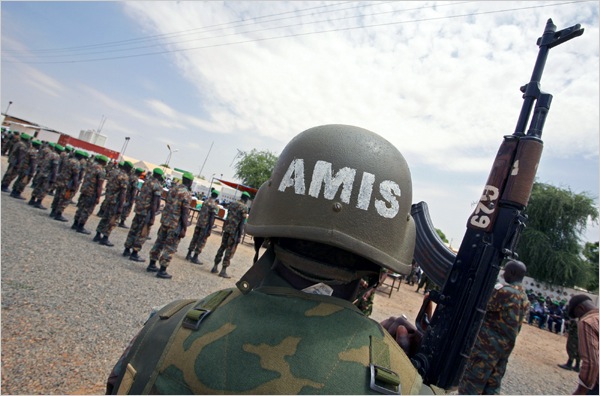
A recent statement by the AU force commander captured the challenge facing peackeepers- 'AU outnumbered, outgunned in Darfur'. It is easy to make calls for peacekeepers to enforce the 'Responsibility to Protect', as Roméo Dallaire does: '...the troops must “go inside the camps, do night patrols and snap inspections, essentially go wherever they need to, without the Sudanese Army or police blocking them.” He said they also need to go after “every one of those splinter groups” and they’ll need the proper gear to do so.' How realistic are these calls?
A number of uncomfortable comparisons in the article are made between Darfur and Somalia. Yet perhaps a better comparison would be the early days of UNPROFOR in the former Yugoslavia? The lack of political will in FRY crippled even relatively well-equipped peackeepers. Can UNAMID hope for better?
The article continues the debate on how damaging the attack on AU peacekeepers in Haskanita will be in the short- and mid-term. While this take on the incident isn't new, the author does start to pose some more critical questions about whether military intervention in Darfur is already too late?- Or, is it too early?
A recent statement by the AU force commander captured the challenge facing peackeepers- 'AU outnumbered, outgunned in Darfur'. It is easy to make calls for peacekeepers to enforce the 'Responsibility to Protect', as Roméo Dallaire does: '...the troops must “go inside the camps, do night patrols and snap inspections, essentially go wherever they need to, without the Sudanese Army or police blocking them.” He said they also need to go after “every one of those splinter groups” and they’ll need the proper gear to do so.' How realistic are these calls?
A number of uncomfortable comparisons in the article are made between Darfur and Somalia. Yet perhaps a better comparison would be the early days of UNPROFOR in the former Yugoslavia? The lack of political will in FRY crippled even relatively well-equipped peackeepers. Can UNAMID hope for better?
Monday, October 01, 2007
Sudan- Peacekeepers Look for Missing in Darfur
There are numerous articles chronicling a rebel attack on an African Union base in Haskanita, northern Darfur yesterday. Apparently 1,000 rebel gunmen overwhelmed the base and its 150 troops before dawn. At least 10 peackeepers have been killed, and between 20 and 50 are still missing.

The rebels looted vehicles and ammunition, and it took Sudanese government troops to chase them away. Photos show government troops looting the leftovers, and burnt armoured vehicles. A quote from an anonymous officer underlines the stakes for the AU Force:
'"It may not be the right political thing to say, but the government forces saved us," said an AU officer, who also asked not to be named because of military regulations.'
The IHT published the first obvious article on the future of Darfur and peacekeeping, namely, whether this tragic incident won't un-nerve other nations considering contributing to the more robust hybrid AU-UN force for Darfur. A spokeman for OXFAM framed the attack in light of the kinds of threats that humanitarian agencies are facing:
'"It's indicative of the complete insecurity," said Alun McDonald, a spokesman for the Oxfam aid organization in Sudan. "These groups are attacking anybody and everybody with total impunity."
McDonald added that armed groups were "increasingly targeting aid workers to steal their vehicles, radios and logistical stuff."
He said the attack on the peacekeepers "sounds quite similar to that, just on a much larger scale."'
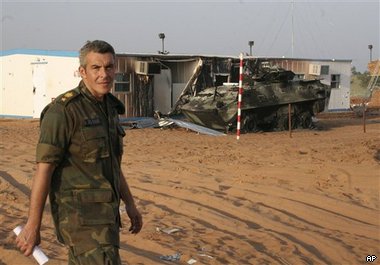

The rebels looted vehicles and ammunition, and it took Sudanese government troops to chase them away. Photos show government troops looting the leftovers, and burnt armoured vehicles. A quote from an anonymous officer underlines the stakes for the AU Force:
'"It may not be the right political thing to say, but the government forces saved us," said an AU officer, who also asked not to be named because of military regulations.'
The IHT published the first obvious article on the future of Darfur and peacekeeping, namely, whether this tragic incident won't un-nerve other nations considering contributing to the more robust hybrid AU-UN force for Darfur. A spokeman for OXFAM framed the attack in light of the kinds of threats that humanitarian agencies are facing:
'"It's indicative of the complete insecurity," said Alun McDonald, a spokesman for the Oxfam aid organization in Sudan. "These groups are attacking anybody and everybody with total impunity."
McDonald added that armed groups were "increasingly targeting aid workers to steal their vehicles, radios and logistical stuff."
He said the attack on the peacekeepers "sounds quite similar to that, just on a much larger scale."'
Tuesday, September 25, 2007
Sudan Advises Aid Agencies to Accept Military Escort Offer
VOA reports that the Sudanese government is warning UN agencies and aid groups that they should accept military escorts to travel through the Darfur region. This offer follows a day after OXFAM reported they would consider withdrawal from Darfur if the security situation did not improve.
Monday, September 24, 2007
NATO retreats from establishment of rapid-reaction force - International Herald Tribune
After months of telegraphing the difficulties of having non-troop contributing nations to shoulder the costs of deployments in Afghanistan, it is perhaps little surprising that NATO member-states have sunk the dream of a NATO Response Force.
"NATO has a problem that affects the EU as well. There are simply not enough troops. NATO is asking member states to sign up to the Response Force at a time when more troops are needed for Afghanistan. NATO has hit a ceiling. The Response Force is a luxury member states cannot afford."
Politics aside, it seems a sad ending that undermines efforts to bolster the Responsibility to Protect and support sustainable peacebuilding and peace support operations. If NATO member-states can't afford this 'luxury', who can?
"NATO has a problem that affects the EU as well. There are simply not enough troops. NATO is asking member states to sign up to the Response Force at a time when more troops are needed for Afghanistan. NATO has hit a ceiling. The Response Force is a luxury member states cannot afford."
Politics aside, it seems a sad ending that undermines efforts to bolster the Responsibility to Protect and support sustainable peacebuilding and peace support operations. If NATO member-states can't afford this 'luxury', who can?
UNDP Jobs- Consultant- Head of Security Unit, Moldova/Ukraine
UNDP is recruiting for a Head of Security Unit to serve as the Mission Security Advisor.
United States Insitute for Peace- US Police in Peace and Stability Operations
USIP has a recent publication examining why the US should carry through on plans to create a federal-level police reserve for international peace and stability operations.
Summary:
• The first obligation of an international intervention force in a peace or stability operation is to provide security for the civilian population. Inevitably the arrival of foreign military forces is followed by a breakdown of public order.
• Historically U.S. military forces have been unable or unwilling to perform police functions to control large-scale civil unrest. This was true in Iraq, where looters destroyed government buildings, cultural centers, and commercial areas.
• The United States lacks civilian constabulary (gendarmes) or other national police forces specially trained for crowd and riot control. Instead the U.S. relies on civil police provided by commercial contractors that do not perform this function.
• Fortunately the U.S. government is taking steps to address this deficiency. Current State Department plans call for creation of a Civilian Reserve Corps that would have a police component.
• There is no agreement on the ultimate size and character of this police capacity. However, the history of U.S. interventions from Panama to Iraq argues for a robust capability.
• A review of U.S. interventions in post-conflict environments demonstrates that the United States has repeatedly needed highly capable police forces but has lacked the capacity to respond effectively. The case studies in this report provide lessons applicable to future operations.
• The State Department’s current efforts are a useful first step that will give an opportunity to create the basic infrastructure for expansion of U.S. capabilities in peace and stability operations.
Summary:
• The first obligation of an international intervention force in a peace or stability operation is to provide security for the civilian population. Inevitably the arrival of foreign military forces is followed by a breakdown of public order.
• Historically U.S. military forces have been unable or unwilling to perform police functions to control large-scale civil unrest. This was true in Iraq, where looters destroyed government buildings, cultural centers, and commercial areas.
• The United States lacks civilian constabulary (gendarmes) or other national police forces specially trained for crowd and riot control. Instead the U.S. relies on civil police provided by commercial contractors that do not perform this function.
• Fortunately the U.S. government is taking steps to address this deficiency. Current State Department plans call for creation of a Civilian Reserve Corps that would have a police component.
• There is no agreement on the ultimate size and character of this police capacity. However, the history of U.S. interventions from Panama to Iraq argues for a robust capability.
• A review of U.S. interventions in post-conflict environments demonstrates that the United States has repeatedly needed highly capable police forces but has lacked the capacity to respond effectively. The case studies in this report provide lessons applicable to future operations.
• The State Department’s current efforts are a useful first step that will give an opportunity to create the basic infrastructure for expansion of U.S. capabilities in peace and stability operations.
UNAMA- Suicide Attacks in Afghanistan, 2001-2007
The United Nations Mission to Afghanistan has published an overview of Suicide Attacks in Afghanistan, 2001- 2007.
The paper notes that suicide attacks remain an alien phenomenon in Afghanistan. UNAMA has set out to raise awareness on the impact of the continuing conflict on Afghan civilians, and highlights that the victims of suicide attacks around 80% civilian. As has been reported elsewhere, the study notes that the death toll has remained relatively low, given the general ineptness of the bombers themselves.
The resulting guidelines revert to the typically big-picture ambitions associated with the Afghanistan nation-building project.
Immediate efforts are needed to diminish perceptions of a foreign military occupation:
- the counter insurgency forces must reduce civilian casualties and conscientiously work to uphold the dignity and honour of Afghans, to avoid provoking an outraged population into volunteering for jihad
- the Afghan national forces must be supported to increasingly assume responsibility for the provision of more effective security
- means must be found to engage other Muslim countries to help provide security and reconstruction in Afghanistan
Military approaches alone may have only marginal short-term impacts. Immediate political efforts are needed to undermine, contain and even constrict the insurgents’ support base. This will require the Afghan Government to:
- meet the demands of the population whose concerns and frustrations might otherwise drive them embrace the armed resistance
- reduce corruption, oversee fair judicial processes and focus on the provision of public services
- engage all relevant civil society groups - including religious authorities - to build a consensus against suicide attacks and their perpetrators. However, for such civil society actors to step up, their safety must be ensured
Eliminate suicide attacks cells through a mix of law and order, military operations and engagement:
- efforts must be made to compel volunteers to reject violence and adopt more constructive forces of change
- insurgents should be encouraged to express their grievances through political and democratic means
Address the cross border dimension of suicide attacks in Afghanistan:
- Pakistani supportiveness is required to eliminate domestic support for the insurgency in Afghanistan, to address militancy within its own borders, to reform governance in the tribal areas and invest in development
- the international community should encourage Pakistan and Afghanistan to embark upon a process through which all outstanding bilateral concerns are addressed and eventually resolved
The paper notes that suicide attacks remain an alien phenomenon in Afghanistan. UNAMA has set out to raise awareness on the impact of the continuing conflict on Afghan civilians, and highlights that the victims of suicide attacks around 80% civilian. As has been reported elsewhere, the study notes that the death toll has remained relatively low, given the general ineptness of the bombers themselves.
The resulting guidelines revert to the typically big-picture ambitions associated with the Afghanistan nation-building project.
Immediate efforts are needed to diminish perceptions of a foreign military occupation:
- the counter insurgency forces must reduce civilian casualties and conscientiously work to uphold the dignity and honour of Afghans, to avoid provoking an outraged population into volunteering for jihad
- the Afghan national forces must be supported to increasingly assume responsibility for the provision of more effective security
- means must be found to engage other Muslim countries to help provide security and reconstruction in Afghanistan
Military approaches alone may have only marginal short-term impacts. Immediate political efforts are needed to undermine, contain and even constrict the insurgents’ support base. This will require the Afghan Government to:
- meet the demands of the population whose concerns and frustrations might otherwise drive them embrace the armed resistance
- reduce corruption, oversee fair judicial processes and focus on the provision of public services
- engage all relevant civil society groups - including religious authorities - to build a consensus against suicide attacks and their perpetrators. However, for such civil society actors to step up, their safety must be ensured
Eliminate suicide attacks cells through a mix of law and order, military operations and engagement:
- efforts must be made to compel volunteers to reject violence and adopt more constructive forces of change
- insurgents should be encouraged to express their grievances through political and democratic means
Address the cross border dimension of suicide attacks in Afghanistan:
- Pakistani supportiveness is required to eliminate domestic support for the insurgency in Afghanistan, to address militancy within its own borders, to reform governance in the tribal areas and invest in development
- the international community should encourage Pakistan and Afghanistan to embark upon a process through which all outstanding bilateral concerns are addressed and eventually resolved
Doug Brooks' Ruthless Logic | Human Security Review
Human Security Review blogs an article by Doug Brooks that they describe as 'short and idiotic'- a perspective that we have to echo.
The idea of commercializing human security or military intervention is in itself not new- look at the grand successes in Iraq and Afghanistan, to take the most evident examples. That said, labelling humanitarian organizations and advocacy groups as ruthless is an odd comment, and one that is written from the uniquely integrationist approach to how the international community operates. This school of thought imagines that all actors, whatever their origin, raison d'etre, politics or principles, should join the 'one team, one mission' concept, and wear the same t-shirts. This school has some merits, while it is also terribly naive- the range of stakeholders, politics, means, resources, donors, politicians, regional groups, local dynamics, national politics, ethnic divisions, etc., etc. all overwhelm such simplistic concepts.
Perhaps Brooks' speculations would seem more credible if the private security sector had a real success story to trumpet their claims of being the 'all singing, all dancing' solution to the world's problems.
The idea of commercializing human security or military intervention is in itself not new- look at the grand successes in Iraq and Afghanistan, to take the most evident examples. That said, labelling humanitarian organizations and advocacy groups as ruthless is an odd comment, and one that is written from the uniquely integrationist approach to how the international community operates. This school of thought imagines that all actors, whatever their origin, raison d'etre, politics or principles, should join the 'one team, one mission' concept, and wear the same t-shirts. This school has some merits, while it is also terribly naive- the range of stakeholders, politics, means, resources, donors, politicians, regional groups, local dynamics, national politics, ethnic divisions, etc., etc. all overwhelm such simplistic concepts.
Perhaps Brooks' speculations would seem more credible if the private security sector had a real success story to trumpet their claims of being the 'all singing, all dancing' solution to the world's problems.
Coordinating Chaos - Peace and Conflict Society (PACS), Trudeau Centre for the Study of Peace and Conflict, University of Toronto
The Peace and Conflict Society (PACS) at the Trudeau Centre for the Study of Peace and Conflict at the University of Toronto is organizing a conference entitled 'Coordinating Choas' which might be of interest to readers.
'The Peace and Conflict Society’s third annual conference entitled Coordinating Chaos: Taking a Multi-Dimensional Approach to Stabilization Operations, focuses on the changing nature of humanitarian intervention and on how to integrate the multiple actors operating within conflict zones in order to foster a lasting peace. The conference seeks to advance the academic dialogue surrounding conflict intervention and to expand potential policy options available to global leaders whose decisions determine the fate of nations and directly impact global stability. Coordinating Chaos will examine the challenges of integrating political, military, economic, and humanitarian actors within conflict zones so as to develop coherent, multi-dimensional strategies for peace support and counterinsurgency operations.'
'The Peace and Conflict Society’s third annual conference entitled Coordinating Chaos: Taking a Multi-Dimensional Approach to Stabilization Operations, focuses on the changing nature of humanitarian intervention and on how to integrate the multiple actors operating within conflict zones in order to foster a lasting peace. The conference seeks to advance the academic dialogue surrounding conflict intervention and to expand potential policy options available to global leaders whose decisions determine the fate of nations and directly impact global stability. Coordinating Chaos will examine the challenges of integrating political, military, economic, and humanitarian actors within conflict zones so as to develop coherent, multi-dimensional strategies for peace support and counterinsurgency operations.'
Fight Less, Win More - the Afghanistan Counterinsurgency Academy
An interesting Washington Post article written by an instructor at the Afghanistan Counterinsurgency Academy.
'The grandly misnamed "academy" is a tiny collection of huts and tents on Kabul's dusty southern outskirts. Since May, motley classes of several dozen Afghan army officers, Afghan policemen, NATO officers, American officers and civilians have been learning and living side by side there for a week at a time.
The academy does much more than teach the theory and tactics of fighting the Taliban insurgents who are trying to unseat President Hamid Karzai and claw their way back to power. It is also a rare forum for military officers, civilian aid workers, academics and diplomats -- from Afghanistan and all 37 countries in NATO's International Security Assistance Force -- to unite in trying to bring good governance, prosperity and security to Afghanistan. The curriculum is based on the Army and Marine Corps' new counterinsurgency doctrine, released in December. Classes revolve around four so-called paradoxes of counterinsurgency. Unless we learn all four well, we'll continue to win battles in Afghanistan while losing the war.'
The theory sounds great, shame there isn't more online about this 'academy'. Where does one sign up for this week-long love-in of soldiers, aid workers and others??
'The grandly misnamed "academy" is a tiny collection of huts and tents on Kabul's dusty southern outskirts. Since May, motley classes of several dozen Afghan army officers, Afghan policemen, NATO officers, American officers and civilians have been learning and living side by side there for a week at a time.
The academy does much more than teach the theory and tactics of fighting the Taliban insurgents who are trying to unseat President Hamid Karzai and claw their way back to power. It is also a rare forum for military officers, civilian aid workers, academics and diplomats -- from Afghanistan and all 37 countries in NATO's International Security Assistance Force -- to unite in trying to bring good governance, prosperity and security to Afghanistan. The curriculum is based on the Army and Marine Corps' new counterinsurgency doctrine, released in December. Classes revolve around four so-called paradoxes of counterinsurgency. Unless we learn all four well, we'll continue to win battles in Afghanistan while losing the war.'
The theory sounds great, shame there isn't more online about this 'academy'. Where does one sign up for this week-long love-in of soldiers, aid workers and others??
UN INSTRAW - Gender, Peace and Security- Gender Training for Peacekeepers
 A good resource site that has a comprehensive overview of available gender training for peacekeepers. Curious to see how little is available in the Americas and East/South East Asia.
Standoff with Taliban leaves big Afghan dam project in limbo - International Herald Tribune
IHT has a great article on the seemingly desperate efforts to bring stability to Helmand Province via reconstruction projects. The cycle seems like that experienced in Iraq: initial attempts were made with a variety of largely private sector actors; insurgents/rebels starting direct attacks on the projects; civilian operators fled, and now a militarized USAID project does all it can to try and rebuild under fire.


Al Jazeera- Video of Taliban
With all the talk of hearts and minds, Al Jazeera embedded a cameraman with Taliban forces wandering about Northern Afghanistan.
Friday, September 14, 2007
The International Geneva Peacebuilding Guide- An Inventory of Geneva-based capacity and expertise
A new resource was launched this week by the Geneva Centre for Security Policy:
'This conference presents the preliminary findings of an analytical mapping that was undertaken as an integral part of ‘The UN Peacebuilding Commission and International Geneva’ project. Since late 2005, the GCSP and its partners have organised a series of events and public discussions looking at the implications for International Geneva of the work of the UN Peacebuilding Commission. The project has been developed by the Geneva Centre for Security Policy (GCSP) in collaboration with its partners, the Quaker United Nations Office in Geneva (QUNO), the Graduate Institute for International Studies (HEI/PSIS) and the Geneva Centre for Democratic Control of Armed Forces (DCAF). Financial support has been provided by the Swiss Federal Department of Foreign Affairs (FDFA) and the Geneva International Academic Network (GIAN).
Since 2006, the project and its partners have engaged a broad range of International Geneva stakeholders in discussions, workshops and public events, aimed at examining the importance of peacebuilding, and the formation of the UN Peacebuilding Commission (PBC). These events and discussions led to a number of findings and recommendations that looked at how International Geneva could influence peacebuilding issues including questions of financing, local ownership, civil society, expertise, analysis, networks and coordination. Please refer to Annex 3 for more details activities of the project to date.
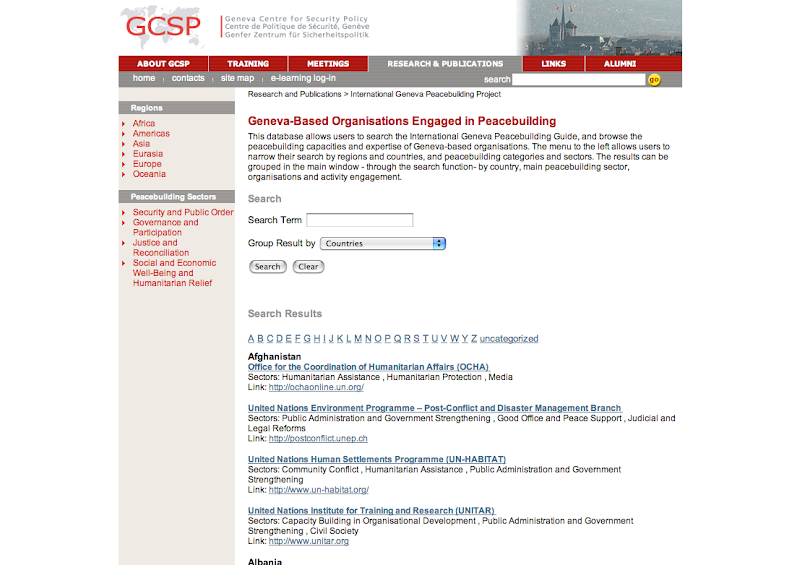
To complement the ongoing discussions and events of 2006, it was decided to undertake an analytical mapping of the peacebuilding capacities and expertise of Geneva-based stakeholders. The results of this mapping have been made public in an online database, the ‘International Geneva Peacebuilding Guide’. This Guide allows users to conduct complex searches and filtering of the data collected from the mapping. The International Geneva Peacebuidlding Guide can be consulted at the following link: http://www.gcsp.ch/e/publications/IGPeaceProject/Guide/index.htm.
The preliminary findings of the project to date are included in this document, and offer a first glimpse of the data collected as of 09 September 2007. We are able to have a comprehensive look at the topography of the International Geneva peacebuilding landscape, the types of organisations present, the countries in which these organisations are engaged, the peacebuilding sectors in which they are active, and the types of activities they undertake. A total of 69 organisations have provided detailed information on on up to 3 peacebuilding sectors where they feel they have the greatest added value, and have also elaborated on how they engage in these priority sectors in the actual and potential PBC focus countries.'
The Guide can be accessed here.
'This conference presents the preliminary findings of an analytical mapping that was undertaken as an integral part of ‘The UN Peacebuilding Commission and International Geneva’ project. Since late 2005, the GCSP and its partners have organised a series of events and public discussions looking at the implications for International Geneva of the work of the UN Peacebuilding Commission. The project has been developed by the Geneva Centre for Security Policy (GCSP) in collaboration with its partners, the Quaker United Nations Office in Geneva (QUNO), the Graduate Institute for International Studies (HEI/PSIS) and the Geneva Centre for Democratic Control of Armed Forces (DCAF). Financial support has been provided by the Swiss Federal Department of Foreign Affairs (FDFA) and the Geneva International Academic Network (GIAN).
Since 2006, the project and its partners have engaged a broad range of International Geneva stakeholders in discussions, workshops and public events, aimed at examining the importance of peacebuilding, and the formation of the UN Peacebuilding Commission (PBC). These events and discussions led to a number of findings and recommendations that looked at how International Geneva could influence peacebuilding issues including questions of financing, local ownership, civil society, expertise, analysis, networks and coordination. Please refer to Annex 3 for more details activities of the project to date.
To complement the ongoing discussions and events of 2006, it was decided to undertake an analytical mapping of the peacebuilding capacities and expertise of Geneva-based stakeholders. The results of this mapping have been made public in an online database, the ‘International Geneva Peacebuilding Guide’. This Guide allows users to conduct complex searches and filtering of the data collected from the mapping. The International Geneva Peacebuidlding Guide can be consulted at the following link: http://www.gcsp.ch/e/publications/IGPeaceProject/Guide/index.htm.
The preliminary findings of the project to date are included in this document, and offer a first glimpse of the data collected as of 09 September 2007. We are able to have a comprehensive look at the topography of the International Geneva peacebuilding landscape, the types of organisations present, the countries in which these organisations are engaged, the peacebuilding sectors in which they are active, and the types of activities they undertake. A total of 69 organisations have provided detailed information on on up to 3 peacebuilding sectors where they feel they have the greatest added value, and have also elaborated on how they engage in these priority sectors in the actual and potential PBC focus countries.'
The Guide can be accessed here.
Monday, August 20, 2007
UN praises Indian women police officers deployed in Liberia - Yahoo! India News
We posted earlier on the deployment of 125 Indian Para-military forces soliders to Liberia. Great to see that they are receiving well-deserved praise for their work:
'New York, Aug 19 (PTI) Indian women police officers - members of the first ever all female unit deployed by the UN - have come in for high praise from the world body's officials who commended their work in emergency situations as also in crime prevention in Liberia where they are posted.
As a mark of the appreciation, UN Secretary-General Ban Ki-moon's Special Representative Alan Doss decorated the officers - who have also been praised for their unflinching support to the National Police in Liberia (NPL) - with the UN Peacekeeping Medals at an impressive ceremony in the Liberian capital, Monrovia.
"Though a new beginning for gender equality in peacekeeping, this deployment is a continuation of India's consistent commitment to peacekeeping operations," Doss said. "All of you standing here represent a proud tradition of service to international peace." Also present at the ceremony were Force Commander Lt Gen Chikadibia Isaac Obiakor, Director of Administration Stephen Lieberman, the Inspector-General of the Liberia National Police Beatrice Munah Sieh, UNPOL Acting Commissioner, General Maritz Du Toit; the Consul-General of India Upjit Singh Sachdeva and other Government officials.
The United Nations Mission in Liberia (UNMIL) is currently assisting the NPL to attract more women into the police.'
'New York, Aug 19 (PTI) Indian women police officers - members of the first ever all female unit deployed by the UN - have come in for high praise from the world body's officials who commended their work in emergency situations as also in crime prevention in Liberia where they are posted.
As a mark of the appreciation, UN Secretary-General Ban Ki-moon's Special Representative Alan Doss decorated the officers - who have also been praised for their unflinching support to the National Police in Liberia (NPL) - with the UN Peacekeeping Medals at an impressive ceremony in the Liberian capital, Monrovia.
"Though a new beginning for gender equality in peacekeeping, this deployment is a continuation of India's consistent commitment to peacekeeping operations," Doss said. "All of you standing here represent a proud tradition of service to international peace." Also present at the ceremony were Force Commander Lt Gen Chikadibia Isaac Obiakor, Director of Administration Stephen Lieberman, the Inspector-General of the Liberia National Police Beatrice Munah Sieh, UNPOL Acting Commissioner, General Maritz Du Toit; the Consul-General of India Upjit Singh Sachdeva and other Government officials.
The United Nations Mission in Liberia (UNMIL) is currently assisting the NPL to attract more women into the police.'
Subscribe to:
Posts (Atom)


